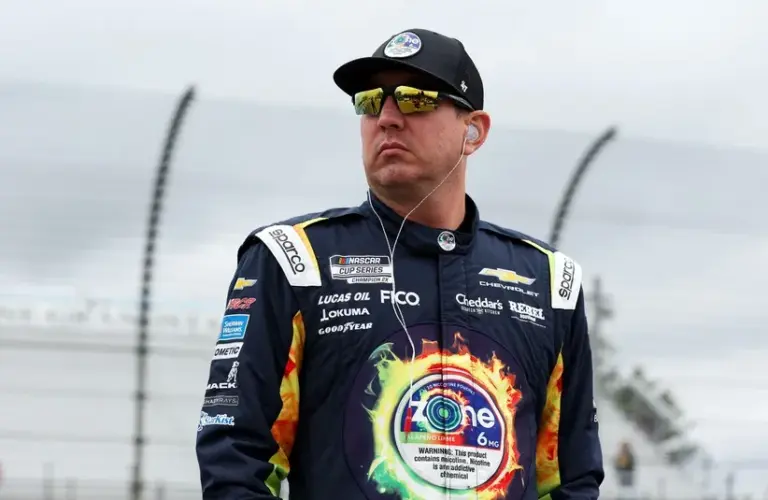


Kyle Larson approaches racing with a singular focus that sets him apart from nearly every other driver in the modern garage. When a Sunday afternoon stock car event goes off the rails, most Cup Series competitors quietly retreat to their motorhomes or board the nearest flight home. Larson takes a radically different route, seeking out more laps, more speed, and whatever racing surface happens to be nearby.
Following a brutal outing at Iowa Speedway that left his car battered and his frustration visible, Larson made the short drive down Highway 14 to Knoxville Raceway. The sudden pivot to dirt provided an immediate reality check, proving once again that few drivers in the country can rebound from on-track adversity as quickly or effectively as Larson.
A Frustrating Afternoon At Iowa Speedway
The trip to Iowa Speedway started with plenty of promise for the No. 5 Hendrick Motorsports team. Larson lined up on the outside of the front row, holding steady inside the top three through Stage 1 as he chased the lead group. The balance of the afternoon shifted dramatically on lap 149 during the second stage.
John Hunter Nemechek experienced a mechanical issue when his transmission missed a shift, dropping into neutral unexpectedly. The sudden speed differential stacked up the field behind him, forcing Larson up into a tight, four-wide corridor. With room completely run out, Larson made contact with his Hendrick teammate, Alex Bowman, sending Bowman into the wall with heavy damage.
Bowman’s afternoon ended on the spot in 34th place with a DNF. Larson’s crew worked frantically on pit road to repair a broken right-rear toe link, allowing him to return to the track several laps down. He limped to a 33rd-place finish, 18 laps behind race winner Ty Gibbs.
Over the team radio, the irritation was clear. When told about Nemechek’s mechanical glitch, Larson offered a biting, dry response: “Cool. Cool. Professional.” That reaction shows a driver who is frustrated and has run out of patience after watching a solid run vanish in the blink of an eye.
Swapping Asphalt For High-Horsepower Dirt
Rather than stewing over the Iowa result, Larson immediately turned his focus toward the Capitani Classic at Knoxville Raceway. Earlier in the week during Southern Iowa Sprint Week, Larson entered a 360 Sprint Car, finishing third in Thursday’s preliminary feature and fourth in Saturday’s 30-lap 360 Nationals main event. Even so, the performance left him feeling dissatisfied.
The issue came down to raw mechanics and engine output. A standard 360 sprint car produces roughly 700 to 800 horsepower. By comparison, a premier 410 sprint car features a 410-cubic-inch engine capable of generating approximately 1,000 horsepower. For a driver who prefers maximum throttle control, the extra power made an immediate impression. Starting fourth in the Capitani Classic main event, Larson systematically picked his way through traffic.
He locked onto race leader David Gravel, making the winning pass with just eight laps remaining. Despite a late caution that wiped out his lead, Larson executed a flawless final restart to hold off Rico Abreu and Gravel for his second career Capitani Classic victory. During his post-race interview in victory lane, Larson spoke candidly about his decision to add the event to his schedule:
“Was happy to get back behind the wheel of a 410 sprint car. I wasn’t planning on running this, but after running 360 Nationals, I was just very grumpy just because those cars suck. They’re so slow, so I needed to feel some horsepower and had a big smile on my face.”
What This Means
Larson operates best when he has uninhibited mechanical performance at his disposal. His blunt remarks tap directly into a growing, passionate debate inside garage stalls across the country regarding engine output across different motorsports. In the Cup Series, modern drag levels and restricted engine packages put a premium on draft positioning, whereas dirt sprint cars place the outcome directly back into the driver’s hands through sheer throttle manipulation.
The victory at Knoxville also underlines Larson’s ability to completely clear his mind after a disastrous Cup Series race. While unpredictable circumstances can wreck a pavement strategy at any moment, his instinct behind the wheel of a high-horsepower sprint car remains unmatched.
That quick mental reset is precisely what makes him such a terrifying competitor over the course of a long season. Most drivers spend days replaying on-track incidents, dissecting telemetry, and nursing grudges that actively drag down their preparation for the next race weekend. Larson simply channels that negative energy straight into the throttle pedal of another race car, using raw speed as a mechanism to flush out the frustration.
What’s Next
As the Cup Series schedule moves deeper into the summer, Hendrick Motorsports will look to clean up the execution issues that cost both Larson and Bowman valuable points at Iowa. Navigating tight quarters without collecting teammates remains a top priority for any multi-car organization aiming for a deep playoff run.
For Larson, the dual-duty schedule will not slow down anytime soon. With the Knoxville Nationals standing as one of the biggest events on the dirt calendar, his Capitani Classic performance provides valuable momentum. If Larson can channel that same aggressive control back into his stock car program, the No. 5 team should have no trouble converting quick pace into victory lane finishes on the track in the coming weeks.
 Don't stop here
Every Score. Every Story. One Home.
Breaking sports, entertainment and news from across the Total Apex network, updated all day.
Get the Full Story →
Don't stop here
Every Score. Every Story. One Home.
Breaking sports, entertainment and news from across the Total Apex network, updated all day.
Get the Full Story →