
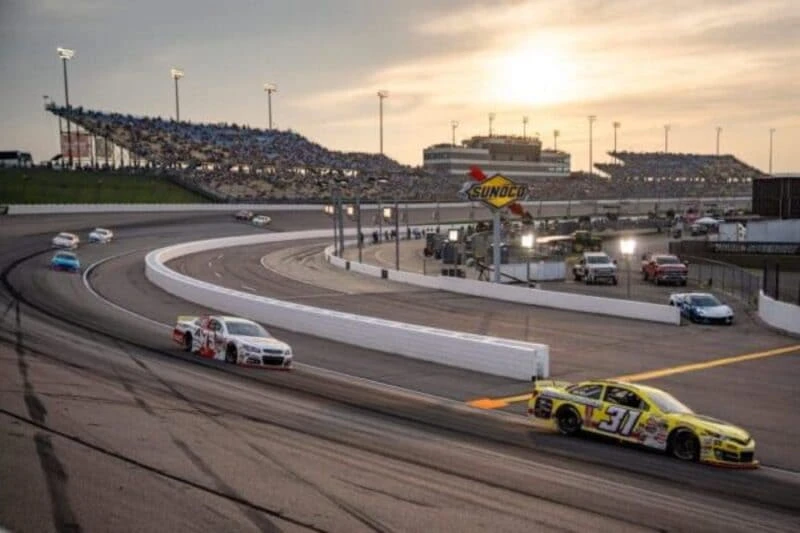
Iowa Speedway has only been part of the NASCAR Cup Series rotation since 2024, yet Sunday’s 350‑lap race delivered the most intense afternoon of its brief tenure. Fresh pavement, rising heat, and heavy tire wear forced constant adjustments and turned the track into a precision test. Iowa punished hesitation, rewarded sharp execution, and kept drivers in traffic that never eased.
The surface at Iowa absorbed heat throughout the day, and grip changed constantly. Engines ran hot. Brakes faded. Crew chiefs faced a nonstop balancing act between tire conservation and track position. One misjudged pit call could erase hours of work. The race became a study in discipline, and the teams that adapted quickest found themselves in contention when it mattered.
The rhythm was tight from the moment the green flag waved. Iowa forced drivers into decisions every corner, and the margin for error shrank as rubber built up. The playoff standings shifted with each caution and each pit cycle, creating one of the most unpredictable afternoons of the season.
Early Incidents Reshape The Field
Ryan Blaney set the early tone with long‑run speed that separated him from the pack. He led 129 laps and captured Stage 1, but Iowa rarely allows a driver to settle. Tire falloff arrived quickly, and the groove widened as the field searched for grip.
The first major incident came almost immediately. On Lap 3, a mid‑pack stack sent Tyler Reddick and Erik Jones into the wall. Both cars suffered heavy damage. Reddick finished 36th. Jones followed in 35th. The crash underscored how narrow Iowa’s entry lanes can become when the field compresses.
Stage 2 brought another wave of trouble. A four‑wide accordion on Lap 149 swept up Kyle Larson and Alex Bowman. Bowman’s car absorbed the worst of the impact and left him with terminal damage. He finished 34th. Larson’s team spent extended time repairing suspension issues. He dropped 18 laps behind the field and finished 33rd. For Hendrick Motorsports, Iowa became one of the most costly afternoons of the season.
As the race settled, Christopher Bell emerged as the strongest driver on long runs. He won Stage 2 and led 108 laps. His pace suggested he had the car to beat. Bubba Wallace delivered one of the day’s most impressive charges, climbing from 26th to the lead for 35 laps. A pit road speed penalty erased his momentum and dropped him to 12th at the finish.
The Strategy Call That Defined Iowa
The race turned on a single decision with 60 laps remaining. Bell held a comfortable advantage and chose four tires during the final green‑flag pit cycle. His pace suggested the call would secure the win. Ty Gibbs and crew chief Tyler Allen saw a different opportunity.
Allen made the bold choice to take only two right‑side tires. The faster stop vaulted Gibbs ahead of Bell as the cycle completed. Clean air became the deciding factor. Iowa’s surface makes passing more difficult as rubber builds up, and Gibbs used that advantage to control the closing laps.
Bell’s four‑tire grip allowed him to close rapidly. He cut into Gibbs’ lead corner by corner and used every bit of speed his car offered. Gibbs never cracked. He managed traffic with precision and protected his line with the kind of composure that defines a maturing driver. He crossed the line 0.253 seconds ahead of Bell and earned one of the most hard‑earned wins of his young career.
Blaney finished third. Josh Berry delivered a standout fourth‑place run for Wood Brothers Racing. Denny Hamlin climbed from last to fifth after starting at the rear due to unapproved adjustments. It capped a late surge that showed how much speed the No. 11 group carried once the balance finally came to life in the closing stretch.
What This Means
Iowa reinforced a truth that continues to shape the modern Cup Series. Track position still outweighs raw grip when the closing laps arrive. Gibbs’ two‑tire call showed how clean air can neutralize a faster car, especially on a surface where passing becomes more difficult as the race progresses.
The win strengthens Gibbs’ position at the top of the regular‑season standings. His short‑track performance continues to trend upward, and Iowa adds another data point to his growing championship résumé. He now holds two wins and has become one of the most consistent drivers on worn surfaces.
Bell’s runner‑up finish adds another chapter to a season filled with speed but near‑misses. He has seven second‑place finishes this year. The pace is there. The execution is close. Iowa showed again that Joe Gibbs Racing has a powerful baseline on high‑wear tracks. The organization placed four cars inside the top six.
For teams caught in mid‑pack incidents, Iowa delivered a painful blow. Larson and Bowman leave Newton with damaged cars and lost points. The playoff cutoff tightens, and Iowa’s early chaos reshaped the standings for drivers hovering near the bubble.
What’s Next
The regular season continues to compress. The next short‑track test will carry even more weight. Iowa served as a costly wake-up call for multi-car operations like Hendrick Motorsports, leaving them short on points and heavy on repair bills. A stretch this tight rewards only the teams that can steady their execution and stop the bleeding before the cutoff closes in.
As the calendar transitions to tracks dominated by pit strategy and track position, flawless execution on the track and discipline on pit road will define their season. The field leaves Iowa knowing the margin for error is shrinking. Every lap from this point forward carries postseason implications. Every decision will shape who enters the playoffs with momentum and who faces a steep climb.
 Don't stop here
Every Score. Every Story. One Home.
Breaking sports, entertainment and news from across the Total Apex network, updated all day.
Get the Full Story →
Don't stop here
Every Score. Every Story. One Home.
Breaking sports, entertainment and news from across the Total Apex network, updated all day.
Get the Full Story →