
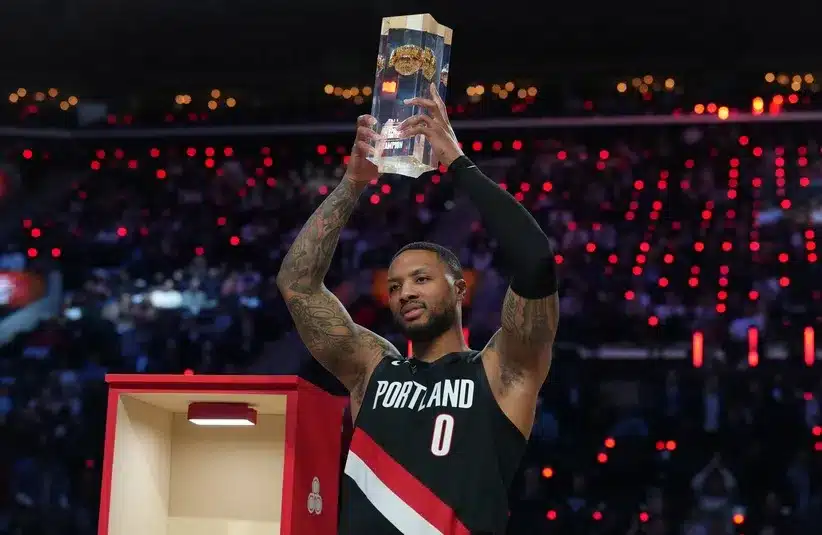
Damian Lillard has never been one to flinch at a challenge. Over the years, he’s carried the Trail Blazers through roster shakeups, coaching changes, and playoff battles that demanded every ounce of his competitive fire. Now, as he returns from a torn Achilles and steps back into a dramatically reshaped roster, he’s facing something new: a backcourt overflowing with talent, personality, and expectation. And he’s embracing it.
Lillard’s Confidence in the New Guard Mix
The Blazers’ guard rotation reads like a fantasy basketball draft: Lillard, Ja Morant, Scoot Henderson, and Jrue Holiday. Four players who all expect the ball, all expect minutes, and all expect to impact winning. For some teams, that’s a chemistry experiment waiting to explode. For Lillard, it’s an opportunity.
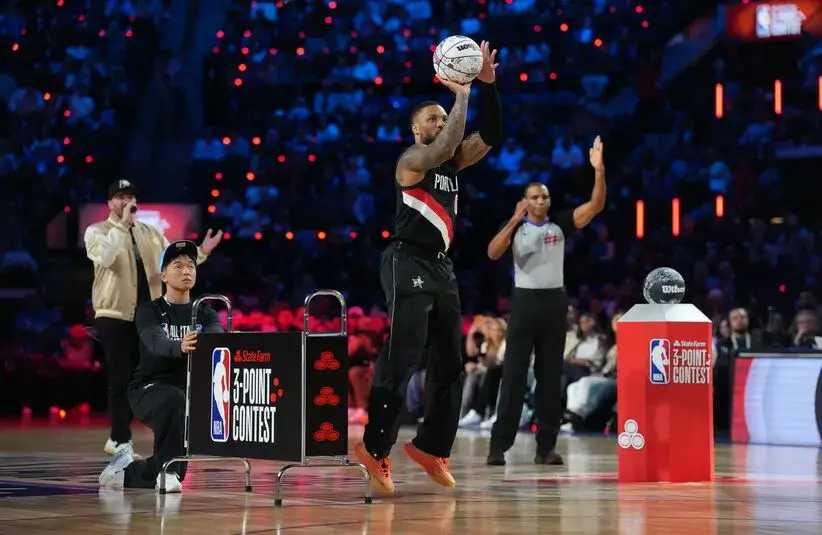
“If we’re doing the right thing, playing the right way, the balance will work itself out,” he said at media day, echoing the same calm, grounded tone that’s defined his leadership for more than a decade. He didn’t sound worried. He didn’t sound hesitant. He sounded energized.
Lillard spoke glowingly about Morant, the former Memphis star whose arrival in Portland marks a fresh start after a turbulent exit from the Grizzlies. And when Morant or Holiday collapse the defense and kick the ball out to him? “They should feel great about that.” It was classic Lillard, confident, direct, and quietly competitive.
A Fully Recovered Lillard Changes the Equation
The last time fans saw Lillard in a Blazers uniform for more than a cameo, he was battling through injuries and a roster that wasn’t ready to contend. Now, at 35, he’s returning with a clean bill of health and a renewed sense of freedom.
That’s a powerful statement for a player whose game relies on sudden bursts, deep‑range shooting, and fearless drives into traffic. Portland’s staff has echoed the sentiment, saying he looks as sharp as he has in years. But Lillard also made something else clear: he doesn’t need to play 35 minutes a night anymore. Not with this roster. Not with this depth. Not with this stage of his career.
Morant’s Fresh Start and Holiday’s Versatility
Morant’s arrival is one of the league’s biggest storylines. Portland’s front office believes the environment, and the presence of veterans like Lillard and Holiday will help stabilize his career. Morant himself admitted the change was needed.
Holiday, meanwhile, may slide to the wing at times, giving Portland flexibility and defensive toughness. His ability to guard bigger players, even centers in certain playoff matchups, gives coach Micah Nori options that most teams simply don’t have.
And Scoot Henderson, still early in his development, now gets to learn from three All‑Star‑caliber guards instead of carrying the burden alone.
Why Lillard Believes It Will Work
The optimism isn’t blind. It’s rooted in experience. Lillard has played with ball‑dominant guards before. He’s shared the floor with wings who initiate offense. He’s adapted to new systems, new coaches, and new expectations. What’s different now is the sheer volume of talent, and the fact that he doesn’t have to be the singular engine every night.
That’s the heart of it. The Blazers don’t need perfect balance. They need shared purpose. And Lillard, more than anyone, understands how to set that tone.
The Road Ahead
Portland’s season won’t be simple. Integrating Morant, managing minutes, and building chemistry will take time. But the franchise has something it hasn’t had in years: options. Real options. Dynamic options. And a leader who believes in the path forward.
Lillard’s confidence isn’t just a quote, it’s a signal. He’s healthy. He’s motivated. And he’s ready to guide a team that suddenly has more firepower than anyone expected. If he’s right, the Blazers won’t just make the backcourt work. They might redefine what a modern NBA backcourt can be.
Written with the help of AI, reviewed and edited by David Desa
 Don't stop here
Every Score. Every Story. One Home.
Breaking sports, entertainment and news from across the Total Apex network, updated all day.
Get the Full Story →
Don't stop here
Every Score. Every Story. One Home.
Breaking sports, entertainment and news from across the Total Apex network, updated all day.
Get the Full Story →