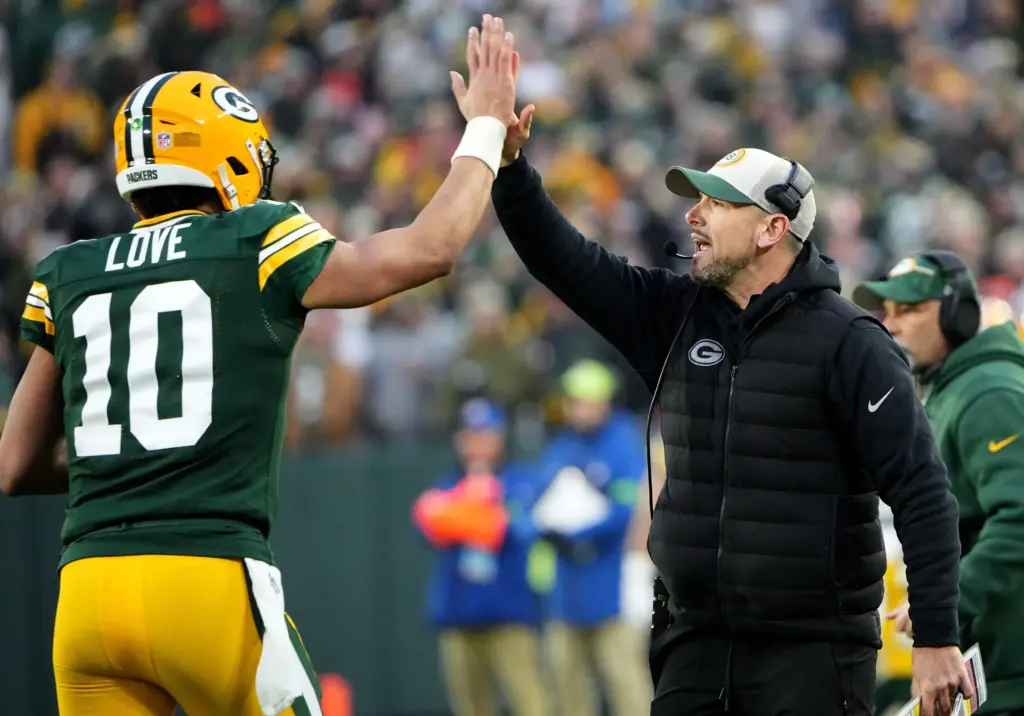
The Green Bay Packers’ 1-2 start traces directly to the Packers offensive line, where injuries and thin depth have left quarterback Jordan Love under siege. Through three weeks, Green Bay allowed pressure on 42.4% of Love’s dropbacks, a rate that would rank 31st in the league, and the Packers are averaging just 0.92 yards before contact on rushes, according to CBS Sports.
Love is completing 52.3% of his passes, the lowest rate in the NFL among quarterbacks with at least 100 attempts, according to FOX Sports. He completed 66.3% of his throws last season, per Yahoo Sports. The problems are not abstract: they are showing up in real stats, real decisions and a real identity crisis on offense.
How injuries blew a hole in the Packers offensive line
Right tackle Zach Bako-Bewele suffered a season-ending knee injury in Week 1. Left guard Aaron Banks has missed two games. The Packers offensive line is now a lineup constructed from spare parts.
Jordan Morgan, who has mostly played guard or right tackle, is lining up at left tackle. Sean Rhyan, a career guard, is anchoring the middle at center. Jager Burton, a fifth-round rookie center, played guard in Week 3, per CBS Sports.
Jacob Monk, a fifth-round pick in 2024, is starting at guard after logging only 57 career snaps before this season.
The result is predictable. In the 35-14 home loss to Atlanta on Sept. 25, Green Bay allowed 15 quick pressures, forcing Love into hurried throws. Love acknowledged Wednesday that the pressure has affected his mechanics. “There’s definitely some plays where my feet are just getting a little bit off. That definitely is some of the pressure being a factor. I’ve just got to be better right there,” he said, according to The Associated Press.
A running game that cannot run
The Packers have just 146 rushing yards through three games, an average of 48.7 per game and the fewest by any team through three games since 2019, according to FOX Sports. Nine carries for 17 yards against the Falcons tell the story. Josh Jacobs is out, and his replacement trio of MarShawn Lloyd, Kaleb Johnson and Chris Brooks has not stepped up.
When the run game fails behind a struggling Packers offensive line, defenses tee off on the passer. Once Green Bay fell behind big against Atlanta, it leaned even further away from the run, and the Falcons knew it. The pressure mounted, and the offense became one-dimensional, which made it predictable, which made it worse.
What the addition of veterans can and cannot fix
The Packers signed guard Kevin Zeitler on Wednesday and added Laken Tomlinson and Mekhi Becton to the roster in recent days. All three were first-round picks with extensive starting experience. Zeitler, 36, made the Pro Bowl in 2023 and has started 213 games across six NFL teams, according to The Associated Press.
LaFleur said veterans “who have been through the war” can “definitely settle things down.” But here is what the veterans cannot do: they cannot turn the Packers back into what they were overnight. Zeitler has not played since undergoing leg surgery after the 2025 season with Tennessee, per the AP.
Tomlinson is in a new scheme. The backfield still lacks a dominant runner. And Jayden Reed, the slot receiver who does multiple things, will miss the rest of the season after a neck injury, forcing more reliance on Christian Watson and Matthew Golden.
The veterans address one problem for the Packers offensive line: protecting the passer long enough for routes to develop. They do not create separation for receivers or fix a running back room. They do not instantly restore rhythm to an offense that has lost it.
Why the scheme is not the core issue
Matt LaFleur’s playbook and design are not the problem. The Packers’ offense was elite for years under Aaron Rodgers and proved effective with Love last season. What changed is execution.
The Packers offensive line cannot sustain blocks. The running backs have not hit holes with aggression. The receivers have dropped too many passes; Green Bay leads the NFL with nine drops, according to CBS Sports. FOX Sports’ film review reached a similar conclusion: better play from the personnel, not new play calls, is what the offense needs.
LaFleur conceded as much after the Atlanta loss, refusing to pin everything on the Packers offensive line. “I don’t want to put all the blame on the offensive line. I mean, there’s plenty of blame to go around,” he said, according to Packers.com. “We’ve got to catch the ball better. Certainly there’s some throws I think J-Love would love to have back, just like there’s some play calls I’d love to have back.”
The problem is not a coordinator calling bad plays or a quarterback who cannot process. The problem is that the Packers cannot run the plays they want to run because the fundamentals up front have broken down. A fresh scheme would not fix that. Only better personnel and better execution will.
What comes next for the Packers offensive line
The Packers play Sunday at Tampa Bay (0-3). If Zeitler plays and the other new linemen help, Green Bay might open some running lanes and give Love more time.
Love needs clean pockets to operate. Without them, his completion percentage stays in the low 50s, and wins stay out of reach.
The fix is not complicated: a functional Packers offensive line buys time, the running game establishes rhythm, and the passing attack operates the way it did in 2025. That requires health and cohesion the Packers do not yet have. Until then, Love will keep absorbing punishment and making the hurried throws of a quarterback under siege. For more on Love’s relationship with his predecessor, read what Love said about Aaron Rodgers this preseason.
Reporting from CBS Sports, Yahoo Sports, The Associated Press, Packers.com and FOX Sports contributed to this story.
 Don't stop here
Every Score. Every Story. One Home.
Breaking sports, entertainment and news from across the Total Apex network, updated all day.
Get the Full Story →
Don't stop here
Every Score. Every Story. One Home.
Breaking sports, entertainment and news from across the Total Apex network, updated all day.
Get the Full Story →