
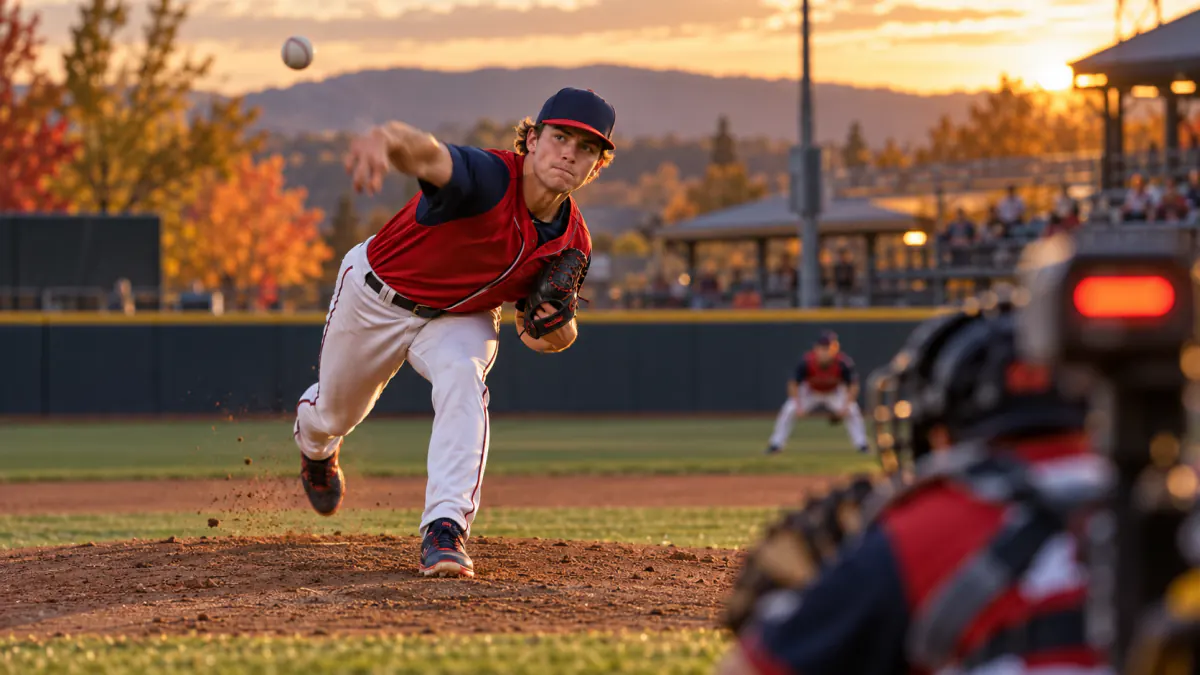
Jarlin Susana’s Arizona Fall League velocity has become the story of his comeback, and the numbers explain why. The Washington Nationals‘ No. 4 prospect touched triple digits repeatedly in his first outing for the Salt River Rafters last weekend, offering an early answer to the question hanging over his lost 2026 season: can the right-hander’s arm still do what it did before lat surgery sidelined him for months. Based on his first look in Arizona, the answer is yes, and then some.
The Debut Numbers
Susana worked 3.1 innings in his first Fall League appearance, striking out four, walking two and allowing a single hit. The strikeout totals matter less than how he got them. He opened the outing by punching out the first batter he faced on three pitches, two of them fastballs that cleared 100 mph.
He closed the second inning with a strikeout on a 103.2 mph four-seamer. By the third inning, he was locating just as well as he was throwing hard: three of his four called strikes came in that frame, and four of his six pitches topped 100 mph, including a final two strikes that each exceeded 102 mph, according to Yahoo Sports.
A Pattern, Not A One-Off
The Fall League outing was not an isolated radar-gun spike. On Sept. 26, pitching for Rochester in the Triple-A National Championship game, Susana threw a 104 mph four-seam fastball, the fastest pitch thrown by a Washington or Rochester pitcher in a regular season or postseason game in the Statcast era, which dates to 2015, according to MLB.com. In those same two scoreless innings, he threw nine more pitches between 103 and 103.8 mph, a mix of seven four-seamers and two sinkers that ranked among the top 10 hardest pitches thrown by a National or a Red Wing on record.
One scout described the stuff to MLB.com this way: “It wouldn’t be a normal Susana. It would be Don Susana.”
Rebuilding Innings After Lat Surgery
None of this was guaranteed after the shoulder-area injury that wiped out most of Susana’s 2026 season. He did not return to game action until mid-August, and once he did, the Nationals kept him on a short leash. He finished the year with just 22 1/3 innings spread across High-A Wilmington, Double-A Harrisburg and Triple-A Rochester, counting playoff appearances, and his longest outing anywhere was 3 2/3 innings for Harrisburg on Sept. 12.
That workload makes the readings in Arizona notable. A pitcher limited to short stints all summer is still finding triple digits with regularity rather than easing back in below his peak.
What Susana Says About The Process
Susana has downplayed any notion that his mechanics or approach needed an overhaul coming back from surgery. “They told me to stay the same. I was good before.
I’m still good now,” he said, according to MLB.com. “Just making sure I do minor adjustments with how I position my arm, but otherwise, stay the same. I’m still the same me.”
That framing lines up with what the Fall League has shown so far: a fastball that still touches triple digits and an upper-80s slider that MLB.com notes continues to generate plenty of empty swings.
The Trade Pedigree And The Pipeline Ranking
Susana arrived in Washington as part of the return for Juan Soto, a deal that also brought James Wood and CJ Abrams from San Diego. He now ranks No. 66 on MLB Pipeline’s Top 100 list and sits fourth in the Nationals’ system. Those rankings were built on the same raw arm strength now showing up on Fall League radar guns, and a healthy return only reinforces the scouting profile that made him a centerpiece of that trade.
A Counterpoint: Small Sample, Short Track Record
The caveat is straightforward. One 3.1-inning outing and a handful of high-octane pitches at the Triple-A National Championship do not erase a season in which Susana topped out at under four innings per start. Walk totals crept up in his Fall League debut, two free passes in a short outing, and his innings count for 2026 remains tiny relative to a full developmental workload. The Fall League exists precisely because evaluators need more than a single sample to trust a pitcher’s recovery.
What To Watch Next
The Nationals, under president of baseball operations Paul Toboni, are using the Arizona Fall League to identify which prospects could factor into the 2027 roster picture. For Susana, that means the next several weeks matter more than any single radar reading. How his innings count climbs, whether his control holds up as his workload increases, and whether the slider keeps missing bats against more advanced Fall League hitters will shape how the organization views his timeline. His next Fall League outings will be the clearest test yet of whether the Week 1 velocity was the start of a trend or a ceiling moment.
 Don't stop here
Every Score. Every Story. One Home.
Breaking sports, entertainment and news from across the Total Apex network, updated all day.
Get the Full Story →
Don't stop here
Every Score. Every Story. One Home.
Breaking sports, entertainment and news from across the Total Apex network, updated all day.
Get the Full Story →