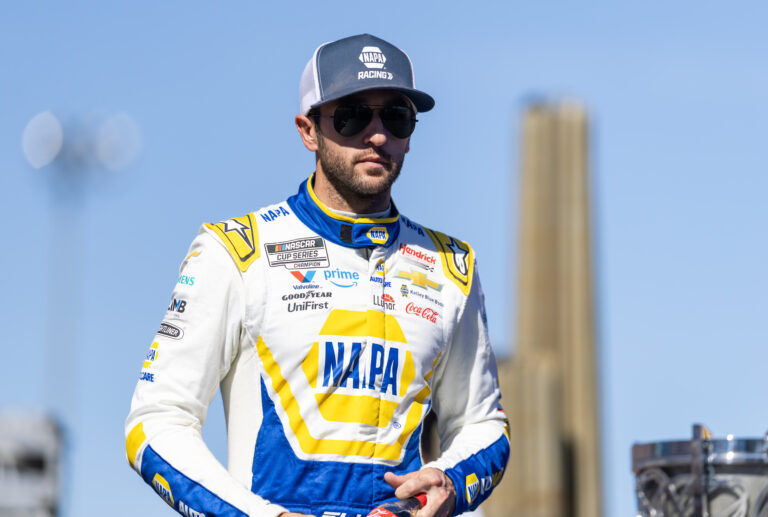


Chris Buescher heads into Sunday’s Dollar Tree 301 at New Hampshire Motor Speedway with one of the strongest statistical profiles of his 2026 season. Through 24 races, the RFK Racing driver sits 10th in the standings with nine top-10 finishes, four top-fives, and a 13.4 average finish, his best mark since joining the organization.
His improvement has also shown up in one of the most important parts of racing at Loudon: restarts, where Buescher has gained a net 57 points this season. That number matters at a track where the field can compress in an instant. New Hampshire’s flat corners and tight racing lanes can erase a long-run advantage in a matter of seconds, making restart execution just as important as having a fast car over an entire fuel run.
Buescher Sees Potential In The Current Package
Despite the statistical improvement, Buescher remained measured when discussing NASCAR’s current rules package during pre-qualifying media availability at New Hampshire. The package is designed to create more movement throughout the field, increase handling differences, and give drivers more opportunities to build runs.
On paper, those characteristics should produce the kind of racing NASCAR wants at Loudon. However, Buescher knows there is only one way to determine whether the package actually delivers. “We hope it does all those things,” Buescher said, before acknowledging that the real answer will come once the field gets into race conditions.
That distinction is important at New Hampshire. What works during a short practice run does not always translate once the tires wear, temperatures change, and traffic begins affecting the car’s handling.
Daytona Cutline Still Does Not Sit Well With Buescher
The conversation eventually moved away from Loudon and toward Daytona, specifically the decision to use the superspeedway as the regular-season cutoff. Considering Buescher’s history at Daytona, the subject could have produced an easy answer. Instead, he was candid about where he stood.
Buescher admitted that he has not liked the idea in the past and remains uncomfortable with it now. His reasoning comes down to the unpredictable nature of superspeedway racing and how many variables can fall outside a driver’s control.
“It’s a racetrack with an immense amount of variables,” Buescher explained. “Speedway racing means you’re at the mercy of what others do well or don’t.” For Buescher, making a track with that level of uncertainty, the championship cutline has always been problematic.
Sarah Talker Presses Buescher on the Loudon Traffic Battle
During Saturday’s Loudon Media availability, the conversation returned to Sunday’s race when Sarah Talker of Total Apex Sports and YourNews Media asked Buescher how he plans to handle the early-race traffic at New Hampshire.
It is an important question at Loudon because the field can compress quickly once the race settles into a rhythm. A driver can have a car capable of running deep into a long green-flag run, only to lose that advantage when traffic forces a different line or a restart changes the entire complexion of the field.
Buescher pointed to tire falloff as one of the weekend’s biggest strategic factors. Over the last three races at New Hampshire, average falloff has been around 1.2 seconds over a 40-lap run. Buescher’s own long-run pace ranks ninth among full-time drivers, giving him reason to believe his car can remain competitive as the tires begin to fade. That could become one of the defining battles of Sunday’s race.
Tire Falloff Could Change The Race
Loudon rewards patience, but it also punishes drivers who cannot adapt when the tires begin to disappear. Buescher’s long-run speed suggests the No. 17 Ford could stay competitive deeper into a run. Yet, that advantage can disappear quickly if traffic forces him out of his preferred line or if a restart puts him in the middle of a tightly packed field.
That is where his improved restart performance becomes significant. The 57-point net gain on restarts is not simply a statistic sitting on the season sheet. It represents points Buescher has collected by making the most of moments when the field bunches up, and the normal rhythm of a race disappears. At New Hampshire, those opportunities can come often.
Buescher Would Rather Keep The Rain Away
The possibility of rain brought another clear answer from Buescher. He does not want it. That does not mean he cannot handle wet conditions. Buescher has already shown he can be competitive on a damp track, including a fifth-place finish during the rain-affected 2024 race at Loudon.
Still, his preference for Sunday is obvious.“We can manage it,” Buescher said. “But I don’t want it to rain.”That may be the simplest assessment of the weather question, but it also speaks to the importance of maintaining predictable track conditions. Teams spend the weekend preparing around a specific tire, setup, and track evolution. Rain can throw all of those calculations out the window.
Loudon Has Given Buescher Room To Work
As the media session wound down, Buescher reflected on what makes New Hampshire different from many of the other tracks on the Cup Series schedule. It is one of the places where he has been able to run independently without constantly being swallowed by traffic.
His recent results back that up. Buescher has finished seventh, 10th, and sixth in his last three races at Loudon, giving him a consistent record at a track where mistakes are often magnified. His average green-flag speed has also climbed steadily and currently ranks 11th for the 2026 season. That consistency has turned New Hampshire into more of an opportunity than a liability. For a driver sitting 10th in the standings, that matters.
What This Means
Buescher enters Sunday with a car that has shown speed, a season that has produced steady statistical gains, and a recent Loudon record that suggests he can compete without relying on chaos to move forward.
The biggest question will be whether that consistency can translate into another strong points day. His 13.4 average finish is the best he has posted since joining RFK Racing, while the nine top-10 finishes show that the No. 17 team has been finding ways to stay relevant throughout the season. Yet, with the championship picture tightening, solid finishes alone may not be enough.
New Hampshire offers a chance to turn that consistency into something more.If Buescher can maximize his long-run pace, protect his tires and continue his strong restart performance, he could leave Loudon with another valuable result and further strengthen his position in the standings.
What’s Next
The next test comes when the Cup Series takes the track Sunday. Buescher will have to manage a race that can change dramatically from one green-flag run to the next. Tire falloff, traffic, and restarts will all play a role, and the ability to adapt could matter more than simply having the fastest car over one lap.
For Buescher, the numbers suggest he has the tools. Now comes the harder part: putting them together when the points are on the line. Loudon has been kind to him in recent years, and his last three finishes at the track prove that he knows how to get a result there.
If the No. 17 Ford can maintain its long-run strength while avoiding the mistakes that can quickly derail a race at the “Magic Mile,” Buescher has an opportunity to turn another strong statistical weekend into one of his most important performances of the season.
 Don't stop here
Every Score. Every Story. One Home.
Breaking sports, entertainment and news from across the Total Apex network, updated all day.
Get the Full Story →
Don't stop here
Every Score. Every Story. One Home.
Breaking sports, entertainment and news from across the Total Apex network, updated all day.
Get the Full Story →