
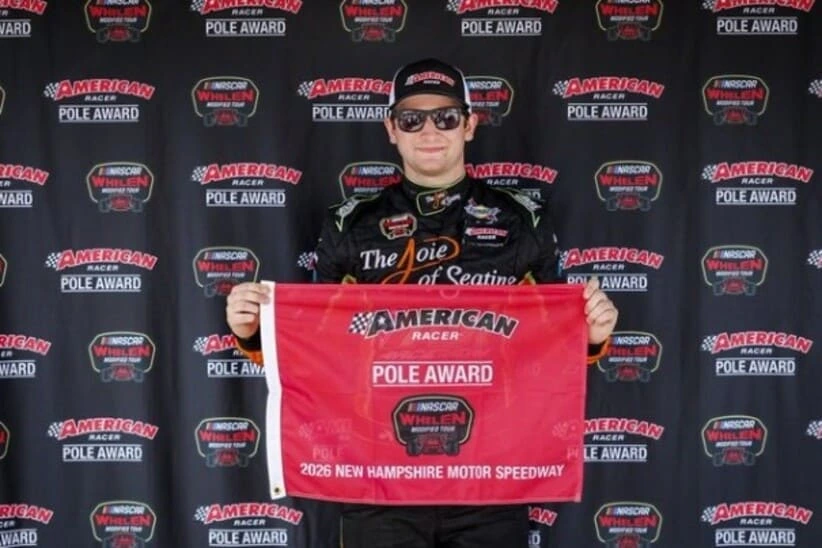
Austin Beers walked into the New Hampshire Motor Speedway media room carrying the calm, grounded confidence of a driver who had just put down a flawless qualifying run. Securing the NASCAR Whelen Modified Tour pole did not shock anyone watching the session unfold, but his demeanor behind the microphone showed he understands what Loudon demands. He approached the media availability like a veteran who knows this flat one-mile oval rewards clinical precision over raw bravado.
That composure will be critical when the green flag drops for the race itself. Loudon has a long history of punishing drivers who mistake single-lap speed for race-long dominance, and Beers made it clear he is not falling into that trap. His focus remains entirely on the discipline required to manage chaotic restarts, navigate traffic, and execute when the intensity cranks up in the closing laps.
Sarah Talker Drives The Media Center Conversation
The session’s sharpest moments came when Sarah Talker pressed for real substance rather than standard boilerplate responses. Talker zeroed in on Beers’ 98% lap-completion rate, a massive benchmark in Modified racing, where multi-car incidents and mechanical attrition are constant threats. She highlighted how that level of reliability reflects a subtle mix of spatial awareness, tactical patience, and car control.
When asked how much that stability impacts his team’s trajectory, Beers did not mince words. He emphasized that keeping the car clean and finishing laps is the literal bedrock of long-term momentum and setup development. For a young driver, maintaining that high completion rate proves he can balance aggressive passing with smart risk management under pressure.
Technical Execution And The Tire Management Curve
Talker then shifted the room’s attention to the weekend’s biggest tactical wild card: tire behavior on Loudon’s abrasive pavement. She pushed Beers to break down the expected wear curve and explain what adjustments his team needed to make before race day. His response offered a clear look into how deep he and his crew have dug into the telemetry.
Beers explained that the current left-side tire package paired with Loudon’s surface yields surprisingly minimal falloff after the initial stint. That lack of degradation fundamentally changes the entire race strategy. Instead of a classic conservation effort where drivers nurse their equipment for late-race runs, Saturday is poised to become a ruthless, high-density street fight dictated entirely by track position and clean air.
Mentorship And Cross-Discipline Experience
Throughout the press conference, Beers credited his poise to a broad developmental foundation built across multiple racing disciplines. He pointed to demanding long-run starts in Late Model majors such as the Thanksgiving Classic and Florence’s high-stakes year-end events as essential classrooms for learning patience, throttle control, and tire conservation.
He also highlighted his working relationship with Spire Motorsports and Chevrolet’s driver development pipeline. Access to advanced simulator tools, tailored fitness regimens, and direct advice from seasoned garage veterans has accelerated his ability to adapt on the fly. That environment has given him the confidence to make aggressive setup calls without fearing costly mistakes.
What This Means
Friday’s pole run was more than just a fast lap on a stat sheet; it was a snapshot of a driver actively mastering the complex variables of Modified Tour racing. Sarah Talker’s line of questioning brought those key factors into sharp relief, pinpointing consistency and non-traditional tire wear as the two elements that will dictate the race.
Beers demonstrated a thorough grasp of both concepts, showing he possesses the analytical mindset required to match his natural speed. By translating telemetry into actionable driving adjustments, he is proving that his qualifying pace is backed by a genuine understanding of racecraft.
What’s Next
Starting from the point gives Beers the ultimate strategic advantage at Loudon: clean air and complete control over the opening pace. However, holding onto that track position will require constant adaptation as the track takes on rubber and ambient temperatures shift throughout the afternoon.
The true test will be how he manages traffic and handles a tire compound that refuses to wear down predictably. If Beers can combine his qualifying speed with the tactical discipline he displayed in the media center, he is in prime position to turn Friday’s pole into a Saturday victory.
 Don't stop here
Every Score. Every Story. One Home.
Breaking sports, entertainment and news from across the Total Apex network, updated all day.
Get the Full Story →
Don't stop here
Every Score. Every Story. One Home.
Breaking sports, entertainment and news from across the Total Apex network, updated all day.
Get the Full Story →