
Matt LaFleur Throws Subtle Shade At Departing Players In NFLPA Report Card Comment

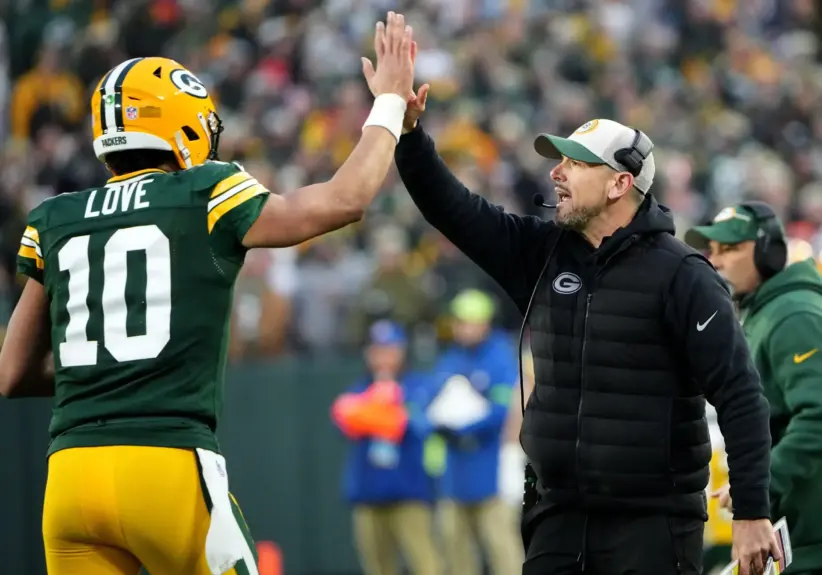
Matt LaFleur has had a bit of rough offseason. For the Green Bay Packers, the recent offseason brought significant roster turnover. The franchise allowed several high-profile defenders, including Quay Walker, Rashan Gary, and Nate Hobbs, to leave the organization. Many wondered why the team would not look to re-sign players who have been so important for the defense over the past four to five years. Head coach Matt LaFleur gave fans a big hint of why the team allowed them to depart when discussing the poor grades from the NFLPA report card.
Matt LaFleur Discusses High Profile Players
During the Annual League Meeting, Matt LaFleur offered a remarkably candid assessment of the team’s internal dynamics last season. He acknowledged that certain players grew deeply frustrated with how the coaching staff utilized them.
“If I’m being honest about it, I think there were some guys that were upset about roles last year, and I think that took a toll on our football team. I think from a coaching standpoint, role clarity is key. So we’ve got to obviously do a better job communicating with our players, ‘Hey here’s your role and if you’re unhappy about your role, it’s on you to do something about that, to carve out a role on this football team.'”
He stressed that role clarity remains a foundational element of successful coaching. When players feel misaligned with their assigned duties, dissatisfaction quickly spreads. LaFleur emphasized that players unhappy with their roles must actively work to carve out the position they want. LaFleur explicitly stated, “we’ve got to obviously do a better job communicating with our players.” However, when that communication fails to resolve the friction, the resulting tension can completely derail a promising season.
The Impact of High-Profile Departures
Analysts widely speculate that the friction LaFleur described involved prominent defensive players who are no longer on the roster. Quay Walker, Rashan Gary, and Nate Hobbs all carried high expectations and significant pedigrees.
When talented veterans expect to anchor a defense but find their snap counts or schematic responsibilities shifting, conflict naturally occurs. Gary, for instance, recently moved to the Dallas Cowboys following a noticeable dip in late-season production and shifting defensive rotations. Walker and Hobbs also commanded significant attention within the defense. When a coaching staff tries to force a square peg into a round hole to satisfy a veteran’s desires, the entire defensive structure suffers.
Allowing these players to walk removes the underlying tension from the building. The front office made a calculated decision: holding onto unhappy talent hurts the collective unit far more than losing their individual skills.
Cultivating Better Team Dynamics
Subtraction by addition is a real phenomenon in professional football. By clearing out players who struggled to accept their roles, the Packers open the door for fresh energy. The remaining roster consists of individuals fully bought into LaFleur’s vision and system.
This approach drastically improves team dynamics. Coaches can spend their time refining schemes and developing talent rather than managing outsized egos or soothing daily frustrations. Furthermore, these departures create valuable opportunities for younger players to step up. Recent draft picks and incoming free agents arrive eager to prove themselves, typically bringing a highly flexible mindset regarding how the coaches deploy them.
When every player actively embraces their specific assignment—whether they play ten snaps or fifty—the entire unit executes with greater precision. A unified locker room translates directly to better communication on the field, fewer blown assignments, and stronger resilience during late-game pressure.
Looking Ahead to a Unified Roster
The Green Bay Packers took a bold step by reshaping their defense this offseason. Letting recognized names like Walker, Gary, and Hobbs leave the facility signals a clear priority for the front office. The organization values total buy-in and role clarity above holding onto disjointed talent. As the 2026 season approaches, fans should watch closely to see how this unified approach translates to on-field execution. A fully connected, cohesive team often outperforms a fractured group of stars.
