
Buescher Turns Texas Into A Statement Run And Sarah Talker Gets Defining Answer On Pit Road

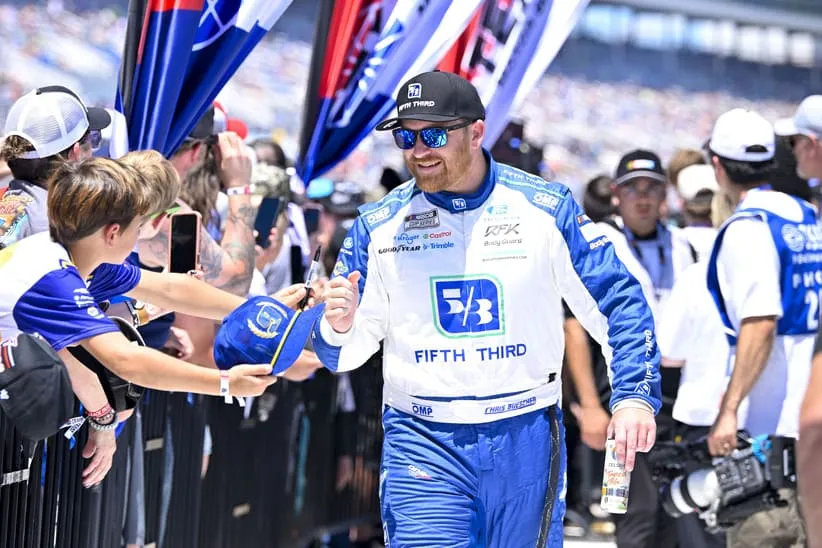
Chris Buescher’s fourth‑place finish in the Wurth 400 wasn’t the product of chaos or strategy roulette. It was the result of a car that steadily improved as Texas Motor Speedway widened out. The No. 17 team found its rhythm in the final stage, matching long‑run pace with the leaders and finally converting the speed RFK has shown in flashes this season.
The run marked one of RFK’s most complete intermediate efforts of the year, especially on a track that has historically demanded precision over aggression. Buescher’s ability to maintain pace through long green‑flag stretches underscored how well the team adapted to the evolving surface.
A Direct Evaluation On Pit Road
During a post‑race pit road interview with Sarah Talker of Total Apex Sports, Buescher delivered a focused assessment of RFK’s performance. He outlined the balance between raw speed and the execution needed to hold a top‑five position at a demanding intermediate track. The exchange offered a clear framework for evaluating the No. 17 team’s day.
Sarah Talker, Total Apex Sports: How do you evaluate the speed versus the execution you had at this track this afternoon?
Buescher’s answer was measured and honest. He said the team executed at a high level, stayed largely mistake‑free, and had the speed to run inside the top three. He emphasized how proud he was of RFK Racing and the No. 17 group for delivering a clean, disciplined day at a track that has historically challenged them.
His tone reflected a driver who knows the difference between a good finish and a meaningful one, and this was the latter. The exchange captured the balance between confidence and realism that defines Buescher’s approach.
RFK’s Competitive Trajectory Sharpens
RFK Racing has been searching for a complete intermediate package, not just speed in isolated runs, but full‑race consistency. Texas offered that in a way the organization has been waiting to see. The No. 17 held its ground against teams with stronger short‑run bursts and showed the long‑run stability that has become RFK’s calling card during its resurgence.
Clean pit stops kept Buescher in position to capitalize when the race settled into rhythm, and the team’s adjustments finally unlocked the rotation he needed on corner entry. The performance also reinforced that RFK’s intermediate program is trending upward, even if the stat sheet hasn’t fully reflected the gains.
Texas didn’t solve every issue, but it showed that RFK’s foundation is sturdy enough to support real gains as the season builds. The team left Fort Worth with proof that its intermediate program is moving in the right direction, even if there’s still work to do.
A Veteran’s Perspective On A Critical Afternoon
Buescher’s tone wasn’t celebratory. It was grounded, confident, and forward‑looking. He knows RFK needs days like this to build momentum heading into the heart of the season, and he spoke like a driver who understands the long game.
His comments reflected a clear awareness that execution, not just raw speed, will determine whether RFK Racing can convert strong runs into wins. The P4 finish showed that when the No. 17 is in the window, it can compete with anyone in the field.
It also demonstrated that Buescher’s methodical style remains one of RFK’s greatest assets on tracks where discipline matters more than aggression. Texas didn’t give him a trophy, but it gave him a platform and a microphone moment that captured exactly where RFK stands right now.
What This Means
Buescher’s P4 at Texas signals that RFK’s intermediate program is stabilizing at a level capable of contending weekly rather than sporadically. The team has been searching for a race where speed, execution, and adaptability aligned, and Texas finally delivered that combination.
It also shows that the No. 17 group is capable of running inside the top five without relying on strategy swings or attrition. For a team that has been building toward consistency, this finish represents a meaningful step forward. It reinforces that their baseline speed is strong enough to compete on merit when the execution is there.
The run also reinforces that Buescher remains one of the most disciplined long‑run drivers in the field. His ability to maintain pace as the track changed gave RFK a competitive edge that has been missing at times this season. It’s the kind of performance that can anchor a team’s confidence heading into a demanding stretch of the schedule.
What’s Next
RFK enters a stretch where execution and balance matter as much as speed, giving the No. 17 a real chance to build on its Texas momentum. Matching the mistake‑free approach Buescher described will put the team in a position to turn strong runs into podiums and potential wins.
Buescher’s confidence, paired with RFK’s improving intermediate package, sets up a run where the No. 17 can become a steady top‑five presence. The gap to the leaders isn’t insurmountable. It comes down to tightening details, sharpening execution, and carrying the steadiness they showed in Fort Worth into the weeks ahead.
For More Great Content
Stay plugged in with more race analyses, features, and behind‑the‑garage storytelling. Follow Sarah on Facebook, LinkedIn, and X at Sarah Talker, where the conversation keeps rolling long after the checkered flag drops.
