
First-Time Winner: Antonelli Triumphs At The Shanghai Grand Prix

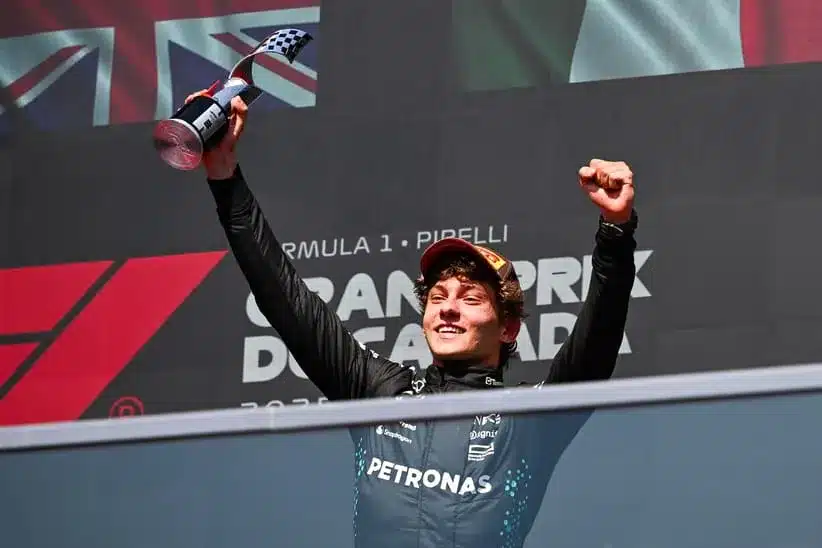
Kimi Antonelli delivered the kind of arrival performance in Shanghai that forces the entire Formula 1 paddock to sit up and reassess what they thought they knew about him. At just 19 years old, he drove with a level of precision, patience, and authority that belongs to seasoned race winners, not rookies still finding their footing. His first Grand Prix victory wasn’t opportunistic or inherited.
It was controlled from the front, executed under pressure, and stamped with the confidence of a driver who already understands how to manage a race at the highest level. By the time he crossed the finish line, it was clear this wasn’t just a breakthrough. It was the beginning of something much bigger.
How Antonelli Took Control From The Start
Antonelli didn’t get a perfect launch. Lewis Hamilton exploded off the line from third, slicing past both Mercedes cars with the kind of aggression that has defined his career. For a brief moment, it looked like Hamilton might steal the race before it even settled. But Antonelli didn’t flinch.
He stalked Hamilton, measured the moment, and by Lap 2, he was back in command. That early recovery told you everything about his race IQ. He knows when to attack, when to wait, and when to strike. From there, he never gave the field another chance. Even the lone Safety Car triggered when Lance Stroll parked his Aston Martin at Turn 1 didn’t shake him.
He pitted, bolted on hard tires, and rejoined still leading. The restart was chaos behind him: Russell struggling for grip, Hamilton and Charles Leclerc fighting like the championship depended on it, Ferrari teammates trading blows through high-speed corners.
Antonelli used that chaos like a shield. While the red cars tripped over each other, he stretched the gap to seven seconds. By the time Russell finally cleared the Ferraris, the damage was done. Antonelli had already broken the race open, and he never let it close again.
A Defining Radio Moment
To understand the emotional weight of Antonelli’s breakthrough, his radio message deserves to stand alone. This wasn’t a rehearsed line or a polished soundbite. It was the raw, unfiltered moment a teenager realized he had just arrived on the world stage.
“I’m speechless. I’m about to cry, to be honest. I said yesterday I really wanted to bring Italy back on top and we did today,” said Kimi Antonelli, moments after taking the checkered flag in Shanghai
This was the instant the paddock stopped seeing him as a prospect and started seeing him as a problem, a new contender with the talent and temperament to reshape the championship.
The One Scare: And The Moment That Proved His Maturity
Every great win has a moment that tests the driver’s nerve. Antonelli’s came with four laps to go. He locked a front tire into the Turn 14 hairpin, flat-spotting it badly enough to send a jolt of concern through the Mercedes pit wall. The radio lit up. Engineers braced for the worst. But Antonelli didn’t unravel.
He adjusted his braking points, managed the vibration, and brought the car home with the composure of someone who has been doing this for years. That’s the kind of instinct you can’t coach: the ability to stay calm when the race tries to take itself away from you.
At the flag, he was 5.5 seconds clear of Russell and a massive 25 seconds ahead of Hamilton, who finally claimed his first Ferrari podium. Leclerc finished fourth after losing a late duel with Hamilton, a battle that cost Ferrari valuable time and will almost certainly spark internal conversations this week. Antonelli, meanwhile, looked like he’d been leading Grands Prix his entire life.
The Midfield Mayhem Behind The Front
While Antonelli owned the front of the race, the midfield delivered its own storyline. Oliver Bearman brought Haas home in fifth after dodging Isack Hadjar’s spinning Racing Bulls machine on Lap 1. Pierre Gasly scored a much-needed sixth for Alpine.
Liam Lawson and Hadjar finished seventh and eighth, giving Racing Bulls a strong double-points day. Carlos Sainz delivered Williams’ first points of the season in ninth, while Franco Colapinto salvaged tenth despite being spun by Esteban Ocon earlier.
Max Verstappen’s day ended ten laps early with a mechanical issue while running sixth — a rare but costly failure for Red Bull. Aston Martin had a nightmare of its own, with both Fernando Alonso and Stroll retiring.
But no team suffered more than McLaren. Lando Norris never made the grid. Oscar Piastri didn’t even reach the formation lap. Two electrical failures, two DNFs, zero points for the reigning constructors’ champions. It was the kind of Sunday that derails momentum and raises uncomfortable questions.
What Antonelli’s Breakthrough Means
Russell still leads the championship, and that matters. But the dynamic inside Mercedes has officially changed. Antonelli didn’t just win. he won cleanly, decisively, and under pressure. He proved he can convert pole into victory, manage a race from the front, and beat his teammate straight up.
That shifts the energy inside the garage. Two title-capable drivers under one roof is a thrilling problem for fans and a delicate one for team management. Ferrari walks away with mixed emotions. A podium for Hamilton is progress.
Yet, watching their drivers burn laps fighting each other while Antonelli disappeared up the road is the kind of inefficiency that championship-level teams can’t afford. Those conversations will happen behind closed doors, but they will happen.
What’s Next
Kimi Antonelli didn’t just win a Grand Prix. he announced himself as a force the entire paddock now has to account for. Shanghai wasn’t a lucky break or a chaotic outlier; it was a complete performance from a teenager who handled pressure, strategy, and adversity with the poise of a seasoned contender.
He beat his teammate straight up, managed the race from the front, and showed the kind of instinct that separates future champions from fast rookies. Formula 1 has a new name at the sharp end of the grid, and the implications stretch far beyond one Sunday in China. Mercedes suddenly has two drivers capable of shaping the championship. Ferrari has internal questions to answer.
And the rest of the field now has to prepare for a 19-year-old who looks like he’s only scratching the surface of what he can become. There are 20 races left, which is plenty of time for the storylines to twist, tighten, and explode. But after Shanghai, one thing feels certain: Kimi Antonelli isn’t just arriving. He’s accelerating.
