
The Karl-Anthony Towns and Mitchell Robinson Duo We Didn’t Know We Needed

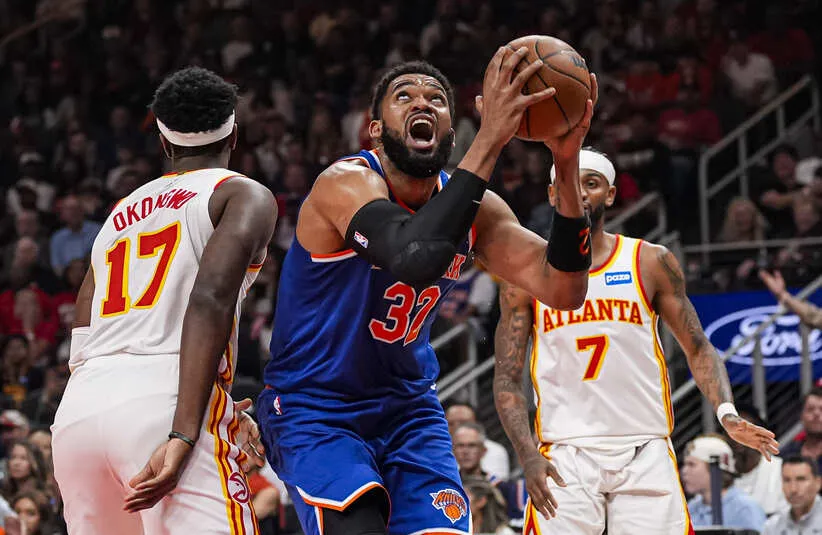
The NBA has entered an era defined by superstar duos rather than the traditional “Big Three”. Across the league, roughly 15 to 20 elite pairings drive their teams’ identities, such as Nikola Jokic and Jamal Murray in Denver, Joel Embiid and Tyrese Maxey in Philadelphia, and, of course, Jalen Brunson and Karl-Anthony Towns in New York. Most of these duos follow a familiar formula: a dynamic guard paired with a versatile big.
But in the first round of the 2026 Eastern Conference Playoffs, the New York Knicks found themselves needing something different. After the Atlanta Hawks’ red-hot backcourt and frontcourt schemes neutralized Brunson and Towns long enough to steal two games, Head Coach Mike Brown reached deeper into his bag. What he pulled out wasn’t a small-ball counter or a defender specialist; it was a forgotten pairing hiding in plain sight. A pairing Knicks fans didn’t know they needed.
The Legacy of the NBA’s “Twin Towers”
While today’s NBA prioritizes guard-wing synergy, some of the most dominant teams in league history were built around two elite big men, true “Twin Towers.” These pairings proved that when two bigs complement each other’s strengths, they can reshape a team’s identity and overwhelm opponents with size, skill, and physicality.
Wes Unseld and Elvin Hayes played for the Washington Bullets and won the 1978 NBA championship. Unseld was the physical rebounding force and outlet passer, while Hayes was the primary scorer and defensive shot-blocker.
Hakeem Olajuwon and Ralph Sampson played for the Houston Rockets and were the original “Twin Towers” of the 1980’s. 7 ‘0 ” Olajuwon and 7’ 4” Sampson led the Rockets to the 1986 NBA Finals, famously upsetting the Showtime Lakers. Their partnership was cut short by Sampson’s injuries, but they proved that two mobile 7-footers could dominate together.
Tim Duncan and David Robinson played for the San Antonio Spurs and were widely considered the greatest big-man duo ever, winning two NBA championships in 1999 and 2003. Robinson, who was called the “Admiral,” was the veteran anchor. Duncan, who was called The Big Fundamental, became the league MVP and focal point.
Pau Gasol and Andrew Bynum played for the Los Angeles Lakers as key frontcourt players for Kobe Bryant’s back-to-back titles in 2009 and 2010. Gasol provided elite finesse and passing, while Bynum served as a massive rim protector and interior presence.
The Knicks’ Modern Twin Towers: Towns & Robinson
When Brown took over in July 2025, he immediately began experimenting with a frontcourt combination that former Head Coach Tom Thibodeau rarely used due to Mitchell Robinson’s injuries. Brown started Towns and Robinson together in all three preseason games, signaling a philosophical shift toward size, versatility, and interior dominance.
During the regular season, the duo logged 265 minutes, outscoring opponents by 6.3 points per 100 possessions, a quietly strong indicator of untapped potential.
But the playoffs have told a different story. Atlanta’s spacing and speed initially exposed the pairing, leading Brown to scale back their minutes. Yet in Game 5, with the Knicks needing a spark, Brown revisited the combination for a brief five-minute stretch. The Knicks outscored the Hawks by six points in that window, reigniting the idea that the duo doesn’t, per se, need to start together; they just need to play together.
Why the Towns/Robinson Duo Works Against the Hawks
Against the Hawks’ smaller frontcourt, Onyeka Okongwu and Jalen Johnson, the Knicks’ size becomes a weapon. During the regular season, Towns and Robinson posted a staggering 45.2% offensive rebounding rate when sharing the floor. That’s not just elite, it’s demoralizing for opponents. Robinson’s ability to extend possessions gives Brunson and Towns more opportunities to punish Atlanta’s defense.
Robinson remains one of the league’s premier shot-blockers, and Towns provides reliable rim protection. Together, they can force Atlanta into perimeter-heavy shots, exactly what they don’t want. Robinson’s Game 2 performance of 12 points on 6-of-6 shooting showcased how his vertical spacing thrives next to Towns. When Towns pulls defenders away from the rim, Robinson becomes open for the lob.
Brown has increasingly run the offense through Towns, who tallied 16 assists across Games 4 and 5. With Robinson lurking around the dunker spot, Towns can operate from the elbow or perimeter with confidence, knowing he has a safety valve for easy finishes.
A Duo With Uptapped Potential
The Knicks currently lead the series 3-2 after a dominant 126-97 win in Game 5, with Game 6 scheduled for tonight, April 30, at 7:00 PM ET. While Brunson and Towns remain the franchise’s marquee pairing, the playoffs have revealed something deeper. New York’s most unexpected advantage might be hiding in its frontcourt.
Towns and Robinson aren’t the traditional “Twin Towers” of the past, but they might be the modern version the Knicks didn’t know they needed to get to a championship. The beauty of the pairing is that it’s still in its infancy. They’ve barely scratched the surface of what they can be together. Towns’ shooting and playmaking, paired with Robinson’s vertical gravity and defensive presence, give the Knicks a stylistic curveball that few teams are built to handle.
It is a combination that can punish smaller lineups, overwhelm finesse teams, and force opponents to abandon their preferred matchups. More importantly, it gives the Knicks something every contender needs in the postseason: a different way to win.
