
William Sawalich Converts Long‑Run Speed Into First Career Victory At The Rock

Rockingham Speedway has long been a benchmark for discipline and precision. The one‑mile oval produces tire fall‑off that can exceed 2.2 seconds over a long run, and only 29% of national‑series winners at the track have come from outside the top five.
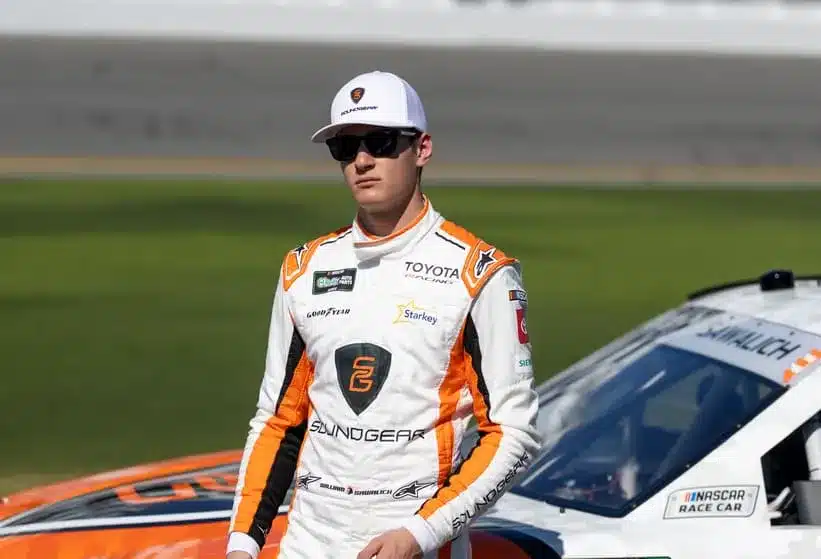
On Saturday, that demanding environment finally belonged to a teenager who had been steadily closing in on a breakthrough. William Sawalich earned his first career NASCAR O’Reilly Auto Parts Series victory, putting his Joe Gibbs Racing Toyota in victory lane after leading the final 38 laps.
His long‑run pace ranked best in the field, and at 19 years old, he became one of the youngest winners in series history. The win removed the weight of a winless rookie season and validated the expectations surrounding his rise through Toyota’s development system.
William Sawalich Conquers Rockingham Speedway
Rockingham requires patience, tire conservation, and precise throttle control. Sawalich excelled in all three areas. His longest green‑flag run showed only 1.6 seconds of fall‑off, compared to the field average of 2.1 seconds.
His Toyota maintained a stable corner‑exit balance, allowing him to withstand pressure from JR Motorsports drivers Justin Allgaier and Rajah Caruth. Both challengers brought significantly more national‑series experience, yet Sawalich controlled the race with composure.
Crossing the finish line for his first national‑touring victory carried clear significance. Only 14% of drivers in this series win before their 20th start. Doing it at Rockingham, where mistakes are punished immediately, underscored his readiness for higher levels of competition.
The performance showed both raw speed and the mental discipline required to finish races under pressure. It also showed he could stay composed when the race tightened up. Every decision he made in the final laps reflected a level of maturity beyond his experience.
Overcoming A Frustrating Rookie Campaign
Sawalich’s 2025 season set the stage for this 2026 breakthrough. He entered the series with an ARCA Menards Series championship and a reputation as a generational short‑track talent. Despite that pedigree, he finished the year 0‑for‑18 in the win column.
His average finish of 12.7 did not reflect the speed he often showed, and mechanical issues erased at least four potential top‑five results. Meanwhile, his peers surged ahead. Connor Zilisch won six races and dominated headlines. Brent Crews delivered multiple podiums.
The contrast suggested that Sawalich might have been elevated too quickly. In a sport where perception shifts fast, a winless season for a top prospect can generate doubts inside the garage. Sawalich focused on improvement.
He spent the offseason logging extensive simulator time, refining his long‑run discipline, and working closely with his crew chief on corner‑entry consistency. The Rockingham win reflected that work. It was not the result of circumstance. It was the product of preparation and growth.
The Future Of Joe Gibbs Racing
Sawalich’s victory also highlights a developing storyline at Joe Gibbs Racing. The organization is loaded with young talent. Sawalich and teammate Brent Crews are both viewed as future NASCAR Cup Series drivers. Both are developing quickly, which adds even more urgency to JGR’s long‑term planning.
Toyota’s development pipeline is deeper than it has been in years, but the Cup Series offers only four seats at JGR. Only one appears likely to open in the near future. The most realistic opportunity is the No. 11 car, currently driven by 51‑time Cup Series winner Denny Hamlin.
Hamlin’s career is closer to its conclusion than its beginning, and a transition plan is inevitable. Every win and every statistical gain from Sawalich or Crews becomes part of the internal evaluation process. Sawalich’s Rockingham triumph strengthens his position in that competition.
It also increases the pressure on JGR leadership to map out a clear succession timeline. Each strong performance from their young drivers makes the eventual decision more complex and more urgent.
What This Means
This victory changes the conversation around William Sawalich. He is no longer a prospect defined by potential. He is a proven winner in one of NASCAR’s most competitive national divisions. His long‑run pace, tire management, and race execution point to a driver capable of winning consistently.
For Joe Gibbs Racing, the win confirms that their development system is functioning as intended. They have a young driver who can handle pressure, execute strategy, and deliver results on a track that quickly exposes weaknesses.
For the rest of the garage, the message is clear. Once a young driver breaks through, momentum often follows. Historically, 62% of first‑time winners in this series earn a second victory within eight races. Teams notice when a young driver starts stacking results.
Competitors understand that confidence can shift the balance of power in a matter of weeks. Sawalich now carries that momentum into the heart of the season. Confidence from a first win often accelerates development, and his performance at Rockingham suggests more success is within reach.
What’s Next
Rockingham Speedway has a reputation for separating contenders from pretenders. On a track that punishes impatience and magnifies mistakes, William Sawalich delivered a disciplined performance to secure a milestone victory.
He handled the pressure, rebounded from a difficult rookie year, and established himself as a rising force in the NASCAR O’Reilly Auto Parts Series. As the season continues, Sawalich becomes one of the most compelling young drivers to watch. Saturday’s win may be the first step toward a much larger future.
