
Reddick Notches Fourth Victory Of The Year In Hard‑Fought Darlington Finish

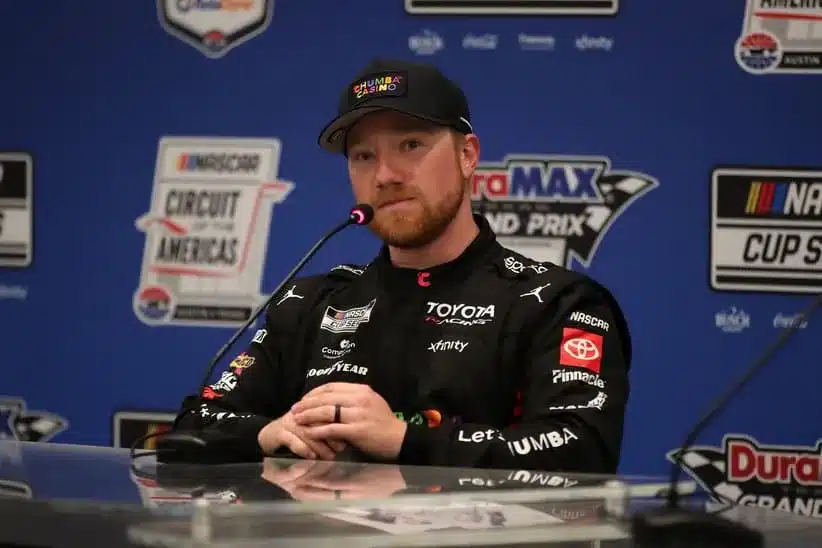
Darlington Raceway has never pretended to be friendly. The 1.366‑mile oval has earned its “Track Too Tough to Tame” nickname over seven decades of shredding tires, punishing mistakes, and turning championship hopes into scrap metal.
Its sandpaper‑like surface produces some of the steepest tire falloff in the sport, often more than two seconds over a long green‑flag run, and it forces drivers to walk a razor‑thin line between speed and survival.
On a blistering Sunday afternoon during the 2026 Goodyear 400, the track lived up to every bit of its reputation. But amid the chaos and attrition, Tyler Reddick delivered a performance that will be remembered for years, scoring his fourth win in just six starts.
It was the kind of afternoon that reshapes a season and sends a message to the rest of the garage. This wasn’t a race won by clean air or pit strategy alone. It was a test of endurance from the moment the green flag waved.
Teams were already talking about tire wear and handling issues within the first ten laps, a sign of how quickly the track was taking control. For Reddick and the No. 45 team, the day nearly fell apart before it even began.
Reddick Battles Early Electrical Trouble
Two laps into the race, Reddick’s radio crackled with trouble. The voltage gauge was dropping fast, and he suspected a violent hit over the Turn 2 bump had knocked something loose in the alternator assembly. Within moments, warning lights filled the dashboard. The team estimated he had only minutes of battery life left before the engine would shut down.
It was the kind of issue that usually ends a driver’s day before the field even settles in.Crew chief Billy Scott immediately shifted into damage‑control mode. Reddick shut off his cooling systems to conserve power, a brutal decision in a cockpit that routinely climbs past 120 degrees.
The team brought him to pit road before it officially opened, swapping the battery and checking the alternator belt. The move saved the car but earned a penalty that sent Reddick to the back of the field for the Stage 2 restart.
Falling to 32nd at Darlington is usually a death sentence, but Reddick stayed composed. Even without cooling fans, he logged steady laps and began working his way forward, refusing to let the early setback define his afternoon.
Keselowski Controls The First Half
While the No. 45 team scrambled to keep their Toyota alive, Brad Keselowski put on a clinic reminiscent of his 2012 championship season. He swept Stages 1 and 2, leading 142 of the first 200 laps, nearly half the race, and lapping more than half the field before the end of the opening stage.
It was the most dominant first half at Darlington since Martin Truex Jr. led 248 laps in 2021. Keselowski’s No. 6 Ford was nearly flawless. He ran the high groove with precision, earning his 11th and 12th stage wins of the year. Chris Buescher wasn’t far behind.
The RFK Racing driver finished second in Stage 2, just 0.364 seconds back, giving the organization a powerful 1‑2 punch. For the first two‑thirds of the race, RFK looked untouchable. Their long‑run speed was unmatched, and both drivers consistently posted top‑five lap averages. It felt like their race to lose.
Darlington Strikes Back
But Darlington rarely lets a race unfold without demanding a price. The track’s bite came early and often. Bubba Wallace, who started fourth, suffered a costly 17‑second pit stop during the Stage 1 break, dropping him to 16th. On the Stage 2 restart, he was swept into a three‑car crash triggered when Denny Hamlin slowed with a loose left‑rear wheel.
Erik Jones clipped Hamlin and spun, leaving Wallace with nowhere to go. The No. 23 slammed into Hamlin and then the outside wall, ending what had been a promising afternoon. It marked Wallace’s third DNF of the season, a frustrating trend for a team that entered 2026 expecting to contend weekly.
Ryan Blaney, who finished third in Stage 1, saw his race unravel when his crew failed to secure the left‑side wheels. He had to stop in Joey Logano’s pit stall to avoid losing a tire, earning a penalty that buried him deep in the field. Even Kyle Larson, a perennial Darlington threat with a career average finish under 10, fell victim to mechanical trouble.
A late‑race issue dropped him to 32nd, his worst Darlington result in six years. By Lap 250, more than a third of the field had suffered damage, penalties, or mechanical setbacks. Darlington was doing what Darlington always does: leveling the playing field.
The Race Turns On A Single Moment
With 30 laps to go, everything changed. Keselowski tried to clear Buescher off Turn 2 but lost momentum. Buescher dove for pit road at the last second, a move Reddick had no way to anticipate. Running directly behind the No. 17, Reddick tapped Buescher’s bumper, sending him sliding sideways into the Turn 3 SAFER barrier.
Buescher saved the car, but the damage ended his shot at the win. It was a crushing moment for a driver who had led 28 laps and posted the fastest average lap time in Stage 2. The chaos opened the door for Reddick. In an instant, the entire balance of the race shifted in his favor.
He surged past Keselowski on Lap 266 and never looked back, stretching his lead to more than a second in the closing laps. Keselowski settled for second, followed by Blaney, Carson Hocevar, who earned his first career top‑five, and Austin Cindric.
For Hocevar and Cindric, the finishes marked their best results of the season and a much‑needed boost for their teams. Both drivers have been searching for momentum, and Darlington finally gave them something solid to build on. It was the kind of afternoon that can shift confidence inside a race shop.
What The Win Means
Reddick’s victory is more than another trophy. It’s a statement. The 23XI driver now holds four wins in six starts to open 202, his 12th career victory, and his second checkered flag at Darlington. He now becomes the first driver since Jeff Gordon in 1997 to win four of the first six races.
Winning at Darlington requires tire management, discipline, and fearlessness. Winning after losing cooling systems, falling to the rear, and battling electrical issues requires something more than the resilience of a championship‑caliber driver. Reddick now leads the series in laps led, average finish, and stage points.
His early‑season form is drawing comparisons to the dominant stretches of Gordon, Johnson, and Kyle Busch. For 23XI Racing, the win proves they can overcome adversity and still beat the field. For the rest of the garage, it’s a warning.
The road to the 2026 championship runs directly through the No. 45. RFK Racing leaves with mixed emotions. They had the speed to win, but execution, not pace, cost them the trophy. Darlington rewards perfection, and even the smallest misstep can swing the race.
What’s Next
The 2026 Goodyear 400 will be remembered as a punishing test of endurance, strategy, and survival. Darlington Raceway did what it always does: it shredded tires, punished mistakes, and turned contenders into spectators. But when the dust settled, Tyler Reddick stood alone on the frontstretch, having conquered both the track and the adversity thrown at him.
He beat the heat, he beat the chaos, and he beat the best drivers in the world. As the season pushes forward, one thing is clear: the championship road runs straight through the No. 45 Toyota, and the rest of the field will have to elevate their game to keep up.
