
The Lady In Black: A Historic Look At Darlington Raceway’s Most Unforgiving Mile And A Third

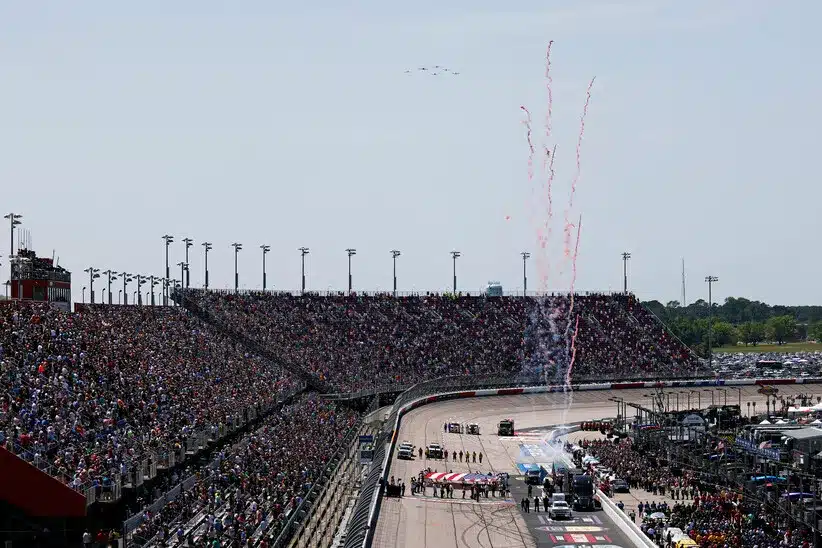
When you walk through the gates of Darlington Raceway in the South Carolina heat, you don’t just see a race track. you step into one of the most historically significant venues in American motorsports. The air carries the smell of rubber, fuel, and more than seven decades of racing heritage.
Since opening in 1950, this 1.366‑mile oval has challenged every generation of NASCAR drivers with its abrasive surface and unforgiving walls. Darlington is the oldest superspeedway on the schedule and remains one of the toughest tracks to master. It’s a place where careers are defined, and confidence is tested.
Drivers often say the track “races you harder than the competition,” and the numbers support it: More than 80% of cars in a typical Darlington race leave with right‑side damage. The track doesn’t care about reputation or momentum. It rewards precision, patience, and respect, and it punishes anyone who shows up unprepared.
The Birth of Darlington Raceway and the Minnow Pond Compromise
Darlington’s origin story is one of the most unique in NASCAR history. In 1950, local businessman Harold Brasington returned from the Indianapolis 500 determined to bring a paved superspeedway to the South. At the time, NASCAR was still running mostly on dirt tracks, and Brasington’s idea was considered unrealistic.
He purchased 70 acres of farmland outside Darlington and began shaping what would become the first 500‑mile stock‑car race. But construction hit a snag when the neighboring landowner refused to let Brasington disturb his minnow pond. Instead of abandoning the project, Brasington redesigned the track around it, creating the now‑famous egg‑shaped layout.
Turns 1 and 2 are wide and sweeping, while Turns 3 and 4 are tighter and narrower. The difference is so dramatic that crew chiefs still say you “can’t set up a car for both ends.” Drivers must compromise, wrestling a car that handles well in one corner and poorly in the next.
That challenge is a big reason Darlington remains a veteran‑friendly track. The first Southern 500 drew 25,000 fans and featured 75 cars, a field size that will never be seen again in modern NASCAR. Johnny Mantz won the race using heavy‑duty truck tires, the only rubber durable enough to survive the surface.
How Darlington Became The Lady In Black
Darlington’s nickname has two origins: one practical, one poetic. In the early decades, track workers would seal the racing surface with fresh asphalt and tar the night before major events. By morning, the track appeared completely black, leading fans and drivers to call it “The Lady in Black.” It became a simple, descriptive nickname that stuck.
But the name gained deeper meaning in 1965 when journalist Benny Phillips compared the track to Mata Hari, the infamous spy known for her beauty and danger. Phillips wrote that Darlington was alluring but treacherous, a place that punished arrogance and rewarded discipline.
His column popularized the idea that the track had a personality, and drivers embraced it. The “Darlington Stripe,” the right‑side scrape nearly every car earns, became a badge of survival. Today, the nickname represents both the track’s appearance and its reputation as one of the toughest venues in the sport.
Cale Yarborough And The Ghosts Of The Southern 500
No track is defined by its legends more than Darlington, and few drivers embody its spirit like Cale Yarborough. Long before he became a three‑time Cup Series champion, Yarborough was a local kid who snuck onto the property just to watch practice. In one infamous incident, he crashed an unauthorized car and flew over the guardrail a moment that only deepened his connection to the track.
Yarborough went on to win five times at Darlington, including four Southern 500s, cementing his status as the track’s hometown hero. His aggressive driving style matched the track’s demands perfectly. Darlington has also produced some of NASCAR’s most memorable finishes.
In 1950, Johnny Mantz shocked the field by winning the inaugural Southern 500 on truck tires. In 2003, Ricky Craven and Kurt Busch delivered the closest finish in NASCAR history, 0.002 seconds, after slamming doors coming to the line. Moments like these are why Darlington remains one of the most respected tracks in the sport.
Throwback Weekend: A Living Time Capsule
Today, Darlington honors its history through Throwback Weekend, one of NASCAR’s most popular traditions. Held each spring, the event transforms the garage into a rolling museum. Teams run retro paint schemes, pit crews wear vintage uniforms, and fans show up in classic jackets and hats.
The entire weekend is a celebration of the sport’s past. Throwback Weekend has become a major draw, often producing some of the highest early-season TV ratings. It also strengthens NASCAR’s generational connection.
Parents and grandparents can point to the cars on track and share stories about Richard Petty, David Pearson, Dale Earnhardt, and other icons. For many fans, it’s the most meaningful weekend of the year.
What This Means
A win at Darlington Raceway is one of the most respected accomplishments in NASCAR. The track demands tire management, throttle control, and mental stamina at a level few venues can match. Drivers must balance aggression with patience, especially as tire falloff can exceed two seconds over a long run.
Winning here means you’ve conquered one of the sport’s toughest challenges. The Southern 500 now plays a major role in the NASCAR Playoffs, adding even more pressure. Darlington often exposes weaknesses in a team’s program, and a poor performance can derail momentum. Conversely, a strong run here is a sign that a team is built for the long haul.
Where The Story Of Darlington Leads Next
NASCAR has changed dramatically over the last seven decades, but Darlington Raceway remains as demanding as ever. Technology has evolved, cars have advanced, and strategies have grown more complex, yet the track still forces drivers to rely on skill and instinct.
The Lady in Black cannot be beaten by simulations or engineering alone. She rewards respect and punishes carelessness, just as she always has. And as long as NASCAR continues to race, Darlington will remain one of its purest and most defining tests.
