
Carson Hocevar Stuns The Field With A 191.340‑MPH Pole Run As Spire Motorsports Sweeps The Front Row At Texas

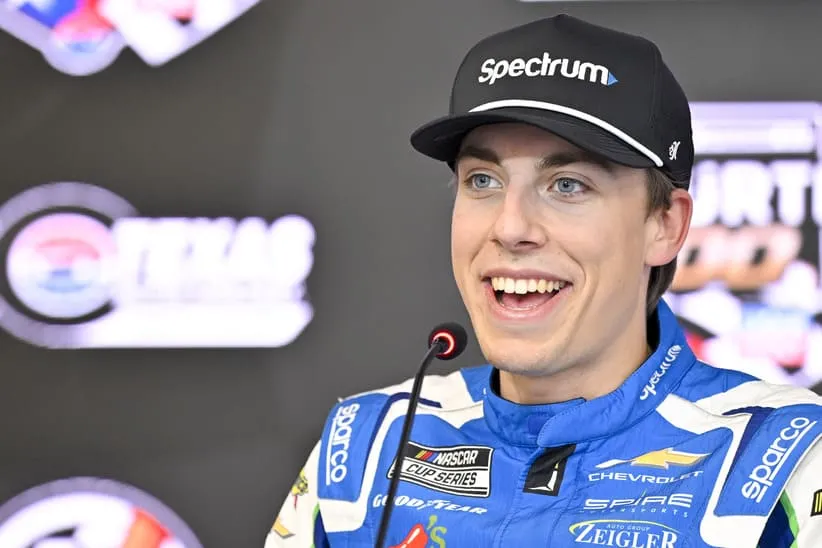
Texas Motor Speedway has a way of exposing weaknesses. The 1.5‑mile layout is fast, abrasive, and unforgiving, and qualifying there often separates the contenders from the pretenders. On Saturday afternoon, Carson Hocevar delivered the most complete single‑lap performance of his young NASCAR Cup Series career, putting the No. 77 Spire Motorsports
Chevrolet is on the pole for Sunday’s Würth 400 with a blistering 191.340 mph average speed. It wasn’t just a fast lap. It was a statement. Hocevar has shown flashes of speed throughout the season. He’s been inching closer to a breakout run for weeks, and this lap finally showed the full speed the team believed they had.
However, Texas marked the first time he converted that potential into the top spot on the grid. For a driver who entered the Cup Series with a reputation for aggression and raw car control, this was the kind of lap that proves he’s learning how to pair speed with precision.
Hocevar’s 191.340‑MPH Lap Sets The Standard
Qualifying at Texas demands commitment. Drivers enter Turn 1 at more than 185 mph, trusting the right‑side tires to hold through the bumps that have defined the track since its 2017 repave. Hocevar never lifted. His lap, 191.340 mph, was the fastest he has ever run at the facility in a Cup car and the second pole of his career.
He hit every mark: deep entry, clean rotation, and a full‑throttle exit that carried all the way down the backstretch. The lap was nearly identical to the one he ran in 2025 when he earned his first Texas pole, making him the first driver since Kevin Harvick to score back‑to‑back poles at the track.
For a driver who spent his early career wrestling dirt late models and leaning on aggression in the Truck Series, the ability to execute a near‑perfect aerodynamic lap shows how quickly he’s adapting to the Cup Series’ demands.
Spire Motorsports Sweeps The Front Row

Hocevar’s pole wasn’t the only surprise. Spire Motorsports delivered its strongest qualifying performance in team history by sweeping the front row. Daniel Suárez, driving the No. 7 Chevrolet, clocked in at 191.320 mph, missing the pole by just 0.003 seconds, the closest front‑row margin at Texas since electronic timing began tracking thousandths.
For a team that spent years fighting to stay inside the top 30 in points, a 1‑2 sweep at a high‑speed intermediate track is a milestone. Spire has invested heavily in engineering support, simulation tools, and personnel over the past two seasons, and Saturday’s result was the clearest evidence yet that the upgrades are paying off. Behind them, the top five featured familiar contenders:
- 3rd: Chris Buescher (RFK Racing), 191.201 mph
- 4th: Denny Hamlin (Joe Gibbs Racing), 191.144 mph
- 5th: Chase Briscoe (Joe Gibbs Racing), 191.102 mph
Further back, Kyle Busch posted his best qualifying effort since the Daytona 500, timing in sixth in his first weekend with new crew chief Andy Street. Points leader Tyler Reddick will start eighth after a steady but unspectacular lap in the No. 45 Toyota.
Practice Trouble For Wallace And Dillon
Before qualifying began, practice delivered its own drama. William Byron topped the session with a 189.294‑mph lap and led the 10‑lap average chart, showing the No. 24 Chevrolet had long‑run speed. Behind him, Michael McDowell, Corey Heim, John Hunter Nemechek, and Bubba Wallace rounded out the top five.
But Wallace’s session unraveled in the final minutes. The No. 23 Toyota snapped loose entering Turn 4 and slammed the outside wall, causing heavy right‑side damage. The team was unable to repair the car in time for qualifying, forcing Wallace to start 38th.
Austin Dillon’s day ended even earlier. His No. 3 Chevrolet suffered a terminal engine failure after just three laps, sending him to the rear of the field as well. Even Suárez had a scare when a flat tire halted his practice run, but his team recovered and helped him secure the front‑row spot.
What It Means For Sunday
Hocevar’s pole gives him the most valuable asset at Texas: clean air. Passing has been notoriously difficult at the track due to the narrow racing groove and the turbulent wake created by the Next Gen car. If Hocevar controls the opening stage, he can dictate the pace and force the field to react to him.
For Spire Motorsports, the front‑row sweep validates the organization’s offseason investments. They’ve added engineering depth, expanded their simulation program, and strengthened their alliance with Chevrolet. Saturday’s result shows they’re no longer a backmarker operation. They’re capable of outrunning the sport’s biggest teams on raw speed.
But Sunday is a different test. Texas is a 400‑mile race that punishes mistakes, and the track’s abrasive surface will force teams to manage tire wear, pit cycles, and long‑run balance. Hocevar and Suárez will have to hold off veterans like Hamlin, Buescher, and Byron, all of whom have shown strong race‑trim speed.
What’s Next
Carson Hocevar didn’t just win the pole. He changed the tone of the weekend. His 191.340‑mph lap was the fastest of the day, and Spire Motorsports’ front‑row sweep sent a shockwave through the garage. The team that once fought for 25th‑place finishes now enters Sunday with a legitimate chance to control the race.
The question now is whether Hocevar can turn one perfect lap into a complete race. If he and Spire execute on pit road and manage the long‑run balance, Texas could produce one of the biggest upsets of the 2026 season.
For More Great Content
Stay plugged in with more race analyses, features, and behind‑the‑garage storytelling. Follow Sarah on Facebook, LinkedIn, and X at Sarah Talker, where the conversation keeps rolling long after the checkered flag drops.
