Shawn Cowie Battles Pressure and Drama to Capture Back-to-Back Championships

In the world of drag racing, some drivers are simply good, and others are forged in fire. Shawn Cowie fits squarely into that second category. By all logical metrics, the British Columbia native probably shouldn’t be dominating one of the NHRA’s most physically demanding Sportsman categories.
If you rewind to April 2011, he was lying in a hospital bed after a devastating motorcycle accident. His injuries were the kind that end careers before they really begin: crushed legs, a shattered pelvis, and a fused right ankle that left him with zero mobility in that joint to this day. But Cowie didn’t just learn to walk again. He relearned how to drive, and, fast-forward to today, he has rebuilt his program to sit exactly where he belongs: on top of the world as the Top Alcohol Dragster champion.
Cowie Dominates at Home in Mission
The road to this second consecutive title wasn’t exactly a smooth quarter-mile pass. It was a grind. While the championship ultimately concluded in Pomona, the real magic happened months earlier, specifically at his home track in Mission, B.C.
For any athlete, there is something sacred about winning at home. But Cowie didn’t just win. He rewrote the history books. In mid-June, with the air conditions absolutely perfect “Disneyland” conditions, as he called them, he unleashed a monster run. He powered his dragster to a 5.11-second pass. That isn’t just fast. It’s the quickest run in the history of blown alcohol dragsters.
Doing that in front of the friends and family who watched him struggle through rehabilitation wasn’t just a statistical victory; it was an emotional one. It set the tone for a season where Cowie proved he wasn’t just participating. He was dictating the pace.
Finally Conquering the U.S. Nationals
Despite his success, there was one glaring hole in Cowie’s trophy case: The U.S. Nationals. It’s the crown jewel of drag racing, the one everyone wants. He’d been a bridesmaid twice before, losing in the finals in 2010 and 2016. He admitted that the thought had crept into his mind that maybe this was the one race he’d never actually win.
But 2025 was different. Cowie and his Mundie’s Towing team were on a mission. They tore through a lineup of heavy hitters, taking down formidable opponents like Madison Payne and Jon Bradford. In the final, he stared down Jamie Noonan, who had just ripped off a blistering 5.16 in the semis.
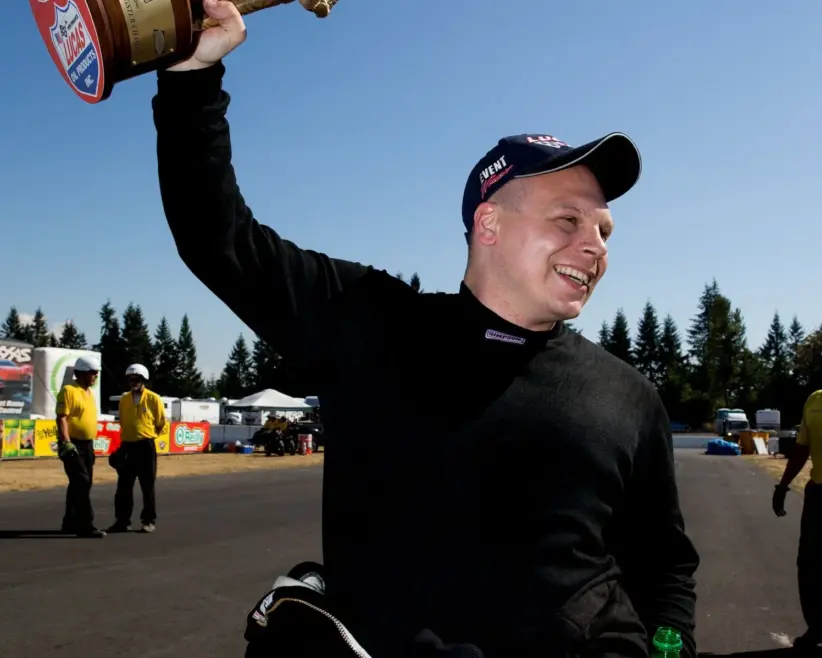
This is where experience pays off. Instead of trying to out-muscle Noonan, he made a veteran tuning call. He told his guys to “race the racetrack,” knowing the surface was going away. They slowed the car down on purpose. It was a gamble, but it paid off. Noonan went up in smoke instantly, and Cowie cruised to a 5.25-second win, finally capturing the elusive Indy Wally.
Cowie Navigates Late-Season Drama
No championship season is without its hiccups. As the year wound down, the team faced mechanical headaches. The boost from their blowers started to tank, dropping three or four pounds of pressure. In a sport decided by thousandths of a second, that’s an eternity.
With a year-long waitlist for new parts, Cowie had to grit his teeth and make it work with what he had.It all came down to a math problem in late autumn. Cowie held the lead, but five-time champ Joey Severance was breathing down his neck. Severance needed wins. Cowie just needed to keep the line.
The Rain-Soaked Coronation
The season finale at the In-N-Out Burger NHRA Finals in Pomona was poised to be a nail-biter, but Mother Nature had other plans. After just one round of eliminations, the skies opened up. For two days, Cowie sat in the rain, waiting, wondering if he’d have to race for his life on a slick track. Eventually, NHRA officials made the call to cancel the event.
It was an anti-climactic end to a high-octane season, but the result was undeniable: Shawn Cowie was the champion. True to his character, Cowie’s reaction wasn’t purely a selfish celebration. He admitted to feeling bad for Severance, who lost his chance to fight back because of the weather. But safety came first, and the trophy was coming back to British Columbia.
What the Future Holds for Cowie
So, what’s next for the champ? A “three-peat” is definitely on the mind. But Cowie is realistic about the toll the sport takes on his body. He’s 14 years removed from his accident, but the scar tissue and fused joints don’t get any younger.
He’s disadvantaged on the starting line reaction times because of his leg issues, but his team makes up for it with raw horsepower. When asked if he’d ever switch to a more straightforward setup, like a torque converter with a hand button, his team jokingly told him they’d quit if he did. So, Cowie presses on the hard way.
Final Thoughts
Winning one title is a dream. Winning two back-to-back is a statement. If Cowie pulls off a third, he becomes a legend. And considering what he’s already overcome, you’d be foolish to bet against him.