
Kansas Doubleheader Runs Back Goodyear’s Established Tire Construction

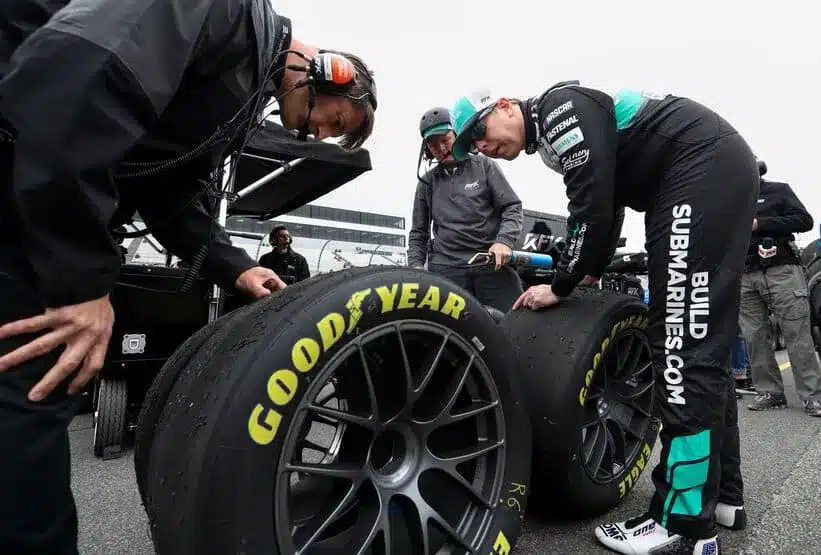
Kansas Speedway returns to the spring slate as one of the toughest tire‑management tracks in the sport. The 1.5‑mile surface has aged enough to create real falloff while still demanding speed on corner entry. With the O’Reilly Series on Saturday and the Cup Series on Sunday, every choice involving pressure and pit timing will carry weight.
Goodyear brings back the same combination used at Las Vegas and Darlington, giving teams a clear read on how far they can push it. That history matters here, where long green‑flag stretches expose any weakness in setup or discipline. The teams that manage this compound best will separate quickly from those just trying to hang on.
The Right‑Side Construction That Changed Intermediate Racing
Last September, Goodyear introduced a new right‑side construction at Kansas designed to widen strategy options and increase falloff. The tire debuted with the goal of creating multiple grooves and forcing drivers to manage their equipment over long green‑flag stretches. That same construction returns this weekend.
Teams learned quickly last fall that this construction changes how Kansas races. The added falloff forces drivers to manage their right‑rear from the moment the run begins, and it punishes anyone who overcharges the entry. The wider groove it creates also keeps the field moving, which means long green‑flag stretches are almost guaranteed.
It also puts more pressure on crew chiefs to stay ahead of balance shifts. As the tire fades, cars migrate up the banking in search of cleaner air and fresh grip, turning Kansas into a track where rhythm matters as much as raw speed. That dynamic is exactly why this compound returns. It rewards discipline and exposes mistakes fast.
Where Teams Have Seen This Tire Before And Why It Matters
Cup teams have already run this exact right‑side setup twice in 2026 at Las Vegas Motor Speedway and Darlington Raceway. Both races produced measurable falloff, with Vegas showing nearly 1.5 seconds of drop over a long run and Darlington producing even more.
The O’Reilly Series ran this tire at Las Vegas as well, giving both garages a solid baseline for Kansas. Teams already understand its heat‑cycle behavior, how fast the grip falls away, and how touchy it is to pressure changes. That level of familiarity strips out the guesswork and forces everyone into a tighter competitive box.
Teams also know how this tire reacts when the track takes rubber and the groove starts climbing the wall, which is a defining trait of Kansas as the laps build. Once the surface widens out, the tire’s wear pattern becomes even more predictable, letting drivers commit to lines without fearing a sudden balance swing.

Kansas is a track where pit timing can swing a race instantly, and this weekend’s tire allotments will dictate how aggressive teams can be. Cup Series teams will have 10 total sets and eight new sets for Sunday’s 400‑miler, plus one for practice and one for qualifying that carries into the race.
O’Reilly Auto Parts Series teams will work with six sets and four new ones for Saturday’s 300‑miler, plus their practice and qualifying sets. With eight fresh sets in the Cup garage, crew chiefs can attack the race instead of guarding inventory. Two‑tire calls become viable late in a run, and a well‑timed four‑tire stop under caution can launch a driver from mid‑pack into clean air.
The O’Reilly teams, working with a tighter margin, must time their stops perfectly to avoid getting trapped on old rubber. Those allotments shape every decision on pit road. A well‑timed stop can vault a driver into the first two rows. One bold call can change the entire tone of the final stage.
Cup Series Allotment
Cup teams receive 10 total sets:
- 1 for practice
- 1 for qualifying (which carries into the race)
- 8 fresh sets for the 400‑mile event
O’Reilly Auto Parts Series Allotment
The O’Reilly Series receives 6 total sets:
- 1 for practice.
- 1 for qualifying and carried into the race.
- 4 fresh sets for the 300‑mile event.
How Kansas Punishes The Wrong Setup
Kansas Speedway’s surface has aged into a wide, multi‑groove layout that rewards drivers who can move around to find clean air. But the track’s speed, often topping 175 mph into Turn 1, puts enormous stress on the right‑rear tire.
Kansas punishes anyone who leans too hard on the right‑rear, especially during long green‑flag stretches when the balance shifts toward tight‑center, loose‑off. Drivers who can manage that degradation without sacrificing corner-entry speed usually separate themselves over a run.
The falloff isn’t dramatic lap to lap, but it compounds quickly enough to expose anyone who overcharges the corner. That’s why teams spend so much time tuning platform stability and rear‑grip longevity for Kansas specifically. A car that stays planted through the middle of Turns 1 and 2 can maintain momentum down the backstretch, where the field tends to string out.
Todd Gilliland’s Perspective
Todd Gilliland, coming off a sixth‑place finish at Bristol, noted how Kansas magnifies tire pressure decisions. With cooler temperatures expected, speeds will rise, and teams will be tempted to drop pressures below Goodyear’s recommendations to build early grip. Even a half‑pound too low can risk a failure in the middle of a corner.
Gilliland also pointed out that Kansas has become one of the best intermediate tracks for racing. As tires wear, the field spreads out, and drivers can search for momentum at the top, middle, or bottom. That variability is why Kansas consistently produces long green‑flag runs and late‑race chaos.
Kansas also forces drivers to commit to a lane and live with the consequences, because momentum swings are brutal once the tires start to give up. A driver who mistimes a move or jumps out of rhythm can lose three or four spots in a single lap. That constant risk‑reward calculation is what keeps Kansas unpredictable deep into a run.
What Teams Already Know From Vegas And Darlington
Because this tire has already run at Las Vegas and Darlington, teams enter Kansas with clear expectations. They know what the falloff looks like over a full fuel run. They know how the balance shifts once the right‑rear starts to fade. Nothing about this compound will surprise them when the race stretches out.
Teams also understand how this construction behaves when the track widens out, and the groove migrates toward the wall. Once the right‑rear starts to give up, the car naturally drifts higher, and drivers who anticipate that shift can stay aggressive without overstepping the limit. That predictability shapes how crew chiefs map out their long‑run balance targets.
They also know the falloff window well enough to time their pit cycles with confidence. At both Las Vegas and Darlington, the drop‑off averaged roughly 1.6 seconds over a full fuel run, and Kansas tends to mirror that pattern. That consistency allows teams to commit to strategy without fearing a sudden, unexpected swing in grip.
Falloff Will Be Real And Long‑Run Speed Will Matter More Than Short Bursts
Vegas produced a steady falloff over a 25‑lap run, and Kansas typically mirrors that pattern. Drivers who burn their right rear early will pay for it. Kansas rewards drivers who can maintain pace over 20‑ to 30‑lap stretches. Teams that chase short‑run speed often fade quickly.
Pressure Settings Will Decide Winners and Losers
The combination of cool air and high speeds will tempt teams to push the limits. Those who go too far risk failure. Those who stay conservative may give up early track position. Crew chiefs will chase every fraction of grip they can find. The teams that guess wrong will feel it within a handful of laps. Kansas has a way of exposing those decisions faster than anywhere else on the schedule.
What This Means For The Weekend
The return of this Goodyear package guarantees a race shaped by tire management. With both series carrying data from Vegas and Darlington, the field enters Kansas more evenly matched than usual. The cooler forecast means restarts will be fast, but the falloff will be sharp once the tires heat up.
Drivers will be forced to manage throttle input, search for grip in multiple lanes, and communicate constantly with their crew chiefs. The teams that balance aggression with discipline will rise as the race stretches into long green‑flag segments.
For More Great Content
Stay plugged in with more race analyses, features, and behind‑the‑garage storytelling. Follow Sarah on Facebook, LinkedIn, and X at Sarah Talker, where the conversation keeps rolling long after the checkered flag drops.
