
AMR26 Under Scrutiny As Honda Links Chassis To Vibration Spike

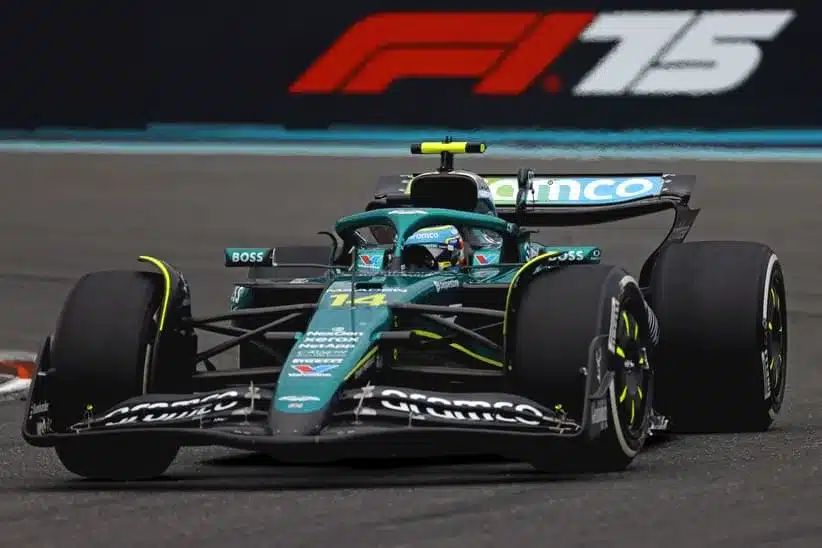
The 2026 Formula 1 season has opened with a major technical problem for Honda and Aston Martin. The AMR26 is producing power‑unit vibrations strong enough to threaten the hybrid system, the chassis, and overall race reliability. The problem has already forced both sides into a full‑time containment effort.
Engineers have recorded oscillation spikes well above the limits typically seen in modern F1 engines, with several frequencies exceeding safe thresholds by wide margins. The team has already reduced running time in multiple sessions to protect components. That lack of mileage is putting them behind the rest of the field in both development and data gathering.
Honda Racing Corporation president Koji Watanabe has acknowledged the scale of the issue, describing a group of engineers working nonstop to identify the source while the drivers deal with violent shaking at speeds over 300 km/h.
The partnership’s first season has already produced multiple retirements linked to these failures. Aston Martin has completed fewer laps than any other manufacturer‑supported team through the opening three rounds. The gap is widening with every missed session.
The Dyno Deception: Why Bench Testing Misled Honda
Honda’s 2026 power unit passed all dynamometer testing during development. Vibration readings stayed within the usual 20–25 mm/s RMS range expected for a current‑generation F1 engine, and the hybrid deployment maps looked stable. Engineers believed the unit was ready for track use. Nothing in the dyno data suggested a resonance problem.
The controlled environment masked the interaction between the engine and the chassis.Once installed in the AMR26, the behavior changed immediately. Harmonic frequencies from the internal combustion engine and MGU‑H began resonating with the carbon‑fiber monocoque, creating destructive vibration spikes that never appeared in the dyno cell.
During Bahrain testing, Aston Martin went through its entire supply of battery packs, each costing more than $150,000, after oscillations caused internal failures and electrical shutdowns. The team ran reduced-power modes to preserve the remaining components. Even then, several systems overheated due to the constant shaking.
With only one partner team, Honda lacks the multi‑team data streams available to four Mercedes teams and two Ferrari teams. Through the first three race weekends, Honda has logged less than 60% of the laps completed by Mercedes‑powered cars. That deficit is slowing their ability to isolate the root cause.
Adrian Newey’s Packaging Demands and the AMR26 Chassis Complications
Aston Martin’s 2026 technical overhaul included the arrival of Adrian Newey, whose design approach favors extreme packaging efficiency. Paddock sources indicate that late‑cycle changes were made to tighten the rear‑end architecture around the Honda power unit, reducing space for vibration damping and thermal expansion.
The AMR26’s rear bodywork is among the most compact on the grid, leaving little tolerance for unexpected resonance. The result is a narrow operating window that the team has struggled to control. Watanabe has made it clear that the issue is not limited to the engine.
The AMR26’s structural stiffness, engine mounting points, and rear‑end geometry are all under review. Honda and Aston Martin engineers are evaluating revised engine mount stiffness, additional chassis reinforcement, and potential firing‑order adjustments.
Any of these changes may require FIA approval under the 2026 power unit homologation rules, which restrict in‑season modifications. The team has already submitted documentation outlining the severity of the problem. Approval could take weeks, delaying any meaningful fix.
Fernando Alonso and the Fight for Survival
Fernando Alonso has been forced to manage one of the most unpredictable cars of his career. The AMR26’s vibration issues have already produced two DNFs in Australia and China and a single classified finish of 18th at Suzuka. Alonso has reported that the shaking is strong enough to blur his vision on long straights.
He also noted that the car’s balance shifts as the vibrations intensify, making consistent driving nearly impossible.Friday practice in Japan showed reduced vibration levels, suggesting progress. By Saturday, without any setup changes, the oscillations returned. The inconsistency is as damaging as the failures themselves.
A car that behaves differently from session to session undermines driver confidence and makes setup correlation nearly impossible. Alonso has warned the team that the issue poses a safety concern if left unresolved. His feedback has become central to the ongoing diagnostic process.
Fernando Alonso’s season has become a test of endurance as much as performance. The AMR26’s vibration problem isn’t just a reliability flaw. It’s a moving target that keeps shifting underneath him. Every session brings a different version of the same issue, leaving the team without a stable baseline and Alonso without the confidence a driver needs at this level.
What This Means for Honda and Aston Martin
The 2026 season is already slipping away. A team cannot chase performance when basic reliability is in question. Under current regulations, power‑unit manufacturers are limited in what they can modify without FIA approval, meaning Honda may need to request an emergency reliability exemption, something rarely granted.
Even if approved, updates may not arrive until mid‑season. That timeline would effectively remove Aston Martin from early‑year competitiveness. Aston Martin must compensate for aerodynamic drag, while Honda works on the mechanical side.
Trackside leadership has already pushed forward new front‑wing iterations and floor revisions to recover the lap time lost to engine detuning. Every race weekend spent firefighting reliability is a weekend not spent developing performance.
The team is already behind its projected upgrade schedule by at least two events. That deficit will be difficult to recover in a compressed calendar. Catching up will require both efficiency and luck. Any further delay risks locking in the performance gap for weeks.
What’s Next
Formula 1 doesn’t offer patience. Honda’s success with Red Bull proved they can build elite power units, but the 2026 reset has exposed the risks of starting over with a new partner and a new ruleset. Aston Martin has invested heavily in infrastructure and personnel, yet none of it matters if the car can’t run reliably. Limited mileage and repeated failures have put the team on the defensive from the start.
If Honda and Aston Martin can’t quickly isolate the vibration issue, the AMR26’s season will shift from performance goals to basic survival. The next few races will determine whether this is a brief setback or a year‑long crisis.
