
F1 Drivers Warn After Piastri’s Near‑Miss: The Mirrors Are Too Slow

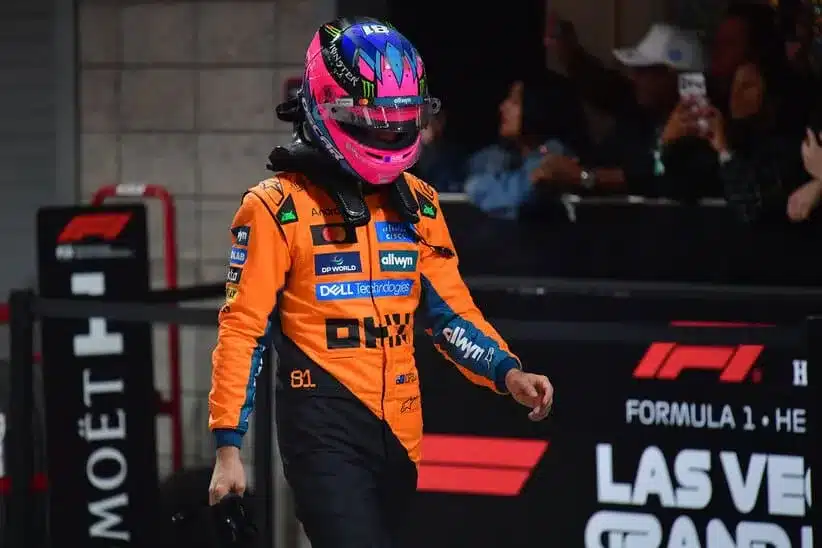
Oscar Piastri’s close call during practice at the Japanese Grand Prix has ignited a major debate inside the Formula 1 paddock about driver visibility, reaction time, and the reliability of the sport’s increasingly complex cockpit technology. Suzuka is one of the fastest and most unforgiving circuits on the calendar.
Drivers routinely exceed 300 km/h on the back straight and pull 4–5 G through its high‑speed corners. In that environment, even a one‑second misjudgment can translate into more than 80 meters of lost awareness, more than enough to trigger a catastrophic collision.
The margin for error is already razor‑thin at these speeds. Any technological delay only amplifies the danger. That margin was tested to its limit when Piastri found himself at the center of a high‑speed incident that exposed a critical flaw in the 2026‑spec virtual mirror system.
What should have been a routine tire-warm-up lap turned into a near‑miss that had engineers, stewards, and drivers scrambling for answers. The moment was over in seconds, but the implications will linger far longer. It immediately raised questions about whether the system is fit for purpose.
A 75 km/h Closing Speed At One Of F1’s Fastest Circuits
The incident occurred during the final practice session at Suzuka, a track where average lap speeds exceed 230 km/h and where the run from Turn 14 to Turn 15 is one of the quickest acceleration zones in Formula 1.
Piastri was exiting Turn 15 at roughly 180 km/h, building temperature in his tires before starting a push lap. Behind him, Nico Hülkenberg was on a qualifying simulation, reaching an estimated 255 km/h at the same point on the circuit.
That kind of speed differential is extremely rare in modern F1. It creates a scenario where even perfect awareness may not be enough. That created a closing speed of 75 km/h, a delta large enough that the faster car can gain 20 meters per second on the slower one.
At that rate, a driver has less than half a second to react, well below the typical 0.3–0.5-second human response window at racing speeds. In practical terms, it means the faster car arrives almost instantly. Even a flawless driver can be caught out by that kind of velocity shift.
Virtual Mirrors Under Fire: Lag, Refresh Rates, And Real‑World Speed
The FIA introduced virtual mirrors to reduce aerodynamic drag and improve rearward visibility, replacing traditional mirrors that often vibrated at high speed. The system uses high‑resolution cameras and cockpit‑mounted screens with a mandated minimum refresh rate.
But as Piastri explained to the stewards, even a 100–150 millisecond delay, well within the tolerance of many digital displays, can translate into a positional error of 15–30 meters at Suzuka’s speeds. That gap is the difference between a safe pass and a violent collision. It’s a margin no driver can afford to gamble with.
Telemetry confirmed that Piastri was accelerating at full throttle when Hülkenberg suddenly appeared in his vicinity. The virtual mirror showed the Audi several car lengths back, but the real‑world delta closed almost instantly. The Australian moved left to clear the racing line, but the timing was razor‑thin.
Hülkenberg had to lift to avoid contact, and the moment was tense enough that the stewards immediately summoned Piastri for impeding. The data made it clear the system had not kept pace with reality. That alone was enough to shift the conversation from driver error to technological reliability.
The Conversation Inside The Stewards’ Room
Inside the stewards’ room, Piastri didn’t blame Hülkenberg. He blamed the technology. He explained that he had grown accustomed to relying on the virtual mirror system throughout the previous season. It had become second nature to him, which made the system’s failure even more alarming.
However, the 2026 cars, featuring increased electric deployment and higher corner‑exit speeds, have created closing rates the system wasn’t designed to handle. The cars have evolved faster than the tools supporting them. That mismatch is now exposing drivers to unnecessary risk.
The stewards reviewed the data and agreed that the lag was a contributing factor. Instead of issuing a grid penalty, they delivered an official warning and escalated the matter to the FIA’s technical department. It was a rare acknowledgment that the system, not the driver, had failed. That decision may set an important precedent for future incidents.
The stewards acknowledged that his explanation highlighted a deeper issue with the current generation of cockpit systems. As cars get faster and closing speeds increase, even minor display delays become far more consequential. The incident made it clear that the technology must evolve at the same pace as the machinery it supports.
A Pattern Emerges: Piastri Isn’t The Only One Affected
This wasn’t an isolated glitch that Piastri experienced. Just 24 hours earlier, Sergio Pérez narrowly avoided a penalty after cutting across Alex Albon’s path during FP1. In that case, the virtual mirror froze for a fraction of a second, long enough for Albon’s Williams to appear farther back than it actually was. The FIA again cited “display latency” as a mitigating factor.
Two similar incidents in two days are not a coincidence. It signals a systemic weakness that needs immediate attention.Across the paddock, drivers have reported similar issues. Several have noted that the virtual mirrors struggle most in high‑contrast lighting, such as Suzuka’s late‑afternoon sessions, when the camera sensors adjust exposure.
Others say the system’s frame rate drops during heavy vibration, especially on curbs. These are predictable conditions on any race weekend. A safety‑critical system should not be vulnerable to them. Even a brief stutter in the display can leave a driver blind at precisely the wrong moment.
In a sport where cars can close at 60–80 km/h during mixed‑pace sessions, even a momentary delay can create a dangerous blind spot. Drivers rely on absolute precision at all times. Anything less introduces unacceptable uncertainty.
Why This Matters: Safety, Trust, And Split‑Second Decision‑Making
Formula 1 drivers operate at the edge of human capability. At 250 km/h, a car travels 70 meters every second. A driver’s brain must process visual data, steering input, and spatial awareness faster than almost any other athlete on the planet. When the information feeding that awareness is delayed even slightly, the consequences can be severe.
Trust in the equipment becomes just as important as trust in one’s instincts. Without that trust, hesitation creeps in. The virtual mirror system was intended to eliminate blind spots, but the current implementation may be creating new ones. If drivers cannot trust what they see, they begin second‑guessing their decisions.
That hesitation is dangerous. It slows reactions, disrupts racecraft, and increases the likelihood of unpredictable moves. In a field separated by tenths of a second, uncertainty is a liability. It compromises both safety and performance. The FIA now faces a critical engineering challenge.
Either improve the refresh rate and latency of the virtual mirrors or reconsider whether the technology is ready for the speeds of modern Formula 1. The solution must come quickly. The current system is already being pushed beyond its limits.
A Warning Shot For The Future Of F1 Technology
Oscar Piastri’s near‑miss at Suzuka was more than a simple miscommunication between two drivers. It was a warning shot for the entire sport. Formula 1 has always embraced cutting‑edge technology, but innovation must never outpace safety.
When a digital display lags by even a tenth of a second, the consequences can be measured in meters and potentially in injuries. The sport cannot afford to ignore these warning signs. Every driver on the grid depends on reliable information.
If the system continues to lag behind the realities of modern F1 speeds, the margin for safety will shrink even further. Technology is supposed to enhance a driver’s awareness, not compromise it. The longer these issues persist, the more likely it is that a preventable incident will become something far more serious.
Drivers can only operate at the limit when they have absolute confidence in the information being fed to them. Any uncertainty forces hesitation, and hesitation at 300 km/h is a recipe for disaster. The sport’s technology must enhance safety, not introduce new variables that compromise it.
What’s Next
The FIA made the right call by issuing only a warning. Penalizing a driver like Piastri for trusting mandated safety equipment would have been unjust. But the governing body now has a responsibility to act quickly. The longer they wait, the greater the risk that a similar incident ends far less cleanly.
Until the virtual mirror system is upgraded, drivers will need to rely more heavily on instinct, awareness, and old‑fashioned caution. The next incident may not end as cleanly. Formula 1 must act before luck runs out.
