
Suburban Propane 300 At Bristol Motor Speedway: O’Reilly Auto Parts Series, Entry List

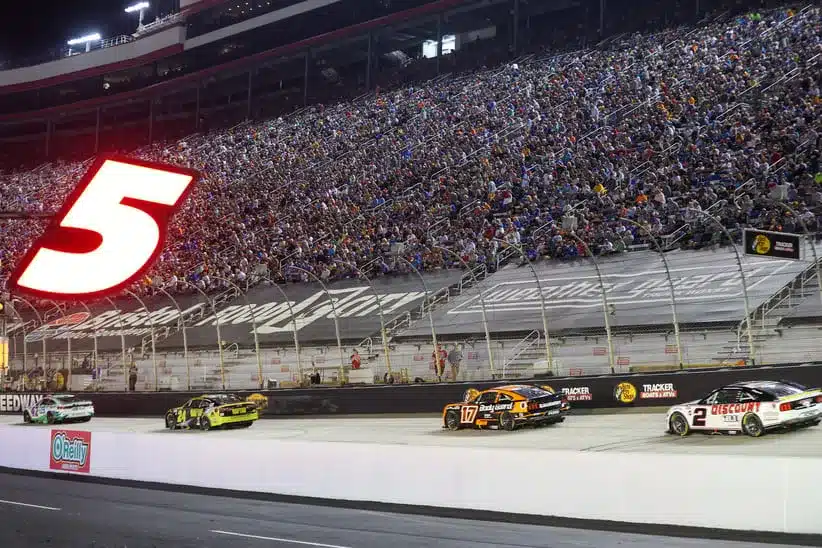
Bristol Motor Speedway wastes no time reminding drivers why it’s one of the toughest half‑miles in the sport. The high banks compress the field into constant traffic, the pace never settles, and mistakes turn into consequences instantly.
Saturday night’s Suburban Propane 300 brings a 38‑car field into a bowl where contact is guaranteed, and survival is never promised. With the entry list set and the Dash 4 Cash opening round on deck, the stakes rise before the first lap is even logged.
Bristol’s average green‑flag run sits at just 22 laps, forcing drivers into urgency from the start. This track is a place where patience evaporates, fenders bend, and reputations are built through toughness. Every lap demands discipline, knowing one misstep can turn a strong night into a wrecked race car.
Bristol’s concrete surface produces a falloff of 1.2–1.4 seconds over a 40‑lap run, making tire management a deciding factor. The combination of speed, attrition, and tight quarters makes this race a true separator. This weekend, the NASCAR O’Reilly Auto Parts Series returns to Tennessee for a Saturday showdown.
The official Entry List reveals a field loaded with veterans, newcomers, and Cup Series disruptors all chasing a Bristol sword. With 38 cars crammed into a half‑mile, the margin for error shrinks to inches. One mistake can trigger a chain reaction that wipes out a quarter of the field.
Where The Field Gets Exposed
Bristol never offers a gentle reentry into the season. The 28–30 degrees of banking demand precision, and the concrete surface punishes anyone who misses their mark. Drivers routinely make 1,000+ steering inputs during a 300‑lap race, and the falloff between early‑run and late‑run pace can exceed 1.5 seconds.
The physical load on drivers is among the highest of any short track on the schedule. The spring event has averaged 10.4 cautions over the past decade, and the tight pit road often becomes a race‑altering hazard. Heavy braking zones magnify every small miscalculation.
Pit road has produced more than 20 penalties in the last three Bristol spring races, and a single mistake can bury a contender deep in the field. Track position can swing instantly when the field stacks up off Turn 4. This race also serves as the first major short‑track test of the year.
Teams must unload fast, adapt quickly, and survive the early aggression that always defines Stage One. A strong run here can launch a driver into the spring stretch with momentum. A bad night can bury a season before it ever finds traction. Bristol exposes weaknesses in brake cooling, long‑run balance, and pit‑stop execution faster than any other track.
A Start Loaded With Developing Storylines
The 2026 season has delivered unpredictability from the start. Three different winners emerged in the opening three races, marking the first time since 2020 that the series began with such parity. Veterans have stumbled, young drivers have surged, and Bristol now becomes the first true separator.
The average margin of victory through the first three races sits at 0.41 seconds, underscoring how tight the field has become. The Colosseum has a way of exposing who has their program together and who is still searching for answers. With thirty‑eight cars entered and only one sword waiting in Victory Lane, the margin for error is razor‑thin.
Every decision carries consequences on a track this unforgiving. Bristol has produced five last‑lap passes in the last decade, and the closing laps often become a survival test. The teams that execute under pressure rise quickly in the standings.
Breaking Down The Entry List
The official Entry List paints a picture of a stacked field with multiple storylines converging at once. Short‑track specialists, Cup Series invaders, grassroots champions, and established veterans all arrive with something to prove.
Bristol’s entry list includes 12 drivers under age 22, the highest youth concentration of any short‑track race this season. The mix of experience and raw talent guarantees unpredictable restarts and aggressive racing.
Five Drivers Entering Bristol As The Strongest Threats
Bristol rewards rhythm, discipline, and the ability to survive the chaos that unfolds in the tight confines of a half‑mile bowl. The top five threats combine for over 2,000 laps led across NASCAR’s national series.
Their collective short‑track average finish sits at 9.4, reflecting consistency under pressure. That kind of reliability forces competitors to race them with precision. They settle into rhythm quickly once the run stretches out. Very few teams match that level of control when the field tightens.
William Sawalich: Joe Gibbs Racing, No. 18
William Sawalich arrives with momentum after his Rockingham victory and carries a 2026 average finish of 6.7. His short‑track background includes multiple ARCA wins on bullrings under one mile. He has completed 99.2% of his laps this season, showing the discipline needed for Bristol.
His average restart gain of +1.3 positions makes him dangerous on late‑race restarts. He stays composed when the field stacks up off Turn 4. That calm approach helps him capitalize when others overdrive the corner.
Justin Allgaier: JR Motorsports, No. 7
Justin Allgaier owns two Bristol wins, more than 500 laps led, and an average finish of 8.9 over his last seven Bristol starts. His restart execution remains among the best in the series. He ranks in the top five in short‑track driver rating over the last three seasons.
His long‑run speed consistently places him inside the top eight on concrete. He rarely fades during extended green‑flag stretches. That stability makes him one of the toughest drivers to dislodge once he settles into a rhythm.
Brandon Jones: Joe Gibbs Racing, No. 20
Brandon Jones has logged four top‑tens in his last six Bristol starts and enters as one of the most consistent performers on concrete. His ability to maintain speed on worn tires gives him an edge in long‑run segments.
Jones has improved his short‑track average finish by 3.2 positions year‑over‑year. His pit crew ranks top‑six in four‑tire stop average. His pit crew ranks top‑six in four‑tire stop average. That efficiency shows up in every late‑race cycle.
Rajah Caruth: Jordan Anderson Racing, No. 32
Rajah Caruth continues to impress with raw speed and improved race craft. His 2026 average running position sits inside the top 12, and his aggression level rises noticeably on short tracks.
Caruth has gained positions in every Stage Two this season. His short‑track passing efficiency ranks in the top ten among full‑time drivers. He attacks openings with confidence when the field bunches up. That instinct keeps him moving forward even in the most chaotic stretches.
Kyle Larson: JR Motorsports, No. 88
Cup Series favorite Kyle Larson returns as the defending winner of this event. With more than 1,300 career laps led at Bristol across NASCAR’s national series, he instantly becomes the benchmark. Larson has finished in the top five in six of his last eight Bristol starts.
His average green‑flag speed typically ranks top‑three whenever he enters an O’Reilly event. He forces the field to match his pace from the moment the race settles in. Very few drivers can maintain that level of pressure over a full run.
The Defending Winner Returns
Kyle Larson immediately jumps off the page. His ability to diamond the corners, maintain throttle commitment, and carve through traffic makes him the most dangerous driver in the field. His Bristol win percentage across all series sits at 18%, an elite number for a track this chaotic.
Every lap he runs forces the field to elevate its pace. He rarely gives competitors a chance to reset once he controls the rhythm. His presence alone changes how the entire field approaches the closing laps.
A Massive Appearance For Connor Zilisch
Connor Zilisch is no stranger to the O’Reilly Auto Parts Series, but Bristol marks one of his most anticipated short‑track appearances yet. The 19‑year‑old brings elite car control and a résumé that includes wins in multiple disciplines.
His short‑track numbers include a 2025 average finish of 7.1 across late‑model and national‑tour events. Zilisch has led laps in five different series before turning 20, showcasing rare adaptability.
Cup Series Invaders Ready To Make A Statement
Cup Series drivers dropping into the O’Reilly Auto Parts Series always tilt the balance, and Bristol amplifies that tension. Kyle Larson, the defending winner of this event, leads the group and instantly becomes the benchmark for the entire field.
His ability to manipulate the banking, maintain throttle through traffic, and control restarts makes him the most disruptive force in the lineup. Larson has more than 1,300 career laps led at Bristol across NASCAR’s national series.
He’s joined by Ty Gibbs, returning in the No. 54 Toyota with a Cup‑level aggression that fits Bristol’s rhythm. Gibbs owns a Bristol Xfinity win and has led more than 300 laps across his national‑series starts. Josh Berry adds another layer of difficulty for the full‑timers, bringing late‑model pedigree and a proven short‑track résumé that translates seamlessly to concrete.
Cup drivers have won three of the last five Bristol spring races, and the regulars know the challenge ahead. For drivers like Sheldon Creed, Sam Mayer, and Jesse Love, outrunning Larson, Gibbs, or Berry would be a defining moment in their season.
JR Motorsports Brings The Heat
JR Motorsports arrives with one of the strongest lineups in the field. Allgaier brings veteran stability. Zilisch adds youthful aggression. Carson Kvapil adds to the group’s short‑track depth with his late-model pedigree and growing national résumé. Sammy Smith rounds out the roster with precision and discipline that translate well to concrete.
JRM has earned six Bristol wins across its history. Their combined lineup has led more than 700 laps at this track. They understand how Bristol changes from one run to the next, and that familiarity shows up when the race tightens in the final 50 laps.
Series Regulars Looking To Make A Statement
The backbone of the series arrives with something to prove. Jeremy Clements brings more than 450 career starts. Austin Hill enters with a Bristol average finish of 10.4. Brent Crews and Jeb Burton see this race as a chance to announce themselves.
Five of the last seven Bristol spring winners finished inside the top eight in points. Hill’s short‑track driver rating ranks in the top ten in the series. He rarely gives away track position once he settles into rhythm. That steadiness makes him a reliable threat on nights when chaos takes over.
Why This Entry List Matters
This Entry List blends championship contenders, grassroots champions, Cup Series disruptors, and powerhouse teams into one of the most competitive fields at Bristol in recent memory.
Thirty‑eight cars on a half‑mile track guarantees contact, strategy swings, and emotional outbursts. Bristol has produced an average of 6.7 on‑track passes per lap, one of the highest in NASCAR. The depth of this field ensures no easy laps.
O’Reilly Auto Parts Series At Bristol Motor Speedway
Suburban Propane 300: Full Entry List
(i) indicates any driver deemed ineligible for championship and or playoff points
- 1. Sheldon Creed — No. 00 — Haas Factory Team
- 2. Garrett Smithley — No. 0 — SS GreenLight Racing
- 3. Connor Zilisch (i) — No. 1 — JR Motorsports
- 4. Jesse Love — No. 2 — Richard Childress Racing
- 5. Ryan Ellis — No. 02 — Young’s Motorsports
- 6. J.J. Yeley — No. 5 — Hettinger Racing
- 7. Justin Allgaier — No. 7 — JR Motorsports
- 8. Josh Bilicki — No. 07 — SS GreenLight Racing
- 9. Sammy Smith — No. 8 — JR Motorsports
- 10. Carson Kvapil — No. 9 — JR Motorsports
- 11. Corey Day — No. 17 — Hendrick Motorsports
- 12. William Sawalich — No. 18 — Joe Gibbs Racing
- 13. Brent Crews — No. 19 — Joe Gibbs Racing
- 14. Brandon Jones — No. 20 — Joe Gibbs Racing
- 15. Austin Hill — No. 21 — Richard Childress Racing
- 16. Harrison Burton — No. 24 — Sam Hunt Racing
- 17. Dean Thompson — No. 26 — Sam Hunt Racing
- 18. Jeb Burton — No. 27 — Jordan Anderson Racing
- 19. Kyle Sieg — No. 28 — RSS Racing
- 20. Blaine Perkins — No. 31 — Jordan Anderson Racing
- 21. Rajah Caruth — No. 32 — Jordan Anderson Racing
- 22. Blake Lothian — No. 55 — Joey Gase Motorsports
- 23. Ryan Sieg — No. 39 — RSS Racing
- 24. Sam Mayer — No. 41 — Haas Factory Team
- 25. Logan Beardan — No. 42 — Young’s Motorsports
- 26. Brennan Poole — No. 44 — Alpha Prime Racing
- 27. Lavar Scott — No. 45 — Alpha Prime Racing
- 28. Patrick Staropoli — No. 48 — Big Machine Racing
- 29. Jeremy Clements — No. 51 — Jeremy Clements Racing
- 30. Taylor Gray — No. 54 — Joe Gibbs Racing
- 31. Joey Gase — No. 55 — Joey Gase Motorsports
- 32. TBD— No. 74 — Mike Harmon Racing
- 33. Austin Green — No.87 — Peterson Racing Group
- 34. Kyle Larson (i) — No. 88 — JR Motorsports
- 35. Mason Maggio — No. 91 — DGM Racing X JIM
- 36. Josh Williams — No. 92 — DGM Racing X JIM
- 37. Anthony Alfredo — No. 96 — Viking Motorsports
- 38. Parker Retzlaff — No. 99 — Viking Motorsports
What This Means
Survival becomes the priority. Bristol punishes mistakes instantly. Drivers must save their equipment while fighting for every inch of track position. Teams that unload poorly often go a lap down within 35 laps. The margin between a top‑five and a mid‑pack finish is often less than 0.3 seconds per lap.
Teams that manage their brakes, protect their tires, and maintain composure through the inevitable bump‑and‑run exchanges will rise to the front. Bristol rewards discipline, but it punishes hesitation even more. The teams that execute under pressure will leave Tennessee with momentum.
All Eyes On Bristol
The haulers are parked. The tires are mounted. The sword waits in its case. Bristol brings out the rawest form of stock‑car racing, and this field is built for chaos. More than 40% of incidents occur before Stage Two, making the opening laps critical.
Rookies chase the honor of earning their first Bristol stripe. When thirty‑eight cars charge into Turn 1 on Saturday night, every driver will tighten their belts, trust their instincts, and brace for whatever the Colosseum decides to give or take.
What’s Next
Bristol resets the balance of power. A stacked entry list, multiple Cup Series disruptors, and a mix of veterans and rising stars turn Saturday into more than a race. The outcome will shape the early championship picture.
Teams that leave Bristol with momentum often carry it deep into May. Strong runs here build confidence for the spring stretch, while mistakes can bury a season before April arrives. Bristol doesn’t hand out momentum. It forces drivers to earn it
