2026 Cook Out Clash: Qualifying and Practice Breakdown

Winter weather has already made its presence felt in the NASCAR world. Snow in Winston‑Salem forced NASCAR to scrap the original Cook Out Clash weekend schedule at Bowman Gray Stadium and replace it with a one‑day sprint on Wednesday. What was supposed to be a gradual season warm‑up is now a compressed, high‑pressure gauntlet.
Drivers won’t have the luxury of easing into anything. Feb. 4 has turned into a full‑scale test of adaptability: practice, qualifying, the LCQ, and the main event all packed into a tight window. Here’s how the field will be set under the revised format.
Practice: Two Sessions, Eight Minutes Each
The biggest shock comes right away. Instead of multiple practice rounds, teams get two eight‑minute sessions. That’s it. At a quarter‑mile track like Bowman Gray, rhythm and precision matter more than anywhere else.
Eight minutes is barely enough time for teams to shake the car down, let alone make meaningful adjustments. Any mistake: a loose wheel, a bad change, a scrape with the wall could derail the entire afternoon.
The garage will be chaotic. Crew chiefs will be forced to make instant decisions, and drivers will need to provide perfect feedback from the moment they hit the track. This format will expose who came prepared and who didn’t.
Practice and Qualifying Groups Breakdown
NASCAR didn’t just split the field randomly for Wednesday’s sessions. These groups shape the tone of the entire afternoon. Evolution at Bowman Gray happens quickly. Rubber builds up, temperatures shift, and the groove changes lap by lap. Who you share the track with in an eight‑minute sprint can make or break your qualifying run.
Some groups are loaded with veterans who know how to stay out of the way; others are filled with young drivers who treat every lap like it’s the final restart of the Daytona 500. Here’s how the lineup shakes out and why each group matters.
Practice Group 1: Veterans, Wild Cards, and Zero Predictability
Group 1 features AJ Allmendinger, Ricky Stenhouse Jr., Zane Smith, Connor Zilisch, and several others. It’s a blend of experience and raw aggression that makes this group unpredictable, both in the best and worst ways. Allmendinger is one of the smartest short‑track racers in the field.
He knows how to create space on a tight track, and he’s patient enough to avoid the early‑session chaos. Stenhouse, on the other hand, is the opposite: physically aggressive and willing to use the bumper to gain track position. The fact that he was out there helping shovel snow off the track tells you everything about his mindset this week. Zane Smith and Connor Zilisch bring the youth movement.
Both are fearless, both are hungry, and both are still learning how to manage traffic at a place like Bowman Gray. Their willingness to push early could either give them a significant advantage or put them in a position where they are against the wall before qualifying even starts. This group could produce a surprise fast time or a surprise wreck.
Practice Group 2: Quiet Killers With Something to Prove
Group 2 is headlined by Kyle Busch and Alex Bowman, with Ty Gibbs and Michael McDowell rounding out the heavy hitters. This is a group full of drivers who don’t waste laps.Kyle Busch is the biggest threat here.
He’s one of the best short‑track racers of his generation, and he thrives in situations where everyone else is scrambling. Eight minutes is more than enough for him to diagnose a car and find the limit. Bowman is sneaky good at tracks where precision matters. He won’t force anything, but he’ll maximize every lap.
Gibbs brings raw speed and a willingness to take risks, which could pay off if he finds clean air early. McDowell is the veteran presence, disciplined, methodical, and rarely the guy who makes the first mistake. This group won’t be as chaotic as Group 1, but it will be fast. Very fast.
Practice Group 3: The Heavyweight Division
Group 3 is the one everyone will be watching. Ryan Blaney, Joey Logano, Chase Elliott, Denny Hamlin, and Kyle Larson are a who ’s-who of Cup Series talent. If you want to know what the pole speed will look like, this is the group that will show you.
Blaney comes in as the defending champion, and he’s been sharp on short tracks for years. Logano is one of the most aggressive qualifiers in the field. He’ll run the fence, the bottom, and everything in between to find speed. Elliott is still trying to reestablish himself after a few uneven seasons, and this format gives him a chance to make a statement early.
Hamlin and Larson are the two biggest threats. Hamlin’s short‑track craft is elite, and Larson’s ability to extract speed from a car in almost no time is unmatched. If either of them gets a clean lap, they’ll be at the top of the board. This group will likely dictate the tone for qualifying. If they unload fast, everyone else will be chasing them the rest of the day.
Qualifying: Four Minutes to Make It Count
Once practice ends, qualifying begins immediately. The field is split into groups, and each car gets a four‑minute window to lay down its best lap. Drivers can run as many laps as they want, but traffic and tire falloff will matter. The mission is simple: finish inside the top 20. Those 20 lock into the main event. Everyone else is headed for a much more stressful path.
The LCQ: Two Spots, No Room for Caution
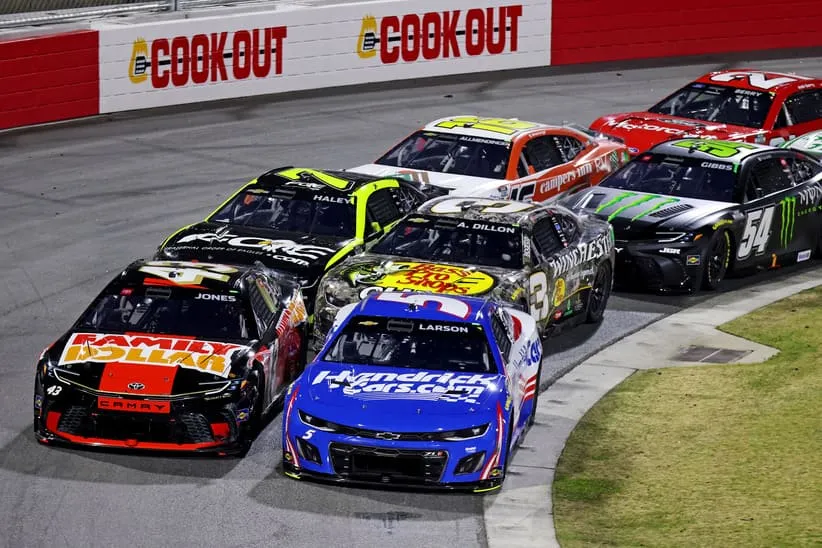
Miss the top‑20 cut, and you’re thrown into the Last Chance Qualifier. Only the top two finishers advance. Everyone else loads up and goes home. On a track as tight as Bowman Gray, the LCQ is going to be pure survival. Fast cars stuck in traffic, frustrated drivers fighting for inches, and no time to be patient.
It’ll likely be the most aggressive racing of the night. There is one final safety net: the 23rd and last starting spot goes to the highest driver in the 2025 points standings who hasn’t already qualified. It’s a lifeline for a big name, but nobody wants to rely on it.
What This Means for the Season Opener
This isn’t just a schedule change as it alters the event’s entire mindset. Normally, drivers have hours to reset between sessions. Now, everything happens back‑to‑back. A driver could struggle in practice, scrape into the LCQ, survive it, and then have to race for the win all within a few hours.
It’s a test of execution and composure. There’s no time for major repairs. No time to rethink strategy. Teams will be patching cars together and hoping nothing breaks. Fatigue will creep in. Tempers will flare. And at Bowman Gray, where contact is part of the culture, that’s a recipe for a wild night.
What’s Next
The Cook Out Clash was already set up to be a spectacle. Bowman Gray guarantees that. But the weather has turned it into something else entirely a one‑day survival test where every mistake is magnified.