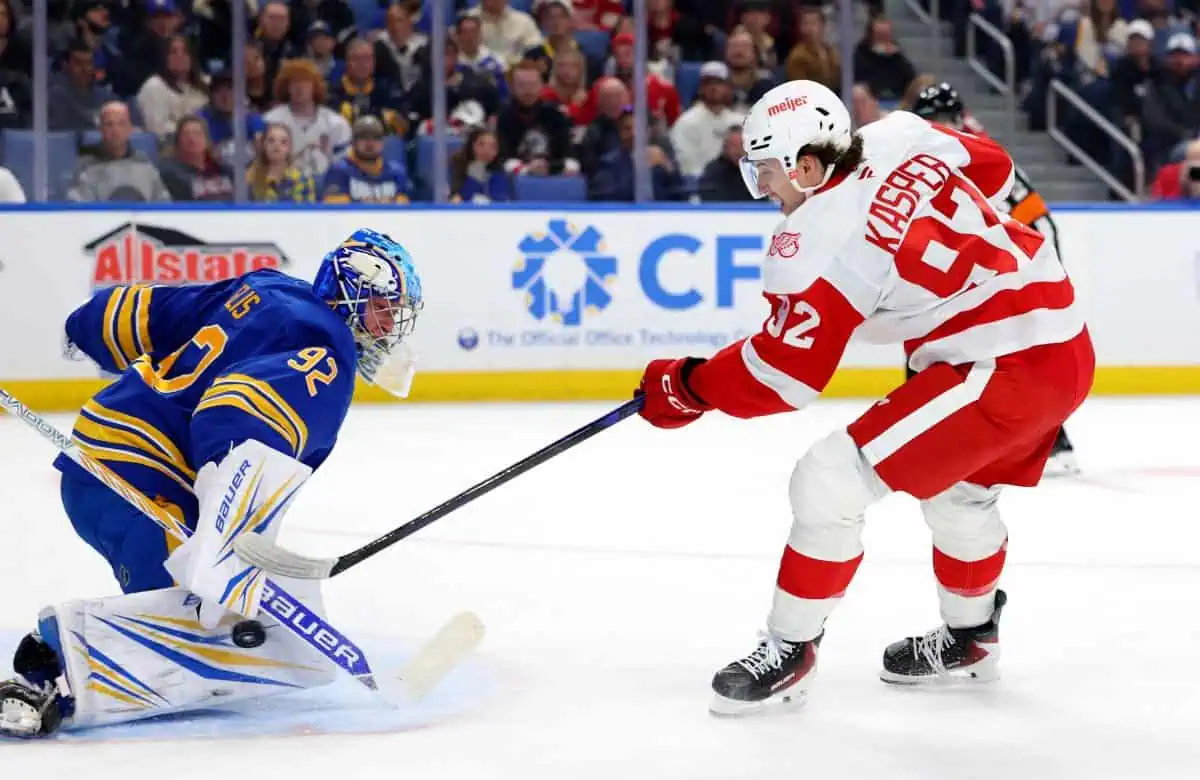
Detroit Red Wings Head Coach Reveals Soft-Benching Of Star Player In Last Night’s Loss

The Detroit Red Wings’ five-game winning streak came to a halt with a disappointing 4-2 loss to the Buffalo Sabres, but the final score wasn’t the only story grabbing headlines. In a move that sent a clear message to his locker room, head coach Todd McLellan made a significant in-game adjustment, removing struggling forward Marco Kasper from the top power play unit. This decision highlights a coach’s demand for accountability and raises questions about a young player’s role on a team with rising expectations.
Detroit Red Wings Marco Kasper: A Mid-Game Demotion
During the loss to the Sabres, fans watching closely noticed a change on the man advantage. Jonatan Berggren was taking reps with the first power play unit, a spot that had been occupied by Marco Kasper. A coach shuffling lines during a game isn’t unusual, but McLellan’s post-game comments left no room for interpretation. The move was a direct response to one player’s poor performance and another’s strong play.
When asked about the change, McLellan was blunt. “I changed them,” he stated. “I didn’t think Kasp played anywhere near what he’s capable of playing, and we’ll talk about it tomorrow, but I thought Berggy had a good night.”
This public accountability is a hallmark of McLellan’s coaching style. It serves as a direct message not only to Kasper but to the entire roster: ice time, especially on special teams, is earned, not given. For Kasper, a former first-round pick, the demotion was a clear wake-up call. He finished the game with 14:21 of ice time but was a minus-2, continuing a difficult start to his sophomore season.
Kasper’s Sophomore Slump
Drafted eighth overall in the 2022 NHL Draft, Marco Kasper carries the weight of high expectations. After a promising first full season where he recorded 19 goals and 18 assists for 37 points, the hope was that he would take another step forward this year. However, through the first seven games of the 2025-26 season, Kasper has struggled to find his rhythm, managing only one goal and often looking out of sync.
The power play is where a player with Kasper’s skill set is expected to make a significant impact. His removal from that unit underscores his inability to generate offense and contribute effectively with the man advantage. While it’s still early in the season, this slump is concerning for a player ticketed to be a key part of Detroit’s young core. The benching is the first tangible consequence of these struggles, and it puts pressure on the young forward to elevate his game quickly.
McLellan’s Demand for Higher Standards
This isn’t the first time Coach McLellan has publicly challenged his team’s performance this season. Following their season-opening loss to the Toronto Maple Leafs, he was openly critical of the team’s effort and lack of focus. He spoke about asking some of the veteran players if they were “tired of this yet,” referring to the culture of accepting sloppy play.
That message seemed to resonate, as the Red Wings immediately rattled off five consecutive wins. McLellan’s decision to single out Kasper after the loss to Buffalo is a continuation of that theme. He is working to instill a culture where mediocrity is not accepted and where every player, regardless of draft status or potential, is held to the same high standard of performance.
The coach’s frustration wasn’t just with Kasper but with the team’s overall readiness against the Sabres. The Red Wings were outshot 11-5 in the first period and took two early penalties, allowing Buffalo to dictate the pace from the start. “I don’t think we were prepared for the pace that the game was played at,” McLellan said. Veteran forward J.T. Compher echoed that sentiment, calling the start “not good enough.” By making a visible change like removing Kasper from a key role, McLellan is demonstrating that there are immediate consequences for not meeting the team’s standards.
What’s Next for Marco Kasper and the Red Wings?
The immediate future for Marco Kasper is clear: he needs to respond. The demotion is a test of his professional maturity. Coaches often use these moments to see how a young player handles adversity. Will he pout and let his struggles compound, or will he take the message to heart, simplify his game, and work his way back into a prominent role? His performance in the coming games will be under a microscope.
For the Red Wings, this move reinforces the team’s internal competition. Jonatan Berggren earned his opportunity with a strong performance, and players like him will continue to push for more ice time. This competition is healthy for a team looking to transition from a rebuilding phase to being a consistent playoff contender.
As the Detroit Red Wings prepare for their next game against the New York Islanders, all eyes will be on the lineup sheet and the power play units. The benching is more than just a line change; it’s a statement about the direction the franchise is heading. It’s a message that accountability is paramount, and for a team that wants to win, every shift matters.