
Valentina Shevchenko Fires Back: Why Khabib’s Take on Women in MMA Completely Misses the Mark

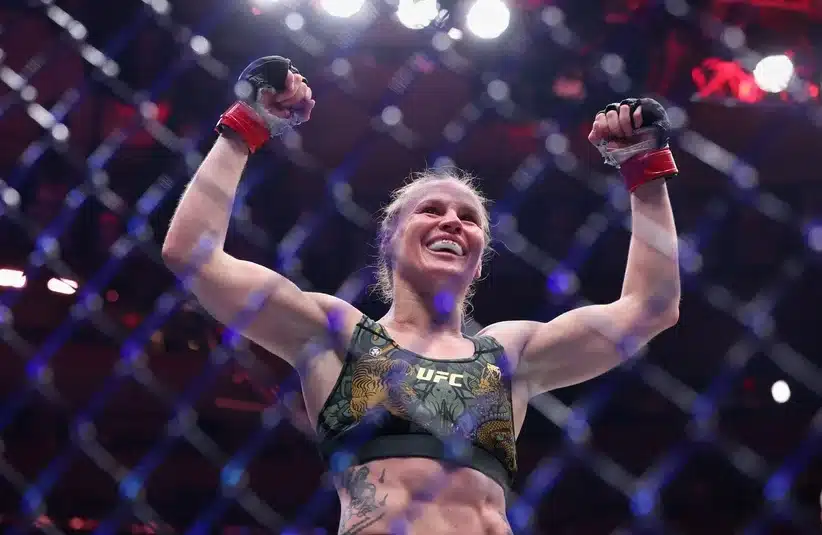
The fight game is not for the faint of heart. It demands your blood, your sweat, your tears, and occasionally, your consciousness. It doesn’t care where you come from, what your background is, or what gender you happen to be. The canvas feels the same when you hit it. Yet, the mixed martial arts world recently found itself wrapped up in a debate that feels like it belongs in a different century.
Khabib Nurmagomedov, an absolute legend of the sport and arguably the greatest lightweight to ever lace up the four-ounce gloves, made some headlines recently. And not the good kind. At a public forum, “The Eagle” essentially suggested that women shouldn’t be competing in MMA, tossing out the word “weak” to describe female fighters.
Enter Valentina Shevchenko. If you know anything about the former UFC women’s flyweight champion, you know she doesn’t back down from a fight—whether that’s inside the octagon against a world-class striker or at a press conference defending her entire livelihood. Shevchenko caught wind of these comments, and her response was exactly what you’d expect from one of the most decorated martial artists on the planet: sharp, technical, and devastatingly accurate.
The Spark: What Khabib Said About Women In MMA
To understand the friction here, you have to look at the context. Khabib operates from a deeply traditional, cultural mindset. His grappling-heavy, smash-everything-in-sight style inside the cage was built in the rugged mountains of Dagestan. He’s an icon. But when he suggested that women belong outside the cage because they are somehow too “weak” for the brutality of the sport, he alienated a massive chunk of the MMA community.
Fans, analysts, and fellow fighters collectively raised an eyebrow. Are we really doing this right now? Are we really pretending that women haven’t been carrying some of the biggest pay-per-view cards of the last decade?
Shevchenko Steps Into the Verbal Octagon
Valentina Shevchenko wasn’t about to let that slide. When she took to interviews and social media to respond, she didn’t just defend herself; she defended every woman who has ever wrapped their hands and walked down that tunnel.
Shevchenko made it abundantly clear: there is absolutely nothing “weak” about the women’s roster. Female fighters endure the same grueling, soul-stealing training camps as the men.
They blow out their knees, they cut agonizing amounts of weight, and they step into a locked cage to trade elbows with trained killers. Shevchenko rightly pointed out that in the fight game, mental toughness and technical discipline reign supreme. Gender has nothing to do with a perfectly executed spinning back kick to the liver.
Hearing Khabib call female fighters weak is incredibly ironic when you consider that Shevchenko is quite literally a master of sport in multiple disciplines. She has spent her entire life perfecting the art of combat. To dismiss that lifetime of dedication with a single, outdated adjective is a tough pill for the combat sports world to swallow.
The Reality Of the Grind: Why “Weak” Just Doesn’t Fly
If you’ve ever watched Shevchenko dismantle an opponent, “weak” is the absolute last word that comes to mind. Women’s MMA didn’t just arrive overnight. It was built on the backs of pioneers who had to kick the doors off the hinges just to get a spot on the preliminary cards.
We watched Ronda Rousey become a global superstar. We watched Amanda Nunes become a terrifying double-champ who hit like a freight train. And we watched Shevchenko put on striking clinics that left audiences absolutely speechless.
These athletes draw millions of eyeballs and generate massive revenue. They bleed, they break bones, and they deliver some of the most technical and savage performances in modern sports history. The cultural divide might still exist in some corners of the world, but the reality of the sport has long since moved past the idea that women can’t hold their own.
FAQ SECTION
Q: What did Khabib Nurmagomedov say about women in MMA?
A: He suggested women are “weak” and should not compete in mixed martial arts.
Q: How did Valentina Shevchenko respond?
A: She strongly rejected his comments, stating that women have proven themselves in MMA and are not weak.
Q: Why is this news important?
A: It highlights ongoing debates about gender equality in sports and the influence of high-profile athletes on public perception.
Q: What are the next steps?
A: The conversation will likely continue as women’s MMA grows, with more fighters and fans pushing back against dismissive attitudes.
What This Means For the Future Of Women’s MMA
The immediate impact of this back-and-forth is actually a net positive for women’s combat sports. Why? Because it gave fighters like Shevchenko a platform to remind the world exactly who they are. Her vocal pushback drew a line in the sand, giving other female athletes a powerful voice to rally behind.
As we look ahead, the women’s divisions in the UFC are only getting deeper. Rising stars are pushing the pace, the technique is evolving rapidly, and the fan base is hungrier than ever for high-stakes matchups. Nurmagomedov is entitled to his opinions, born from his own cultural background, but the sport of MMA is a global juggernaut that waits for no one.
