Steve O’Donnell: NASCAR Must “Get the Garage Back” After Chase Format’s Return

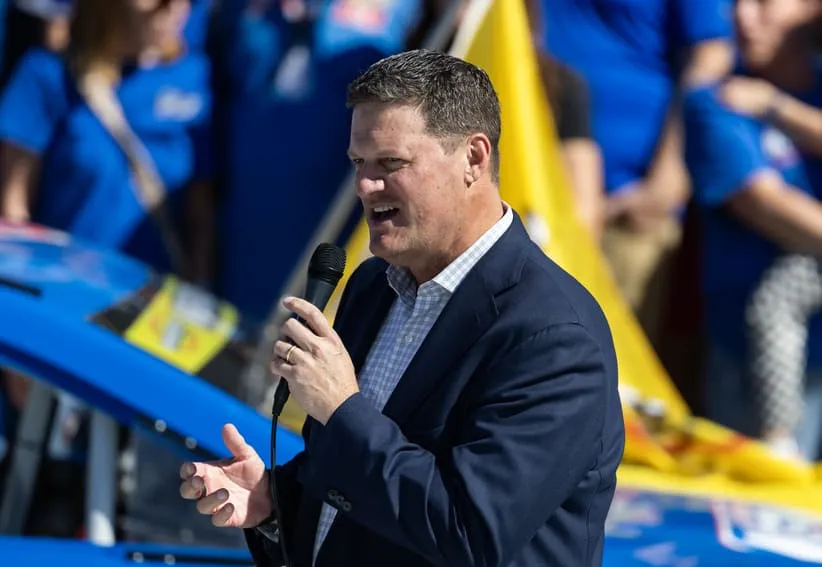
Anyone who has walked through a NASCAR garage over the past two seasons has felt the shift, including NASCAR president Steve O’Donnell. The usual rhythm of crews hustling, engines firing, and radios crackling has been overshadowed by tension, and it’s not going anywhere anytime soon. So, what sparked this controversy?
Between the charter dispute, the antitrust lawsuit, and a playoff format that left fans arguing more than cheering, the sport has been carrying a noticeable weight. That’s why Monday’s announcement landed with such significance. NASCAR is retiring the elimination-style playoff system in 2026, ending a format that has defined the championship since 2014.
Over those 12 seasons, the “win-and-advance” model produced dramatic finales but also created statistical oddities, including champions who ranked outside the top five in average finish or laps led. The return of the Chase marks a philosophical reset, and perhaps more importantly, a recognition that the sport’s foundation has to be stronger than a single high-stakes race.
O’Donnell made it clear in a conversation with Racer.com that this isn’t a cosmetic change. He didn’t pretend that swapping formats would erase the fallout from the charter negotiations or the lawsuit filed by 23XI Racing and Front Row Motorsports. Instead, he acknowledged the deeper fractures.
O’Donnell and the Weight of Expectation
The push for change was fueled by fans who felt the championship no longer reflected season-long excellence. Joey Logano’s 2024 title run became the flashpoint. Despite finishing the year with only one win, seven top‑five finishes, and ranking ninth in average finish, he left Phoenix with the championship trophy.
The debate wasn’t about Logano’s talent. It was about whether the system rewarded the right things. O’Donnell, however, is focused on something even more fundamental: the people inside the garage. He recalled a conversation with Fox Sports executive Eric Shanks that stuck with him: “You guys need to get the garage back.” O’Donnell didn’t deflect. He agreed.
For a sanctioning body that often prefers to smooth over conflict, that honesty stands out. The charter dispute alone involved 15 team owners, representing roughly 80% of the Cup Series field, who publicly challenged NASCAR’s control over the sport’s economic structure.
That level of open resistance hadn’t been seen since the early 2000s.“We’ve got work to do on this,” O’Donnell said. “It’s not lost on any one of us at NASCAR… We’re going to work our a**es off for the industry to deliver to our race fans.”
The Nuts and Bolts: 2026 Rule Changes
Fastest Lap Integrity
Under the current system, a fastest lap point can swing a driver several positions in the standings. In 2024, for example, Christopher Bell earned 11 fastest-lap points, which moved him up two spots in the final regular-season standings. Starting in 2026, any car that heads to the garage for repairs will no longer be eligible for those bonus points. It’s a move aimed at eliminating loopholes and keeping the points system honest.
Lug Nut Enforcement
Loose wheels have been a recurring issue. In 2023 and 2024 combined, NASCAR issued over 40 penalties for improper wheel installation across the national series. The new rules in the O’Reilly Auto Parts and Truck Series are blunt:
- One loose nut: Loss of pit selection
- Two loose nuts: Fines ($5,000 in O’Reilly, $2,500 in Trucks) and potential crew member suspension
- Four loose nuts: Immediate disqualification
RAM’s Arrival and Field Expansion
RAM’s entry into the Cup Series marks the first new manufacturer since Toyota joined in 2007. To help the new OEM get its footing, NASCAR is adding four provisional spots for the first three races of 2026. These entries will start 37th through 40th, based on speed, and while they won’t be eligible for purse money immediately, they can earn championship points. It’s a measured way to grow the field without destabilizing the charter system.
A Youth Movement on Short Tracks
NASCAR is also opening the door for younger talent. The age limit for the O’Reilly Auto Parts series is dropping to 17 for tracks 1.25 miles or shorter. That change mirrors the developmental path of drivers like William Byron, who reached the Cup Series at 20, and Kyle Larson, who debuted at 21. Earlier exposure to heavier cars could accelerate the next wave of elite drivers.
What This Means for the Sport
Consistency Regains Value
Under the elimination format, a driver could dominate the season and still lose the title due to one bad race. In 2020, Kevin Harvick won nine races and still missed the Championship 4. The Chase rewards sustained excellence over a 10‑race stretch, restoring balance between consistency and performance.
A Step Toward Reconciliation and Clearer Competitive Boundaries
O’Donnell’s acknowledgment that NASCAR needs to “get the garage back” is a clear sign that the organization wants to move past the combative tone of recent years. Collaboration, not confrontation, is the new priority. The stricter pit road and fastest-lap rules remove ambiguity. Teams know exactly where the lines are and what happens if they cross them.
What’s Next
NASCAR is trying to reset its compass. After years of chasing dramatic finales and headline-grabbing formats, the sport is steering back toward the fundamentals that built its identity. The 2026 season feels like a nod to tradition and a recognition that the garage, the people, the relationships, and the trust are the heart of the sport.
The Chase won’t fix every issue overnight. It won’t erase the tension of the past few years or instantly elevate the on-track product. But acknowledging the problem is the first real step toward solving it. O’Donnell and his team say they’re ready to put in the work. Now the industry waits to see whether the racing and the unity follow.