Kevin Patullo Reflects on Week 7 Vikings Game

Look, we’ve all watched enough football to know that the best-laid plans can crumble faster than a wet paper bag in a rainstorm. But what happened in Minneapolis on October 19? That was something different. The Eagles walked into U.S. Bank Stadium with a clear identity: run the ball, control the clock, impose your will, and then did something that would make most coaches break out in hives: they pivoted. Hard.
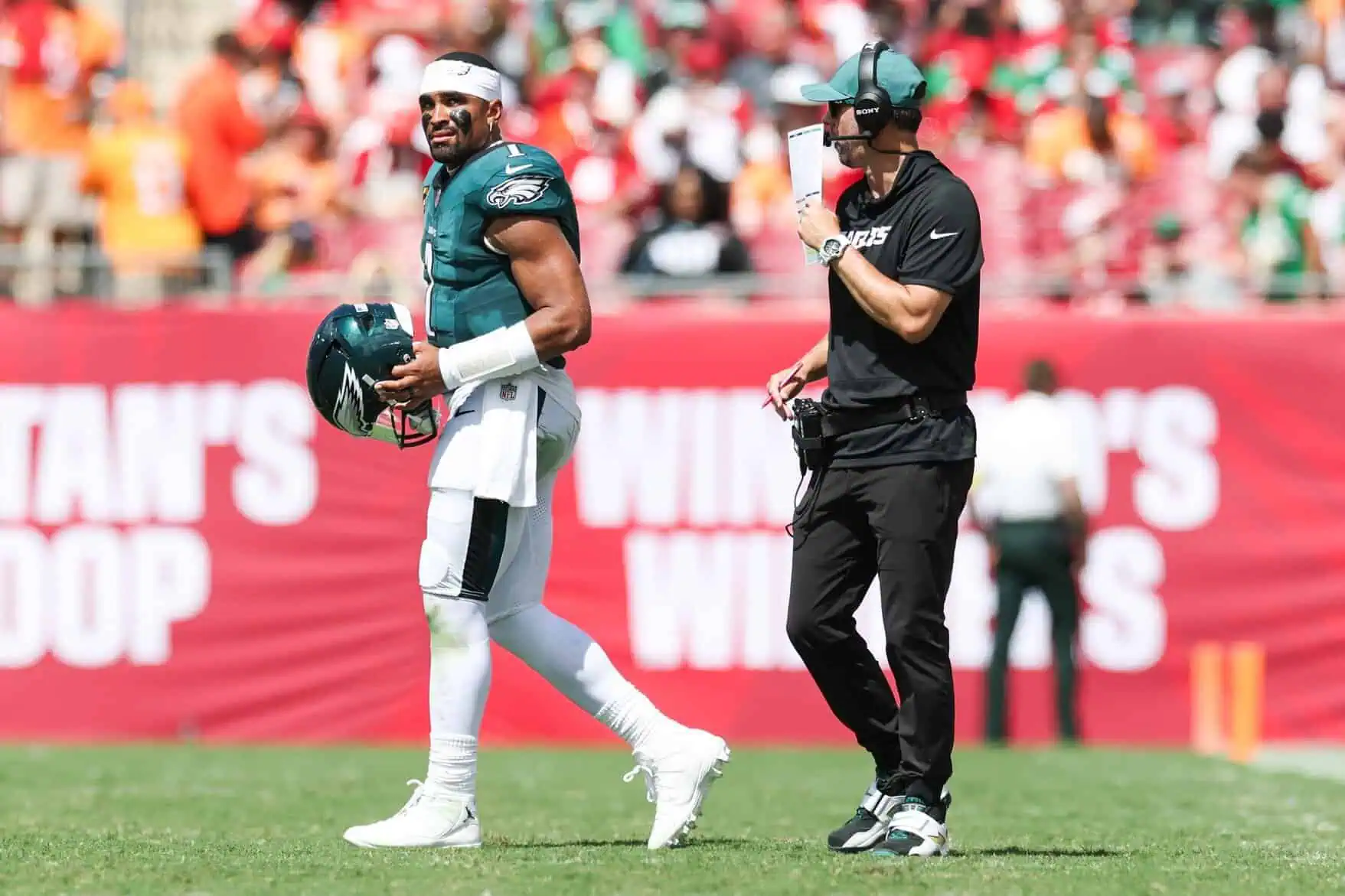
Kevin Patullo’s offense came alive in a way we hadn’t seen all season, and suddenly Jalen Hurts looked like the guy who once finished second in MVP voting. The Birds beat the Vikings 28-22, with Hurts posting a perfect 158.3 passer rating (yes, you read that right—perfect). DeVonta Smith went nuclear for a career-high 183 yards. A.J. Brown added 121 and two scores. And the ground game that was supposed to be the star of the show? A modest 45 yards that somehow set up everything else.
Sometimes football’s beautiful chaos works exactly as it should.
Patullo’s Poker Face: Setting the Table Before Dealing the Cards
Here’s where it gets interesting. Patullo, the first-year offensive coordinator who inherited an offense that desperately needed an identity after last season’s playoff flameout, didn’t panic when the run game stalled. Instead, he leaned into what he’d been preaching all week: patience, recognition, and trust.
“Going into a game, you have the game plan … Sometimes you have to be patient for it and wait for the right opportunities, and I think that’s what presented itself in the game,” Patullo explained on Tuesday, probably while the rest of us were still processing what we’d witnessed.
The early-down runs weren’t working statistically, Saquon Barkley managed just 44 yards on 18 carries—but they were doing something more important: they were setting up Minnesota’s defense for the kill shot. The Vikings started dropping eight defenders to stop the pass, which is basically NFL shorthand for “we’re terrified of your receivers and don’t think you can hurt us on the ground.”
Bad bet.
The Smith Special: When Lobbying Actually Works
Let’s talk about that 79-yard touchdown to DeVonta Smith, because it’s the perfect encapsulation of what Patullo’s trying to build. This wasn’t some desperation heave or busted coverage gift. This was a play that Smith had been campaigning for since Wednesday’s practice, a traditional play-action hook with max protection that he knew would torch former Alabama teammate Isaiah Rodgers.
Chirping. That’s the technical term for a receiver basically telling his coordinator, “Trust me, I’ve got this guy.” And to Patullo’s credit, he listened. The play was installed Wednesday, refined through practice, and then held in reserve until halftime discussions confirmed the Vikings were giving them exactly what Smith predicted.
When the moment arrived, Rodgers bit on Smith’s double move like a hungry bass on a shiny lure, and suddenly Smith was gone, 79 yards of vindication sprinting into the end zone.
The IQ Test: Why Smart Players Make Coordinators Look Brilliant
Here’s what separates great offenses from merely good ones: football intelligence. Patullo didn’t just stumble into success against Minnesota; he orchestrated it with players who understand not just their assignments, but the entire chess match happening around them.
“What’s great about our team is their football IQs are so high, so when I asked them a question like, ‘Hey, can you run what I need you to run here, what’s his leverage?’ The guys are really good about identifying what they’re seeing and telling me,” Patullo said.
Translation: His receivers aren’t just running routes. They’re reading defenses in real-time and communicating adjustments that turn good plays into explosive ones. It’s the difference between following a recipe and understanding why the ingredients work together.
Even veteran center Landon Dickerson was in on the plan, knowing protection schemes before the ball was snapped. When everyone from the offensive line to the skill positions understands not just the “what” but the “why,” you get plays like that third-and-9 dagger Hurts dropped to Brown with 1:45 left—a 45-yard beauty that sealed the game.
“When you have guys like Jalen and A.J. … they can accelerate that and really foresee what’s going to happen,” Patullo noted. “To make a play like that work in those moments … shows how poised they were.”
The Barkley Paradox: When 44 Yards Tells Half the Story
Now, about Saquon Barkley’s stat line. On paper, 44 yards on 18 carries looks pedestrian at best, concerning at worst. But context matters, and Patullo was quick to defend his running back’s performance with logic that actually makes sense.
“Late in the games in the fourth quarters, we’ve had a few four-minute drives … Statistically they’re probably going to go down just because of what we’re trying to do with the clock,” he explained.
Fair point. When you’re nursing a lead and prioritizing clock management over chunk plays, yards-per-carry becomes a misleading metric. Plus, center Cam Jurgens left with a back injury in the first half, forcing backup Brett Toth into action, never ideal when you’re trying to establish physicality up front.
The real question isn’t whether Barkley had a great statistical day (he didn’t). It’s whether his early-down carries created the opportunities for Hurts, Smith, and Brown to destroy Minnesota’s secondary. And on that front? Mission accomplished.
The Real Takeaway: Flexibility Is the New Power
What happened in Minneapolis wasn’t just about explosive plays or perfect passer ratings. It was about an offensive coordinator who came in with a plan, recognized when that plan needed adjusting, and had the players and the guts to make those adjustments work.
Patullo’s offense isn’t trying to be the 2017 Eagles or the 2022 Eagles or any other previous iteration. It’s trying to be adaptable, intelligent, and situationally aware. Some weeks, that means feeding Barkley 30 times. Other weeks, it means letting Hurts cook with two elite receivers who can win one-on-one matchups.
The scary part for the rest of the NFC? This is still a work in progress. If Patullo can keep building this kind of communication and trust, where receivers are lobbying for specific plays and quarterbacks are making split-second reads that turn broken plays into touchdowns, this offense has a ceiling we haven’t seen yet.
For now, though, Eagles fans can enjoy watching their team remember how to play complementary football. The defense creates turnovers and forces field goals. The offense capitalizes on explosive plays. And the coaching staff—from Patullo to Fangio to Nick Sirianni, stays patient enough to let the game come to them.
Revolutionary? No. Effective? Absolutely.
And sometimes in the NFL, effective beats revolutionary every single time.