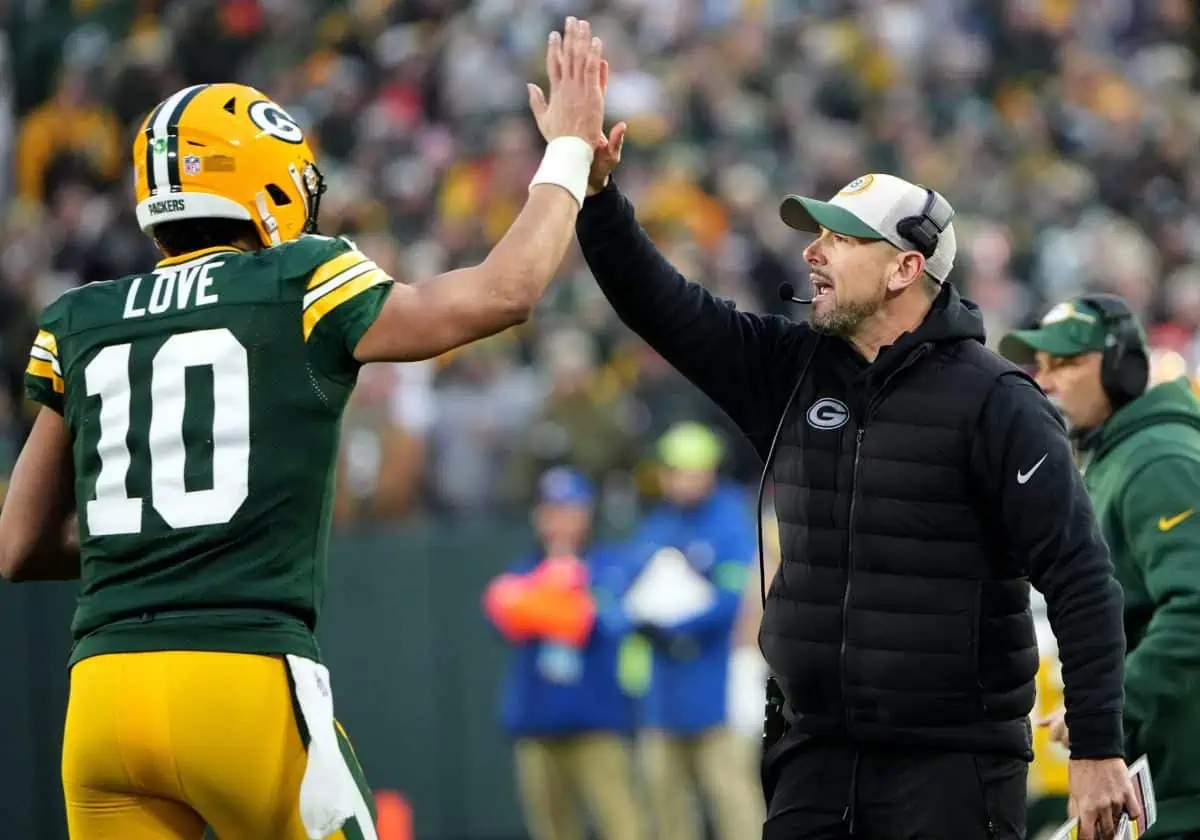
Matt LaFleur Is Looking For Answers On Why The Green Bay Packers Defense Struggles After Halftime

The Green Bay Packers have looked like two completely different teams this season, often within the same game. For three quarters, their defense resembles a championship-caliber unit capable of shutting down any opponent. But when the fourth quarter begins, a troubling pattern has emerged, turning dominant performances into nail-biting finishes. This stark contrast has not gone unnoticed by the coaching staff.
Head coach Matt LaFleur and defensive coordinator Jeff Hafley are now focused on diagnosing and fixing the team’s late-game collapses. This article will break down the perplexing Packers fourth quarter defense struggles, contrasting their first-half dominance with their late-game collapses, and explore the potential causes and solutions being brainstormed by the coaching staff.
Green Bay Packers Matt LaFleur Trying To Solve Inconsistencies
To understand the frustration in Green Bay, you only need to look at the scoring differential by quarter. Through the first five games of the season, the Packers have been a juggernaut in the first half. They have outscored their opponents by a staggering 57-22 before halftime, including a remarkable 24-0 differential in the first quarter alone. This dominance is a testament to the talent on the defensive side of the ball and Hafley’s game planning. The defense starts games fast, aggressive, and fundamentally sound, looking every bit like one of the league’s elite units.
However, the second half tells a completely different story. While the Packers have played opponents to a draw in the third quarter, the fourth quarter has been an outright disaster. In the final 15 minutes of games, the Packers have been outscored 60-54. To put that in perspective, they have allowed more points in the fourth quarter (60) than they have in the first three quarters combined (39). This late-game bleeding has turned potential blowouts into uncomfortably close contests.
Pinpointing the Fourth-Quarter Problems
The issue has been particularly glaring in the last two games. Against the Cincinnati Bengals and Dallas Cowboys, the Packers’ defense seemed to fall apart after halftime. In nine combined second-half defensive series across those two games, Green Bay allowed opponents to have eight scoring chances, resulting in five touchdowns. This trend of giving up chunk plays and failing to get off the field late in games is the primary concern LaFleur and Hafley are trying to address.
LaFleur openly discussed the coaching staff’s deep dive into the problem. “That’s something Haf and I were kind of, like, just nitpicking,” he said. “Like, why is it happening?”
The coaching staff is exploring several potential reasons for the Packers fourth quarter defense struggles:
- Conditioning and Fatigue: Are the players running out of gas? LaFleur questioned whether the team is well-conditioned enough or if long offensive drives by the opponent are tiring out the defense. Against the Bengals, a single drive ate up nearly 10 minutes of the clock. “Does that gas you out? Does that make you more tired? Do we need to roll more guys in the first half?” LaFleur pondered.
- Lack of Takeaways: After emphasizing turnovers all offseason, the Packers have been shockingly ineffective at taking the ball away. They currently rank 31st in the NFL with only two takeaways and have not forced a single fumble. Takeaways are often drive-killers and momentum-shifters, and their absence is putting more pressure on the defense to be perfect on every snap.
- Offensive Adjustments by Opponents: Teams are adapting their game plans to neutralize the Packers’ ferocious pass rush, led by Micah Parsons. After Green Bay recorded eight sacks in the first two games, opponents have shifted to a quick-passing attack. Quarterbacks are getting the ball out of their hands almost immediately with screens and short routes, and they are using double-teams and chip blocks on obvious passing downs. “That’s just going to be the way it is, I think, for a while,” LaFleur admitted.
Brainstorming Solutions for a Stronger Finish
There is no single, easy answer to fix the Packers’ fourth-quarter woes. LaFleur and Hafley are collaborating to find solutions that will help the defense maintain its high level of play for a full 60 minutes.
One potential solution is to be more strategic with player rotations. If fatigue is a legitimate factor, getting backups more snaps in the first half—even when the defense is rolling—could help keep the starters fresh for the critical moments of the fourth quarter. This requires a delicate balance, as coaches are often hesitant to take their best players off the field.
Another point of emphasis will be adjusting to the quick-passing game. While the pass rush is the strength of the defense, the secondary and linebackers must be more aggressive in challenging short routes and tackling securely in space. This may involve playing more press-man coverage to disrupt the timing of quick throws or designing blitz packages that can get home before the quarterback releases the ball.
Finally, the defense needs to rediscover its knack for creating turnovers. While takeaways can be unpredictable, a renewed focus on stripping the ball and jumping routes could help generate the game-changing plays that have been missing.
The Packers are not in crisis mode yet, but the fourth-quarter defensive trend is a significant concern for a team with Super Bowl aspirations. The talent is clearly there, as evidenced by their first-half dominance. Now, the challenge for LaFleur and Hafley is to solve this perplexing puzzle and build a defense that can close out games as emphatically as it starts them. The success of their season may depend on it.