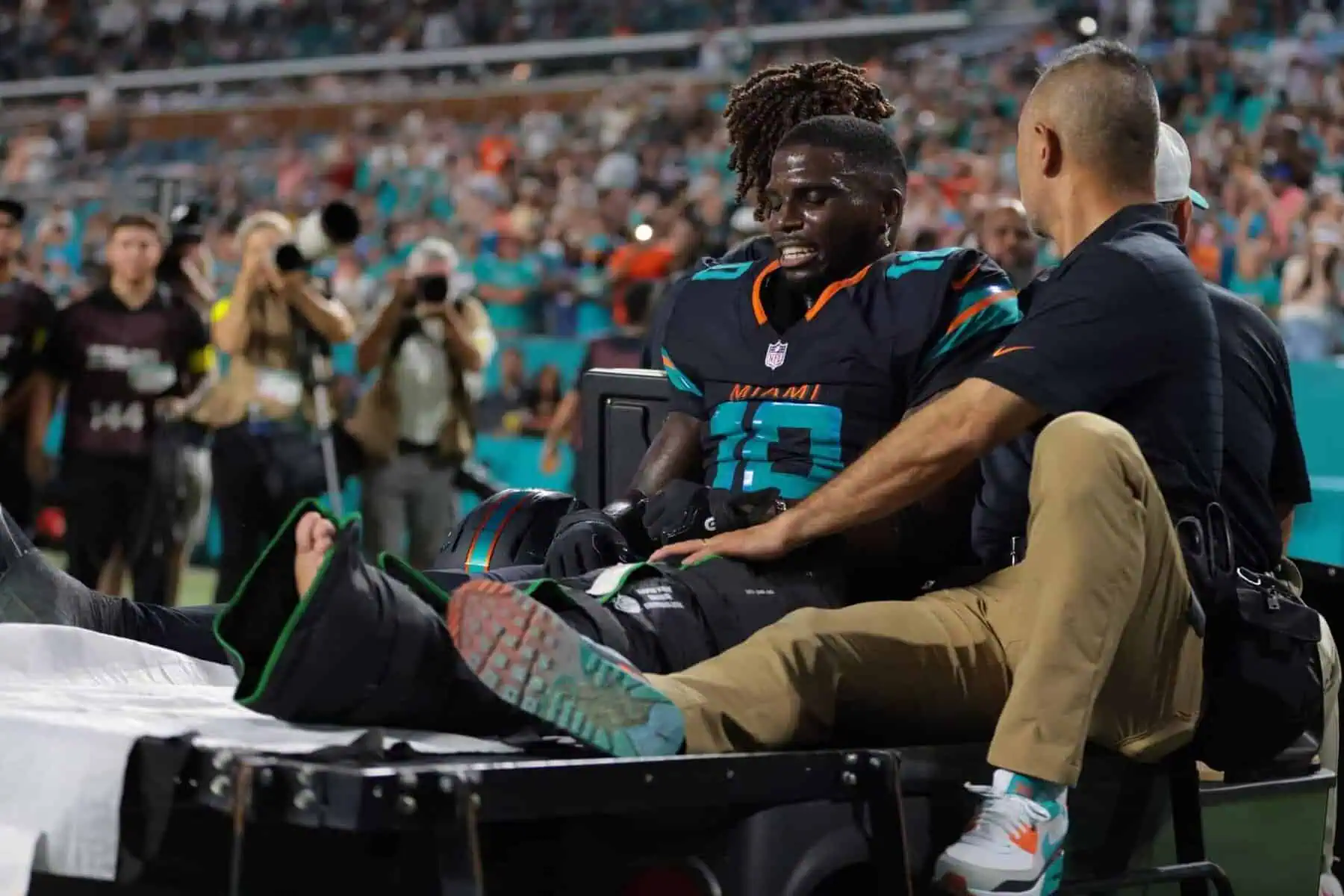
Tyreek Hill’s Season-Ending Knee Injury: What This Means For the Miami Dolphins’ Championship Dreams

The football gods can be cruel, but Monday night’s injury to Tyreek Hill felt particularly heartless. One moment, the Dolphins’ speedster was hauling in a routine 10-yard pass from Tua Tagovailoa. The next, he was writhing on the turf with his left leg twisted at an angle that would make a yoga instructor wince.
The initial diagnosis was sobering enough—a dislocated knee that sent Hill straight to the hospital. But Tuesday morning brought the news that fantasy football owners and Dolphins fans dreaded: Hill tore his ACL along with multiple other ligaments. His 2025 season is over, just four games in.
Hill’s Injury: More Serious Than It First Appeared
#Dolphins WR Tyreek Hill has torn multiple ligaments in his dislocated knee, including his ACL, ending his season and giving him a long road ahead for 2026, source says.
He’ll have surgery today to repair the significant injury. pic.twitter.com/N2OFR8UREX
— Ian Rapoport (@RapSheet) September 30, 2025
When you hear “dislocated knee,” your mind might wander to the garden-variety kneecap injuries that sideline players for a few weeks. But Hill’s injury is an entirely different beast. We’re talking about a knee dislocation—where the bones in the joint separate completely—not just a dislocated kneecap.
This type of injury typically involves damage to multiple structures within the knee. In Hill’s case, the ACL took the brunt of it, but other ligaments likely suffered collateral damage. It’s the kind of injury that makes grown men cry, and Hill’s reaction on the field—staying upbeat and cracking jokes while being carted off—spoke volumes about his character.
The 31-year-old receiver underwent surgery Tuesday, beginning what will undoubtedly be a long road back to the field. At his age, and with this type of extensive damage, questions about his future effectiveness are inevitable.
Miami’s Offensive Identity Takes a Major Hit
Let’s be real here—losing Hill is catastrophic for Miami’s offensive scheme. The man entered Monday night, leading the team with 198 receiving yards, and his mere presence on the field opens up opportunities for everyone else. Defensive coordinators have spent sleepless nights trying to figure out how to contain his game-breaking speed.
Now, the Dolphins must reimagine their entire offensive identity. Jaylen Waddle suddenly becomes the undisputed WR1, a role he’s more than capable of handling. But who fills the void left by Hill’s departure?
Second-year Receiver Malik Washington appears to be the prime candidate, having impressed during training camp when Hill was holding out. But asking a young player to replace one of the most dynamic receivers in NFL history is like asking a community theater actor to fill in for Robert De Niro.
The Silver Lining: Darren Waller’s Timely Return
If there’s a bright spot in this otherwise gloomy situation, it’s the timing of Darren Waller’s return. The veteran tight end made his season debut Monday night and looked like he’d never left, hauling in two touchdown passes in the victory over the Jets.
Waller’s presence gives Tagovailoa another reliable target, and his ability to stretch the seam and create mismatches in the middle of the field could help offset some of Hill’s lost production. Running back De’Von Achane has also emerged as a receiving threat, leading all NFL running backs in receptions and receiving yards since last season.
Championship Aspirations On Life Support?
The Dolphins entered 2025 with legitimate Super Bowl aspirations. A healthy Tagovailoa, an improved defense, and the Hill-Waddle receiving duo had many analysts picking Miami as a dark horse contender. But championship dreams often die in hospital beds, and Hill’s injury could be the dagger that ends Miami’s season before it truly begins.
Head Coach Mike McDaniel deserves credit for the way he’s handled the situation. His comments about Hill’s leadership in the moments after the injury—joking with teammates and demanding they “get this win”—paint a picture of a player whose influence extends far beyond the stat sheet.
The real test for Miami comes in the coming weeks. Can they maintain their offensive efficiency without their most dynamic playmaker? Can Waddle handle the increased attention from opposing defenses? Can the running game and tight end position pick up the slack?
The Long Road Ahead For Hill
For Hill personally, this injury represents a career crossroads. At 31, with significant knee damage, the question isn’t just when he’ll return—it’s whether he’ll ever be the same player who terrorized NFL secondaries with his blazing speed.
Modern medicine has made remarkable advances in ACL reconstruction, and plenty of players have returned from similar injuries. But Hill’s value has always been his ability to separate from defenders and create explosive plays downfield. If that elite speed is compromised, what kind of player does he become?
The Dolphins organization has shown faith in Hill, and his positive attitude throughout this ordeal suggests he’s not ready to hang up his cleats. But the reality is harsh: at his age, with this type of injury, the odds of returning to his previous level of dominance are slim.
Miami’s championship window may have just slammed shut, courtesy of one horrific tackle along the sideline. In a league where fortunes change in an instant, Hill’s injury serves as a cruel reminder that no team is ever more than one play away from heartbreak.