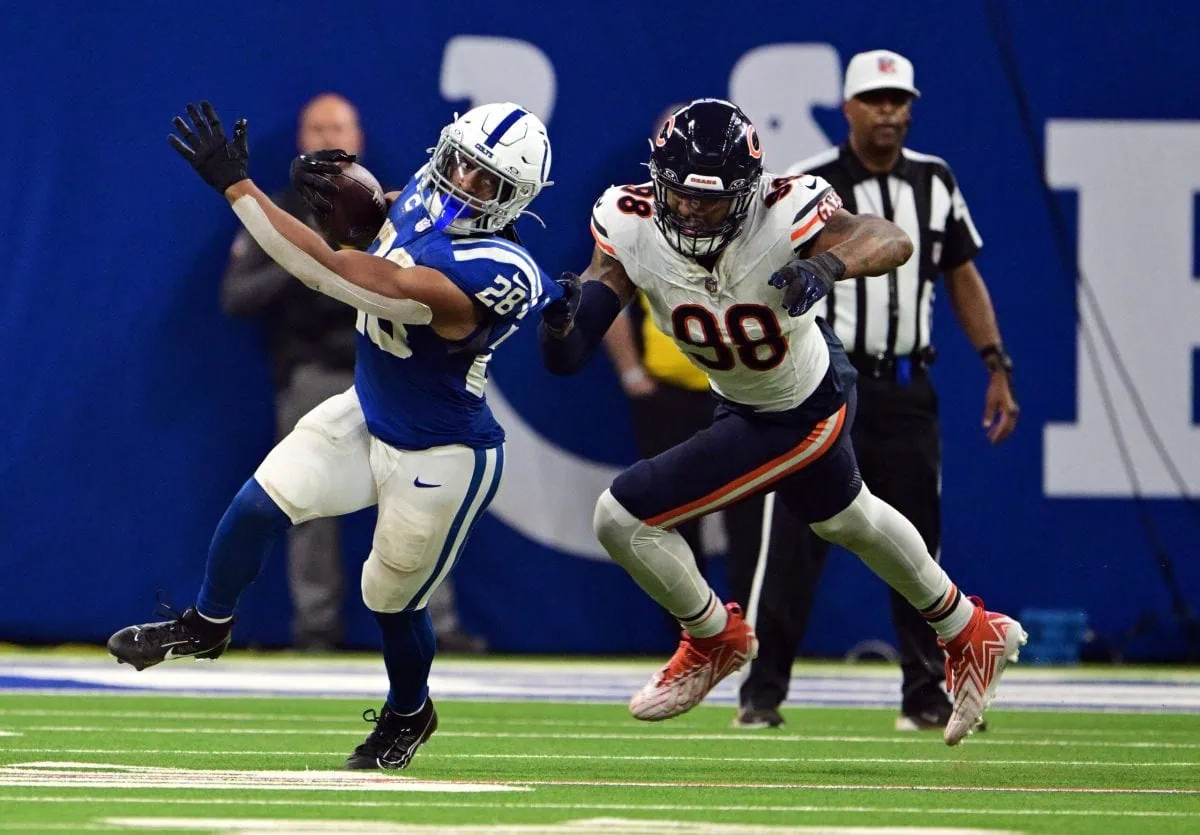
Chicago Bears Fans Concerned After Abysmal Preseason Outing From Montez Sweat

As the Chicago Bears wrap up their preseason preparations and look ahead to what many consider a pivotal 2025 season, a troubling pattern has emerged that threatens to undermine their defensive ambitions. Montez Sweat, the team’s $98 million pass-rushing cornerstone, has shown concerning signs that his struggles from 2024 may be carrying over into the new campaign.
The alarm bells grew louder following Chicago’s preseason finale against the Kansas City Chiefs, where Sweat and the Bears’ first-team defense failed to generate meaningful pressure against Patrick Mahomes and the Chiefs’ starting offense. The performance has raised uncomfortable questions about whether the Bears’ most expensive defensive investment can deliver the impact needed for their championship aspirations.
Chicago Bears Montez Sweat Struggles In Preseason Finale
Against Kansas City, the Bears’ starting defense managed just one quarterback hit and zero sacks while allowing the Chiefs to score on all three of their opening drives. The lackluster showing was particularly concerning given that it came against a Chiefs offensive line that underwent significant changes during the offseason.
“Where is the pass rush?” wondered Jacob Infante of Windy City Gridiron, capturing the frustration many observers felt watching the Bears’ inability to pressure Mahomes. The expensive edge-rushing tandem of Sweat and Dayo Odeyingbo struggled to create the kind of havoc that defensive coordinator Dennis Allen’s scheme demands.
The statistics tell a stark story: three Chiefs drives, three scores (two touchdowns and a field goal), and virtually no pressure from Chicago’s premier pass rusher. While preseason performances don’t always predict regular-season success, the lack of impact from Sweat was impossible to ignore.
The Weight of Expectations
Sweat’s current situation carries extra weight because of both his contract and his role within the defense. After arriving via trade from Washington in 2023 and immediately signing a four-year extension worth $98 million (with $72.9 million guaranteed), he became the undisputed centerpiece of Chicago’s defensive front.
His 2023 performance justified that investment, as he recorded a career-high 12.5 sacks and 72 pressures while helping transform the Bears’ pass rush. However, 2024 told a different story. Despite playing in 16 games, Sweat managed just 5.5 sacks as opposing teams focused their attention on neutralizing his impact.
The drop-off wasn’t entirely unexpected—elite pass rushers often face increased attention once they establish themselves—but the magnitude of the decline raised questions about Sweat’s ability to overcome schemes designed to limit his effectiveness.
The Allen Factor
The arrival of Dennis Allen as defensive coordinator brings both hope and additional pressure to Sweat’s situation. Allen, who previously coordinated successful defenses in New Orleans, has a track record of maximizing pass-rushing talent through creative schemes and personnel usage.
Head coach Ben Johnson has expressed confidence in Allen’s ability to unlock Sweat’s potential. “When he turns that thing on, he is hard in the pass-rush game,” Johnson said. “It’s hard to block him. You have to account for him. You move him around, right side, left side, makes it even more difficult because you’re looking to help your tackles out with some chips and some nudges, and if you don’t know where he’s going to be, then that makes it that much harder.”
Allen’s reputation for developing pass rushers and creating favorable matchups could be exactly what Sweat needs to return to his 2023 form. However, the coordinator’s system also places significant responsibility on star players to execute at a high level, meaning Sweat’s performance becomes even more critical to the defense’s overall success.
Depth Concerns Amplify the Issue
The Bears’ pass-rushing depth makes Sweat’s performance all the more crucial. Beyond the Sweat-Odeyingbo pairing, Chicago relies on a group that includes Austin Booker (currently dealing with an injury), Daniel Hardy, Dominique Robinson, and Tanoh Kpassagnon.
While this group has potential, none have established themselves as reliable complementary pass rushers capable of taking pressure off Sweat. Booker, a promising young player, is still developing, and the other veterans have shown flashes but lack consistency.
This depth situation means the Bears cannot afford for Sweat to have another down year. If he struggles to generate consistent pressure, opposing offenses will likely focus their attention on neutralizing Odeyingbo, leaving Chicago without a reliable pass-rushing threat.
The Broader Defensive Picture
Chicago’s defensive ambitions extend beyond just generating sacks. Allen’s system emphasizes creating turnovers and disrupting offensive timing through consistent pressure. When the pass rush struggles, as it did against Kansas City, it creates a ripple effect throughout the entire defense.
Secondary players find themselves in coverage longer, linebackers face additional responsibilities in coverage, and the overall defensive structure becomes more vulnerable to big plays. The Chiefs’ perfect offensive execution in their three scoring drives demonstrated exactly how problematic a lack of pass rush can be.
Bears Wire’s Alyssa Barbieri captured the urgency of the situation: “The Bears have a huge problem with their pass rush, which was nonexistent against the Chiefs and made life easy on Patrick Mahomes behind a revamped offensive line. Dennis Allen needs to find a way to get something out of this pass rush.”
Looking for Solutions
Allen and the coaching staff have several options for addressing the pass-rushing concerns. Moving Sweat around the formation, as Johnson mentioned, could create more favorable matchups and prevent offenses from consistently chipping him with running backs or tight ends.
The Bears could also explore more creative blitz packages, using linebackers and defensive backs to create confusion and free up Sweat for one-on-one opportunities. Allen’s background includes extensive experience with such schemes, and his ability to adapt could prove crucial.
Additionally, the development of complementary pass rushers becomes essential. If Booker can return healthy and contribute immediately, or if players like Robinson can take a step forward, it would prevent opponents from focusing entirely on Sweat.
The Stakes for 2025
The Chicago Bears’ defensive success in 2025 will largely hinge on Sweat’s ability to bounce back from his 2024 struggles and justify his substantial contract. With expectations high for the franchise’s overall performance, having a pass rush that opponents can largely ignore would severely limit Chicago’s ceiling.
The preseason finale against Kansas City serves as both a warning and an opportunity. While the performance was concerning, it also provided Allen and the coaching staff with clear evidence of areas needing immediate attention before Week 1.
For Sweat personally, the 2025 season represents a crucial juncture in his career. At 28 years old and in the prime of his career, he needs to prove that 2024 was an aberration rather than the beginning of a decline. The Bears’ championship aspirations may well depend on his ability to do exactly that.
As Chicago prepares for the regular season, all eyes will be on whether Sweat can rediscover the form that made him one of the league’s most feared pass rushers. The $98 million question facing the Bears is whether their defensive cornerstone can rise to meet the moment when it matters most.