
Mirra Andreeva’s “Neutrality” Questioned After Receiving Award From Vladmir Putin

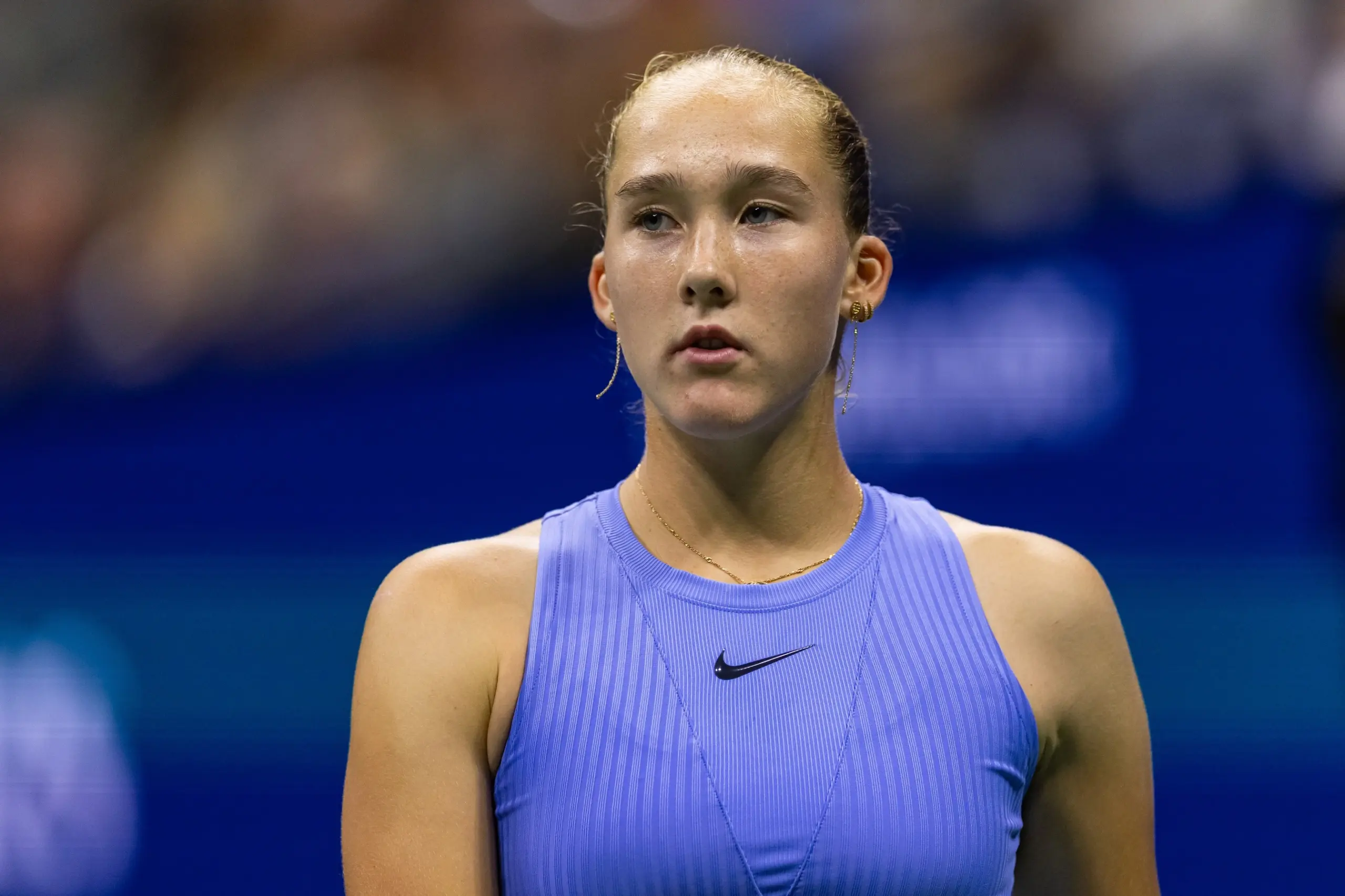
The world of professional tennis often feels like a bubble, insulated from the gritty realities of global politics. Players chase fuzzy yellow balls, fans cheer, and the biggest controversy is usually a line call or a smashed racket. But every now and then, the real world barges in, and things get uncomfortably real. This time, the spotlight is on Russian tennis prodigy Mirra Andreeva and her compatriot Diana Shnaider, and it’s not for their on-court heroics.
Ukrainian player Oleksandra Oliynykova has thrown a verbal grenade into the mix, questioning the “neutral” status of Russian players like Andreeva. Her argument? It’s a little hard to swallow the whole “neutrality” thing when players are accepting awards from Vladimir Putin, the very man orchestrating a brutal war. It’s a fair point, isn’t it? Like claiming you’re a vegetarian while publicly accepting a “Steak-Lover of the Year” trophy from the local butcher.
Oliynykova, who has been grinding on the tour and recently broke into the Top 100, didn’t mince words. She feels that simply removing a flag from next to a player’s name is a superficial gesture that does little to address the core issue.
“The neutrality should be tested. Many support the war. For some, not having a flag is enough, but it’s not,” the Ukrainian stated, making it clear that the current measures feel like a flimsy band-aid on a gaping wound.
Are Andreeva and Shnaider Truly Neutral?
This is the million-dollar question. Oliynykova directly called out Mirra Andreeva and Diana Shnaider, pointing to the awards they received from Putin as a glaring contradiction to their supposed neutrality. The two players were reportedly honored with the Order of Merit for their contributions to sports in Russia.
“Andreeva and Shnaider received prizes from Putin. We have to talk more about this. It’s a big problem because they have global recognition while supporting the Russian government,” she added.
You have to see her point. On one hand, you have players competing under a white flag, a symbol meant to detach them from the actions of their government. On the other, they’re shaking hands and accepting accolades from the head of that same government. It creates a cognitive dissonance that’s hard to ignore. For players like Oliynykova, whose home country is under daily assault, seeing Andreeva and others receive such honors must feel like a slap in the face. It’s a stark reminder that while the tour tries to maintain a semblance of normalcy, the war rages on, and its tendrils reach everywhere, even the pristine courts of the WTA.
The Struggle Beyond the Baseline
For Oliynykova, this isn’t just about tour politics; it’s deeply personal. She has been using her platform to raise awareness about the war in Ukraine. She even created a website not just for donations, but to provide accurate information about the conflict, cutting through the fog of misinformation.
In a classic case of “no good deed goes unpunished,” she revealed that her attempt to wear a logo promoting the website during matches was shut down by the WTA, which classified it as a charity initiative. Seriously? The tour can have betting sponsors plastered everywhere, but a player trying to bring attention to a humanitarian crisis is a step too far? The optics are, to put it mildly, not great.
Undeterred, Oliynykova changed her Instagram handle to boost her project’s visibility, a simple yet effective move. She stressed the importance of staying informed, warning about the prevalence of fake news and fraudulent donation channels. Her message is a powerful one: this war isn’t some distant conflict on a news ticker. It’s a daily, grinding reality for millions, and she believes Russia “has no intention of stopping.” For Ukrainians, there is “no other home” to return to if they lose.
So, while Mirra Andreeva continues her meteoric rise, a shadow now hangs over her public image. Is it fair to hold Andreeva accountable for the actions of her government or the awards she accepts? Maybe not entirely. But in a world where sports and politics are inextricably linked, claiming neutrality is a luxury many, especially those from war-torn nations, simply cannot afford. And as long as players accept honors from controversial leaders, their “neutral” status will, and should, be called into question. The ball is in their court now.
