
Novak Djokovic’s Reaction To Ilia Malinin’s Backflip Tells the Whole Story

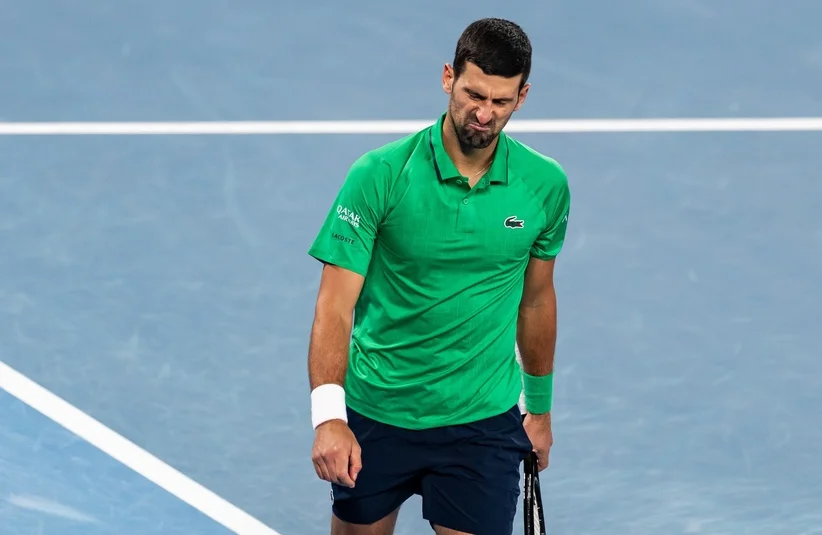
You know you’ve done something truly insane when you make the greatest tennis player of all time look like he just saw a ghost. Novak Djokovic has seen it all. He’s stared down match points on Center Court at Wimbledon. He’s battled through five-set marathons in the Australian heat.
He is, by most metrics, unshakeable. But on a chilly Saturday evening in Milan, the 24-time Grand Slam champion wasn’t the iceman. He was just another fan in the stands, jaw on the floor, watching Ilia Malinin rewrite physics.
When Malinin, the 21-year-old American phenom known as the “Quad God,” launched himself backward into the air during his free skate, the crowd held its collective breath. It wasn’t just a jump; it was a statement. A legal backflip—landing on one skate—in the middle of an Olympic program.
The cameras caught Djokovic in the VIP section right as Malinin stuck the landing. The tennis legend’s eyes went wide, his mouth agape, a look of pure, unfiltered disbelief plastered across his face. It was the universal sports face for: Did that actually just happen? In that split second, Djokovic became the face of a sport that has fundamentally changed.
The Gamble That Paid Off In Gold
Malinin didn’t need the backflip to win. He’s arguably the most technically gifted jumper in the history of figure skating. He had five quad jumps planned. He could have played it safe. But playing it safe isn’t why they call him the “Quad God.”
Team USA was locked in a dead heat with Japan heading into the men’s free skate, the final event of the team competition. The pressure was suffocating. Malinin, coming off a shaky short program where he trailed Japan’s Yuma Kagiyama, needed a score that was undeniable. He needed to be perfect.
Instead, he chose to be legendary. The backflip, banned by the International Skating Union (ISU) for nearly 50 years until just two years ago, is a high-risk, high-reward move. Mess it up, and you lose the gold for your country. Nail it, and you become immortal. Malinin didn’t just nail it; he integrated it seamlessly into a routine that scored a massive 200.03 points.
That score was the dagger. It vaulted the United States over Japan, securing back-to-back Olympic gold medals in the team event.
Why This Moment Matters
For decades, figure skating has been a battle between artistry and athleticism. Old-school purists argued that acrobatics like backflips were cheap tricks that detracted from the elegance of the blade work.
Terry Kubicka did one in 1976 at Innsbruck, and the ISU promptly banned it. They said it was too dangerous. They said it wasn’t “skating.” Fast forward to 2026. The ban is gone, lifted in 2024 to modernize the sport. Malinin is the perfect avatar for this new era. He isn’t just a skater; he’s an athlete pushing the boundaries of human rotation.
When Djokovic watched that flip, he wasn’t looking at the artistic interpretation of the music. He was looking at sheer athletic audacity. It’s the same audacity Djokovic summons when he hits a return winner on a serve he has no business reaching. It’s “game recognize game.”
This moment does for figure skating what the dunk contest did for basketball in the ’80s. It brings an element of danger and explosive power that casual fans—people who don’t know a triple axel from a salchow—can immediately understand.
From Fairfax To the history books
It’s worth noting the lineage here. Malinin is the son of two former Olympic skaters. He was born into this world. But he hasn’t just followed in his parents’ footsteps; he’s sprinted past them and leaped off a cliff.
At 21, he is carrying the weight of the US figure skating program. After the retirement of Nathan Chen, there were questions about who would step up. Malinin answered those questions emphatically in Milan.
But it wasn’t just the backflip. It was the five quads. It was the stamina. It was the mental toughness to shake off a disappointing short program and deliver the highest score of the night when the lights were brightest.
FAQ Section
Q: What happened in Ilia Malinin’s Olympic performance?
A: He landed the first legal backflip in nearly 50 years and scored 200.03 points, securing Team USA’s gold in the team event. It surprised Novak Djokovic and his wife.
Q: Who is Ilia Malinin?
A: A 21-year-old American figure skater, two-time World Champion, and son of former Olympians.
Q: Why is this news important?
A: It marks a historic shift in figure skating, blending athletic innovation with Olympic tradition. It also attracted other sports figures, like Djokovic.
Q: What are the next steps?
A: Malinin will compete in the men’s singles event, where he is a favorite for gold.
What’s Next?
The team event is just the appetizer. The main course is still to come. Expectations are now effectively in the stratosphere. Malinin has shown his hand. Everyone knows he has the backflip in his arsenal. Everyone knows he can hit the 200-point mark. The question now shifts from “Can he do it?” to “Can anyone stop him?”
Japan’s skaters, including Shun Sato, who put up a valiant fight in the team event, will be re-evaluating their strategies. Do they try to match his technical difficulty? Or do they lean harder into artistry and hope Malinin makes a mistake?
For now, though, the image of these Games remains frozen in time: Ilia Malinin upside down, defying gravity, and Djokovic in the stands, looking like he just witnessed a miracle. If the greatest tennis player in history, Djokovic, is impressed, the rest of us should probably pay attention.
