
“He’s Already a Legend:” Rafael Nadal Anoints Carlos Alcaraz After Historic Career Grand Slam

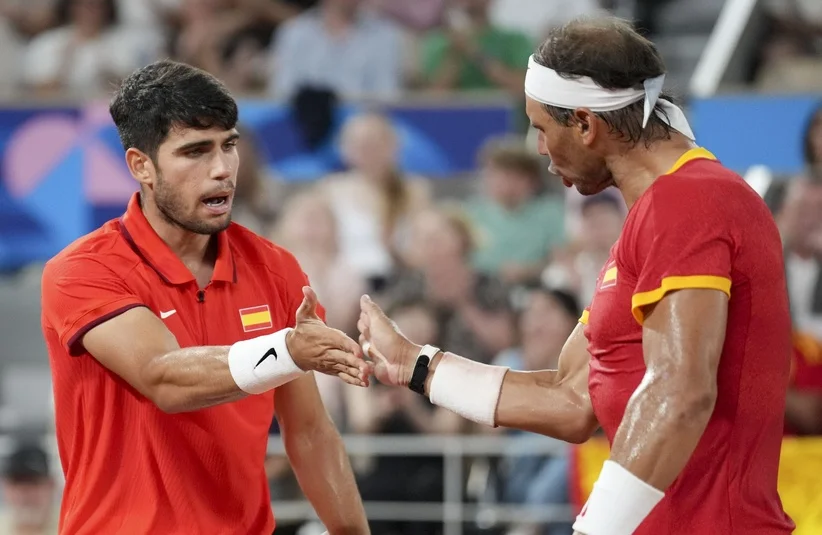
When Rafael Nadal speaks about clay, you listen. When he speaks about the future of Spanish tennis, you take notes. But when the 22-time Grand Slam champion looks at a 22-year-old and drops the “L-word,” you realize the debate is effectively over.
The tennis world witnessed a changing of the guard, perhaps the final one for a long time, in Melbourne. Carlos Alcaraz didn’t just defeat Novak Djokovic in the Australian Open final; he dismantled the narrative that the “Big Three” era would have a long, slow sunset. By securing his seventh major title and completing a Career Grand Slam before his 23rd birthday, Alcaraz has done something even the sport’s greatest icons couldn’t manage at his age.
And Nadal, who hung up his racquet in 2024, wasn’t about to let the moment pass with mild praise. Speaking at a foundation event shortly after the final, the “King of Clay” rejected the idea that Alcaraz is still an up-and-comer.
“He’s not a prospect,” Nadal said, shutting down any notion that Alcaraz is still earning his stripes. “He has seven Slams, so he’s definitely not just a promise for the future. He’s already a legend.”
A Historic Night In Melbourne For Alcaraz
To understand why Nadal’s assessment rings true, you have to look at what happened on Rod Laver Arena. Beating Djokovic is difficult. Beating Djokovic in Australia, where he has reigned supreme for over a decade, is a Herculean task.
Alcaraz didn’t just survive the encounter; he thrived. The victory secured his seventh major, but more importantly, it checked the final box on his resume. The Spaniard has now lifted trophies in Paris, London, New York, and Melbourne. Completing the Career Grand Slam is a lifetime achievement award for most players. For Alcaraz, it’s just another day in his early 20s.
He has now matched the career total of legends like John McEnroe and Mats Wilander. Let that sink in. At 22, Alcaraz has equaled the lifetime output of players whose posters hung on bedroom walls for decades.
Why Nadal’s Endorsement Matters
There has always been a hesitation in sports media to crown young athletes too early. We’ve seen “the next Pele” or “the next Jordan” flame out before they hit their prime. But Nadal’s comments strip away that caution.
Nadal isn’t prone to hyperbole. Throughout his career, he was known for his humility and respect for the grind. For him to bypass the “great potential” label and go straight to “legend” signals a shift in how the sport views greatness. It’s an acknowledgment that we aren’t waiting for Alcaraz to become great; we are currently living through his prime.
This feels like a distinct passing of the torch. Alcaraz grew up idolizing Nadal. Now, with Nadal watching from the stands as a retired spectator, seeing his protégé shatter records he once chased, the circle is complete.
The Numbers Behind Alcaraz’s Rise
If you strip away the emotion and look strictly at the data, Alcaraz is actually ahead of schedule compared to the “Big Three.” Federer, Nadal, and Djokovic all dominated, but they ramped up to it. Alcaraz has sprinted out of the gates. Reaching seven majors at this speed is unprecedented in the modern game.
Critics might argue that the field is weaker following Nadal’s retirement and Federer’s departure, but that ignores the presence of Djokovic. Alcaraz isn’t winning in a vacuum; he’s winning against the greatest hard-court player in history, preventing Djokovic from extending his record of 24 majors.
FAQ
Q: What happened in the Australian Open final?
A: Carlos Alcaraz defeated Novak Djokovic to win his seventh Grand Slam and complete the career Grand Slam.
Q: Who is involved?
A: Carlos Alcaraz, Rafael Nadal, and Novak Djokovic are the central figures.
Q: Why is this news important?
A: Alcaraz’s achievements at such a young age mark a generational shift in tennis, with Nadal himself declaring him a legend.
Q: What are the next steps?
A: Alcaraz will aim to add more majors to his tally, potentially challenging Djokovic’s record.
What’s Next?
The scary part for the rest of the tour isn’t that Alcaraz won—it’s that he’s 22. He hasn’t even hit what sports scientists typically consider the physical prime of a male tennis player (usually 25-28).
With the Career Slam in his pocket, the pressure to “prove it” is gone. Now, he’s just chasing numbers. The conversation shifts from “Can he win on all surfaces?” to “Can he catch Novak?”
It might seem premature to talk about Alcaraz challenging the record of 24 slams, but the math is on his side. If he averages two slams a year, a reasonable pace given his current dominance, he puts himself in the conversation within a decade. For now, though, the verdict is in. We don’t need to wait 10 years to look back fondly on the start of his career. As Nadal made clear, we are watching a legend in real time.
