
Zilisch’s Watkins Glen Breakthrough In The O’Reilly Series Signals A Rising NASCAR Force

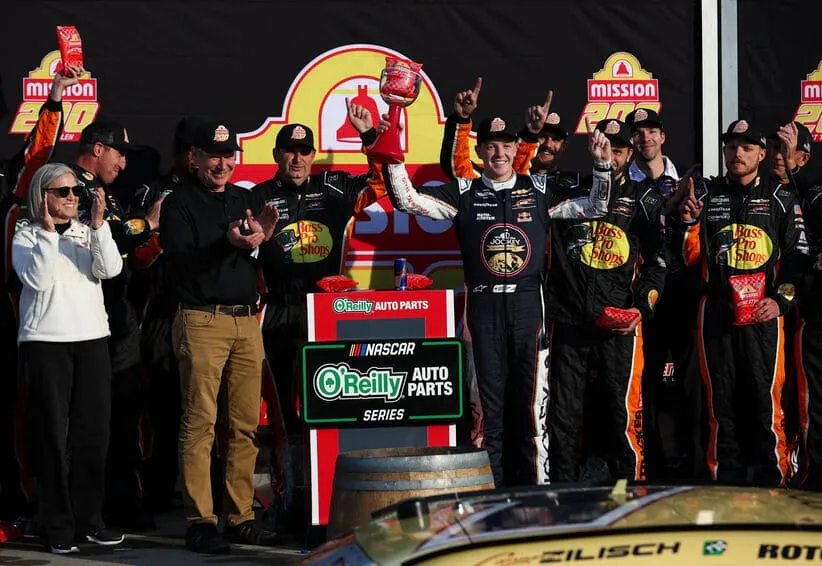
Connor Zilisch didn’t simply win at Watkins Glen. He controlled a race that demanded precision at every corner, beating Jesse Love in a direct, sustained fight. Watkins Glen is a track where the average lap speed clears 120 mph. The braking zone into Turn 1 drops drivers nearly 70 mph in a heartbeat, and the Bus Stop chicane punishes even a six‑inch mistake.
In that environment, Zilisch made fewer errors, executed cleaner laps, and managed pressure with the kind of discipline that decides road‑course races. From the early laps, he avoided the trap of overdriving. He let the race come to him instead of forcing moves that would have broken his rhythm.
Instead of forcing gaps, he built rhythm, keeping himself within striking distance as the field settled. That patience mattered later, because once the race tightened into a two‑driver duel, track position became nearly impossible to reclaim without a mistake from the leader.
A Race That Narrowed Into A Two‑Driver Duel
By the midpoint, the event had compressed into a straight fight between Zilisch and Love. Both had spent more than eighty percent of the race inside the top five, and their lap times differed by barely a tenth of a second through the middle stint.
The race settled into a rhythm where every corner exit and every braking point carried weight, and neither driver could afford even the smallest lapse in execution. Traffic became a strategic variable; every lapped car could swing the interval by half a second, and Zilisch consistently cleared traffic one or two corners earlier than Love.
That efficiency kept him in control of the tempo.Watkins Glen rewards drivers who can maintain momentum through the Esses and carry speed into the Carousel, and Zilisch’s consistency in those sections prevented Love from ever fully closing the gap.
Zilisch Controls The Critical Laps When It Matters Most
The defining stretch came in the final twenty laps. Zilisch delivered a run of laps so consistent that the variation from fastest to slowest sat inside a tenth of a second. Love matched the pace but not the precision. He could stay close, but he never found the extra stability Zilisch carried into each braking zone.
Zilisch hit his braking marks into Turn 1 with fewer corrections, carried steadier speed through the high‑speed uphill section, and exited Turn 7 with one to two extra miles per hour on multiple laps. He kept the car balanced through each transition, never giving up the momentum he needed to stay in control.
Those gains were small in isolation, but over a full run they became decisive. Watkins Glen is a track where momentum compounds, a slightly better exit becomes a slightly safer entry into the next corner, and the advantage builds lap after lap. Zilisch never let that rhythm break.
Love Stays Close But Never Gets The Opening He Needs
Jesse Love never faded from the fight. He kept the gap inside six‑tenths for most of the closing run and twice closed to within three‑tenths. Each time, Zilisch answered with a clean lap rather than a defensive overreach. Love could apply pressure, but he never found the moment where Zilisch’s composure cracked.
There was no wheel hop into the Bus Stop, no missed apex in the Carousel, no over‑commitment that would have opened the door. Love needed a mistake to create an opportunity. Zilisch never gave him one. He kept the car settled in every critical moment, refusing to offer even a hint of vulnerability.
He drove those closing laps with a calm that never wavered, even as the pressure tightened behind him. Every corner showed the same steady hands and the same trust in what the car could give him. He never rushed a throttle input or forced a braking point, choosing control over aggression at every turn.
Why This Win Matters Inside Zilisch’s O’Reilly Season
This victory carries weight inside Zilisch’s O’Reilly Series campaign. He has already shown speed on ovals, but Watkins Glen demands a different skill set of precise braking, tire management, rhythm through high‑speed transitions, and the ability to navigate traffic without losing momentum.
Winning here, in a direct fight against a championship‑caliber rival, reinforces that his season is not built on circumstance. It is built on execution. It also underscores his versatility. Road courses expose the driver more than the car, and Zilisch proved he can win in an environment where every lap is a test of concentration.
He showed the kind of adaptability that separates a good road‑course driver from a complete one, adjusting his pace and approach without ever losing control of the moment. Every lap reflected a clear understanding of what the car needed and what the race demanded, especially with a rival as close as Love shadowing his every move.
What This Means For Zilisch Moving Forward
The broader implication is confidence. A win earned through a head‑to‑head battle on one of the most technical tracks on the schedule becomes a reference point for the rest of the season. It shows that Zilisch can adapt to different race rhythms, manage pressure, and close out a race without giving away the small margins that matter most.
The next challenge will come on tracks where the tempo changes and the windows for mistakes shrink even further. Watkins Glen suggests he is capable of carrying this level of control into any format. He has shown that his approach holds up whether the race demands patience, aggression, or a blend of both.
The confidence gained from a win like this often becomes just as valuable as the points it delivers. As the season shifts to different racing styles, his ability to stay composed under pressure will matter even more.
What’s Next
Connor Zilisch’s win over Jesse Love at Watkins Glen was a measured, disciplined, pressure‑tested performance and the kind that defines a season. In a race where precision decides everything, he delivered it from the moment the duel began until the checkered flag fell.
Watkins Glen now stands as one of the clearest markers of a season that continues to build momentum. It was the kind of afternoon that shows not just what a driver can do with speed, but what he can do with control. Every lap reinforced that he understood the stakes and refused to let the moment slip away.
For More Great Content
Stay plugged in with more race analyses, features, and behind‑the‑garage storytelling. Follow Sarah on Facebook, LinkedIn, and X at Sarah Talker, where the conversation keeps rolling long after the checkered flag drops.
