
Van Gisbergen Breaks The Clock: A Bus Stop Masterclass Secures The Pole At Watkins Glen

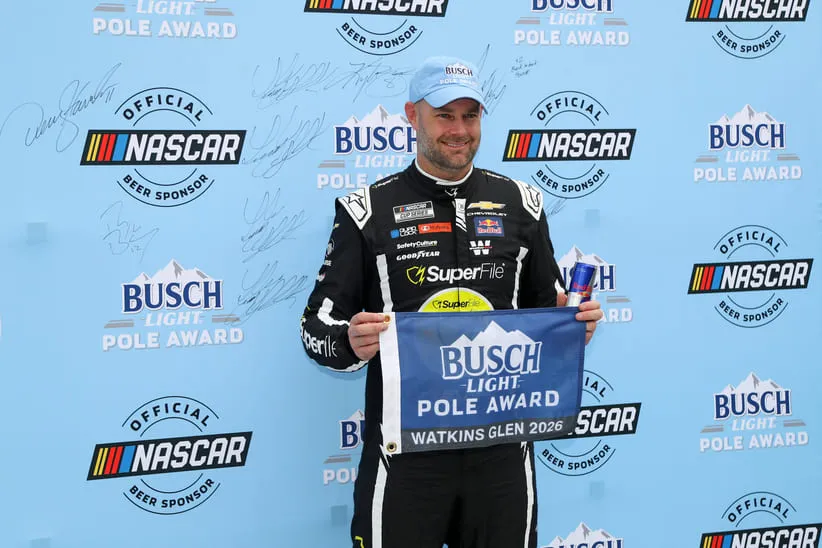
Shane van Gisbergen entered Watkins Glen on Saturday with the calm of a driver who already knew how to win on the 2.45‑mile layout. By the end of qualifying, he had turned that confidence into a pole‑winning performance that separated him from a field fighting for grip and consistency.
His lap of 71.165 seconds at 123.937 mph immediately became the benchmark, and no one else came close to matching the precision he carried through the most demanding corners. Michael McDowell, one of the Cup Series’ most reliable road‑course specialists, posted 123.488 mph, leaving a gap of more than two‑tenths.
That margin is unusually large for Watkins Glen, where qualifying often comes down to hundredths. Van Gisbergen’s execution made it clear he had more speed in reserve than the rest of the grid. He looked like a driver in complete control of every corner he touched.
The Bus Stop Becomes The Decisive Advantage
The turning point of Van Gisbergen’s lap came in the Bus Stop chicane, where he carried more speed than nearly the entire field. Drivers routinely lose time there by over‑attacking the curbs or entering too cautiously, but Van Gisbergen found the exact line that kept the car planted through the transition.
His gain through that section alone accounted for the majority of his advantage over the field, and it was visible on the timing charts from the moment he crossed the line. Even his second attempt, which began with promise, fell off due to reduced tire grip, but the first lap had already done the damage.
“I knew the lap wasn’t perfect early, so I had to make the Bus Stop count,” Van Gisbergen said. “That’s where everything came together.”
The consistency between both runs showed how comfortable he was attacking the most technical part of the track.His confidence in that section has become a defining trait of his road‑course performances. Few drivers in the field can match his ability to stay aggressive without losing stability.
Watkins Glen Aligns With His Driving Style
Watkins Glen’s seven‑turn configuration rewards rhythm, braking discipline, and the ability to maintain speed through fast transitions, all strengths Van Gisbergen developed through years of international road‑racing experience.
Since joining the NASCAR Cup Series, he has consistently adapted to technical circuits faster than most of the field. His comfort level was obvious from the moment practice began, especially in how he managed the uphill Esses and the heavy braking zones into Turn 1 and the Inner Loop.
While others fought wheel hop or mid‑corner instability, van Gisbergen carried momentum cleanly and repeatedly. His ability to maintain balance under pressure continues to make him one of the most dangerous drivers on road courses.
Trackhouse Racing Shows Depth Across The Board
Trackhouse Racing’s overall performance reinforced that the team unloaded with high speed. Ross Chastain qualified fourth at 123.445 mph, and Connor Zilisch placed fifth at 123.386 mph, giving the organization three cars inside the top five. That level of consistency across teammates is rare on a road course, where setups often diverge dramatically.
Team Penske also showed strength with Austin Cindric in third and both Joey Logano and Ryan Blaney landing inside the top seven. Joe Gibbs Racing added three cars inside the top ten, confirming that multiple organizations brought competitive packages.
Even so, Van Gisbergen’s advantage through the most technical portion of the track made him the clear standout. He found time in places where most drivers were simply trying to survive the lap. That kind of separation doesn’t happen by accident on a road course as demanding as Watkins Glen.
Tire Wear Expected To Shape The 100‑Lap Race
Sunday’s Go Bowling at The Glen will introduce a different challenge, as the race expands from 90 to 100 laps this season. Longer green‑flag runs will place more emphasis on tire management, especially with stage breaks set for laps 20, 50, and 100.
During practice, lap times dropped by nearly four seconds over a run as grip faded, a dramatic swing for a road course where braking stability and corner exit speed determine passing opportunities. Heavy tire marbles off the racing line also posed a risk in the braking zones at Turn 1 and the Inner Loop.
Drivers who missed an apex or over‑committed into a corner found themselves sliding across buildup that offered no grip. Teams will need to balance short‑run speed with long‑run durability, especially with the added distance.
Van Gisbergen Holds The Early Advantage
Starting from the pole at Watkins Glen gives Van Gisbergen the ability to control the early pace and manage his tires in clean air. He also enters as the defending winner at Watkins Glen, adding another layer of confidence to a weekend where he has already shown superior speed in the most demanding part of the track.
Clean air on a road course can be worth several tenths per lap, especially when tire wear becomes a factor. That advantage could allow him to build a buffer before strategy cycles begin. His ability to stay composed under pressure has become one of his defining traits.
If he maintains that level of control on Sunday, he will be difficult to unseat. He has shown all weekend that he can manage pressure without letting it change the way he drives. The field knows that if he settles into a rhythm early, the window to challenge him will shrink fast.
What’s Next
Shane van Gisbergen’s pole‑winning performance at Watkins Glen was a complete demonstration of why he continues to excel on technical circuits. His precision through the Bus Stop, his consistency across both attempts, and his ability to find speed where others lost it all pointed to a driver fully in command of his craft.
Sunday’s race will introduce new variables, especially with tire wear and the expanded distance, but Van Gisbergen begins the day with every advantage a road‑course specialist could want. If his qualifying form carries over, the rest of the field will spend the afternoon trying to match a pace that has already proven difficult to reach.
For More Great Content
Stay plugged in with more race analyses, features, and behind‑the‑garage storytelling. Follow Sarah on Facebook, LinkedIn, and X at Sarah Talker, where the conversation keeps rolling long after the checkered flag drops.
