
TriMech Steps In As Sam Hunt Racing’s Technology Backbone For Texas Motor Speedway

TriMech heads into Texas Motor Speedway with Sam Hunt Racing at a place that hits you the moment you walk in. The heat, the noise, the speed. It all blends together on a 1.5‑mile track where cars push past 180 mph and tire falloff starts almost immediately. Races here are often decided by a few hundredths of a second.
That’s the reality Sam Hunt Racing is preparing for as the team heads into the May 2 race with Dean Thompson in the No. 26 Thompson Pipe Group Toyota GR Supra. This time, they’re bringing more than horsepower. They’re bringing TriMech.
A Partnership That Shows Up In The Data
TriMech isn’t new to the team. They became Sam Hunt Racing’s official technology partner in September 2025, and the impact showed up quickly. The team cut chassis prep time by nearly 20%, streamlined several shop processes, and began unloading with more consistent baseline setups.
For a smaller team competing against organizations with far larger engineering departments, those gains matter. Jesse Little, the team’s VP of Business Development, said the difference was noticeable almost right away, not something you often hear in a sport where improvements usually come in tiny steps.
Small gains add up fast over a long season. Saving time in the shop or improving a baseline setup can show up immediately in balance, tire wear, or pit‑stop adjustments. For a team that has to maximize every resource, those improvements stack up and help close the gap to the larger organizations they’re racing against.
Tools Built For The Smallest Details

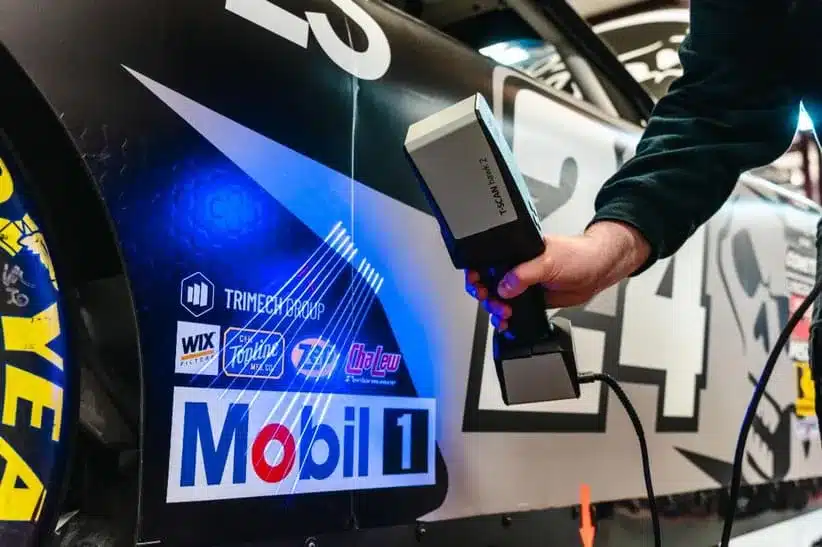
One of the biggest changes came from a single piece of equipment: the Zeiss T‑Scan Hawk 2 3D Hand Scanner. It captures up to 1.2 million data points per second with an accuracy of 0.02 mm. In NASCAR, where body tolerances are measured in millimeters and races can be decided by 0.001 seconds, that level of detail isn’t a luxury. It’s a necessity.
What The Scanner Allows The Team To Do
- Map the exact shape of the GR Supra body
- Spot tiny surface flaws that create drag
- Check chassis flex and alignment
- Compare the car to digital models with near‑perfect accuracy
At a track like Texas, where corner entry speeds are high and the racing line is unforgiving, these small details add up. A tiny aero imbalance can cost a driver several positions over a long run. TriMech’s tools help the team find those issues before the car ever reaches the track.
Conner Janeteas, TriMech’s Advanced Manufacturing Manager of Innovation, sees Sam Hunt Racing as a real‑world test bed. Every scan and every model feeds directly into performance. There’s no guesswork. Just data and results.
Bringing Fans Into The Process
TriMech isn’t keeping everything behind closed doors. On April 28, they’re hosting the Connect, Create, Innovate Forward Event in Austin. It’s a chance for engineers, designers, and race fans to see how digital ideas become physical parts.
The event includes facility tours, hands‑on demonstrations, and conversations with people who build the tools teams rely on. Drivers Harrison Burton andDean Thompson will also be there, taking part in a panel discussion and signing autographs.
It’s a rare chance for fans to hear how driver feedback blends with engineering data to shape a race car’s setup. Fans get to see how much of a car’s performance comes from those conversations. It’s a side of the sport that usually stays behind the shop doors.
What It Means For Sam Hunt Racing
For Sam Hunt Racing, this partnership with TriMech is more than a technology upgrade. It’s a way to compete with teams that have far larger budgets and deeper engineering benches. In the past, tools like high‑end scanners, digital twins, and advanced modeling software were mostly found inside the biggest shops in the sport.
Smaller teams had to rely on trial and error and whatever equipment they could afford.TriMech changes that equation. With accurate data and better processes, SHR can make smarter decisions, avoid wasted time, and give Thompson a car capable of fighting for every spot on the track. It’s not about spending more. It’s about spending smarter.
Smaller teams don’t get the luxury of guessing. Every change has to move the car forward, and every hour saved in the shop can turn into a better balance or a stronger long‑run feel once the wheels hit the track. When the tools finally match the effort, the gap to the bigger teams starts to feel a little more manageable. That’s where TriMech comes in.
What’s Next
NASCAR is leaning harder into data every year, and the teams that adjust quickest are the ones running near the front. Texas Motor Speedway only sharpens that point with its speed, tire wear, and unforgiving racing line. With TriMech in their corner, Sam Hunt Racing heads into the weekend with more information, better tools, and a clearer read on their car than ever.
Texas doesn’t give teams anywhere to hide. Long runs expose every weakness, especially on a surface that chews up tires. That’s where the extra data and sharper processes start to show their value. They give Sam Hunt Racing a real chance to stay in the fight deep into the race.
For More Great Content
Stay plugged in with more race analyses, features, and behind‑the‑garage storytelling. Follow Sarah on Facebook, LinkedIn, and X at Sarah Talker, where the conversation keeps rolling long after the checkered flag drops.
