How Pit Stop Precision Could Determine the 2025 Title Fight

It’s loud and filled with the aroma of burning rubber, and high-octane fuel fills your lungs. Thirty-eight other finely tuned machines are screaming around the track, jockeying for position at nearly 200 miles per hour. Inside the car, it’s a pressure cooker. But the real make-or-break moments? They often happen while standing still. We’re talking about pit stop execution.
You can have the fastest car on the track, a driver with nerves of steel, but if your team fumbles on pit road, your shot at a championship can vanish in the blink of an eye. It’s a brutal, unforgiving dance of choreographed chaos, and in the NASCAR playoffs, every tenth of a second is pure gold. A single lug nut, a splash of fuel, a slight adjustment.
It makes all the difference between spraying champagne in Victory Lane or packing up the hauler with your head hanging low. This isn’t just about changing tires. This is about trust, about a driver putting their life and their race in the hands of the crew. It’s about a team that has practiced the same five-lug ballet thousands of times, knowing that perfection is the only acceptable outcome.
Why Pit Stop Execution Is Everything in the Playoffs
When you get to the Round of 8, every driver left in the hunt is elite. The cars are dialed in, and the margins for error are razor-thin. You can’t just rely on raw speed anymore. Track position becomes the king, and the fastest way to gain—or lose—a handful of spots without burning up your tires is on pit road. Think about it.
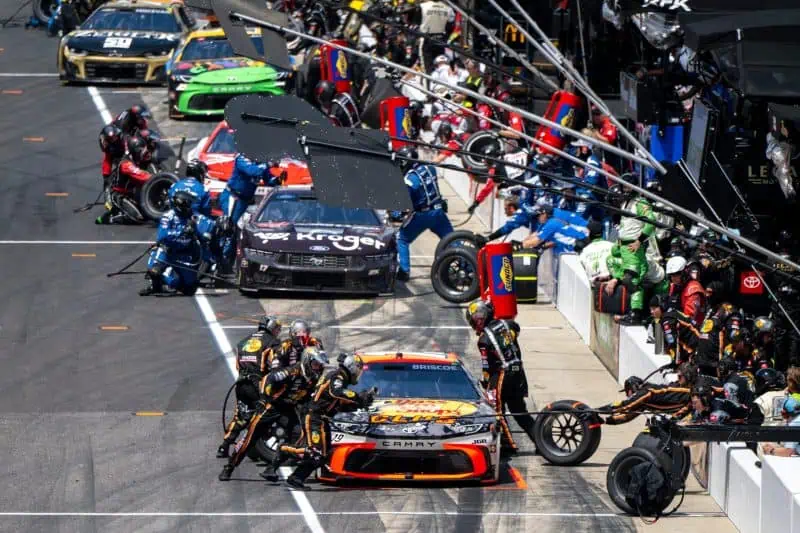
A flawless, sub-10-second stop can leapfrog your driver ahead of two or three cars. That’s clean air. That’s a chance to control the restart. That’s momentum. On the flip side, a slow stop of 12 or 13 seconds feels like an eternity. You watch helplessly as the cars you were just battling with fly by. It’s a gut punch, not just for the driver, but for the entire team. All that hard work on the track, undone by a sticky lug nut or a slow fill-up. It’s heartbreaking.
The Mental Game of Pit Road
The pressure on these pit crew athletes is immense. They’re jumping over the wall into a live pit box with a 3,400-pound car sliding to a stop just inches away. They have to be precise, fast, and unfazed by the roaring engines and the high stakes. But it’s not just about the crew. The driver plays a huge role.
They have to hit their marks perfectly, nail the pit road speed without a penalty, and give the crew the best possible chance to do their job. If a driver slides through the box or comes in too hot, they’ve already sabotaged the stop before the first lug nut is even touched. It’s a total team effort, and when one piece of the puzzle is off, the whole picture falls apart.
The Playoff Pressure Mounts
In the playoffs, that pressure ratchets up to a level most of us can’t even imagine. Every stop is under a microscope. Crew chiefs are making gutsy calls, such as whether to use two tires or four. Fuel only? No tires at all? These decisions are made in a split second, and they can either look like genius moves or colossal blunders.
As former crew chiefs Steve Letarte and Todd Gordon often point out, you have to be ready to adapt. A plan is great until the race throws you a curveball. The difference between a championship team and everyone else is how they handle that adversity. Do they crumble after a bad stop, or do they shake it off and come back with a vengeance on the next one?
Final Thoughts
Mental toughness and resilience are what separate the good from the great. A flawless pit stop execution isn’t just mechanical; it’s a reflection of a team’s heart and will to win. When the title is on the line, you don’t just need speed. You need perfection when the car comes to rest.