
NASCAR’s Inspection Crackdown Reshapes Bristol Weekend As Five Teams Are Hit With Major Penalties

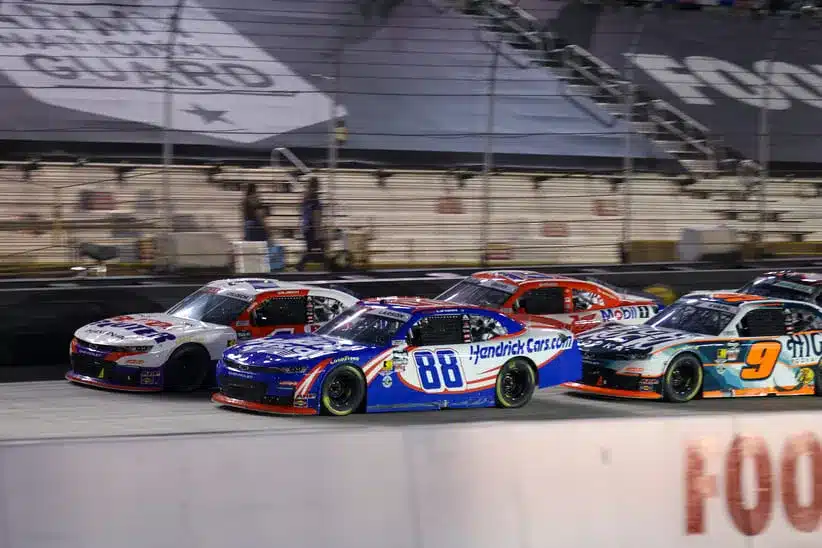
Bristol Motor Speedway already punishes the unprepared, but this weekend, the trouble started long before anyone hit the racetrack. Five Cup Series teams failed pre‑race inspection twice, triggering automatic penalties under NASCAR’s rulebook and reshaping the competitive landscape before a single lap was turned.
These weren’t borderline misses or clerical errors. There were repeated violations in areas NASCAR considers essential to fairness and safety. When a car fails twice, officials interpret it as a sign that the team attempted to race with an illegal advantage. That’s why the sanctions came swiftly, decisively, and without hesitation.
Why These Teams Were Penalized
NASCAR’s inspection process measures body tolerances, underwing geometry, suspension components, and aerodynamic surfaces with millimeter‑level precision. A single failure is treated as a warning. A second failure signals that something in the car’s construction or setup remains outside legal limits, raising immediate concerns about a potential competitive advantage.
A second failure means the car still does not meet legal specifications, which NASCAR views as a competitive breach rather than an honest mistake. These violations often involve areas where even a tiny change in measurement can create real speed, making them high‑impact infractions.
These cars remained outside legal tolerances even after correction, which is why NASCAR escalated the penalties. When a team cannot bring its car into compliance after two attempts, officials assume the issue is intentional or performance‑related rather than accidental. NASCAR’s goal is to protect competitive integrity, and these failures crossed the line.
Penalties That Reshaped The Weekend
Teams That Failed Inspections Twice
- No. 1 Trackhouse Racing: Ross Chastain
- No. 5 Hendrick Motorsports: Kyle Larson
- No. 41 Haas Factory Team: Cole Custer
- No. 66 Garage 66: Chad Finchum
- No. 71 Spire Motorsports: Michael McDowell
Failing inspection twice triggers two major consequences that immediately alter a team’s competitive outlook. NASCAR uses these penalties to ensure that teams who attempt to push beyond the rulebook do not gain an advantage over those who play within the lines. At a track as tight and punishing as Bristol, these sanctions can derail an entire weekend before it begins.
Loss of Pit Stall Selection
This penalty is devastating at Bristol, where pit road is tight, narrow, and constantly congested. Teams rely on premium pit stalls to avoid traffic jams and minimize the risk of contact. Losing that choice forces drivers into compromised positions that can snowball into lost track position and damaged strategy.
On a track where track position is everything, this penalty alone can bury a team before the green flag waves. Teams rely on premium pit stalls to avoid traffic jams and minimize the risk of contact.
Losing that choice forces drivers into compromised positions that can snowball into lost track position and damaged strategy. On a track where track position is everything, this penalty alone can bury a team before the green flag waves.
The Price Of A Penalty At Bristol
- 2–4 positions per stop.
- Multiple seconds of lost time.
- Clean exits, which are nearly impossible on a 15‑second lap.
Ejection Of Key Crew Members
NASCAR also removed a critical team member from each operation. These individuals oversee measurements, verify setup sheets, and ensure the car complies with all rules. Removing them is not symbolic. It disrupts workflow, slows adjustments, and forces the crew chief to absorb their responsibilities.
Losing a car chief or engineer on a Bristol weekend is like losing your offensive coordinator before kickoff. It fractures communication, increases the likelihood of setup mistakes, and forces the remaining crew to operate under intense pressure.
Ejected Crew Members And Car No.
- David Fero: Car Chief, No. 1
- Jesse Saunders: Car Chief, No. 5
- Scott Brewer: Car Chief, No. 41
- Dylan Roberts: Car Chief, No. 66
- Adam Sturgill: Lead Engineer, No. 71
How The Penalties Showed Up In Practice
All five teams eventually passed inspection on their third attempt and made it to practice. The stopwatch revealed who could absorb the hit and who could not. The spread between the fastest and slowest of the penalized group was nearly three‑tenths of a second, a massive gap on a half‑mile track where every thousandth matters.
That difference reflects the real‑world cost of losing leadership and starting the weekend in chaos.McDowell and Larson showed resilience, proving their baseline setups were strong enough to withstand the disruption.
The others struggled significantly, suggesting the penalties created real instability in their garage operations. At Bristol, where confidence and rhythm matter, that instability can be fatal. One bad adjustment or misread change in the track can snowball into a multi‑lap deficit in minutes.
Practice Speed Rankings For Penalized Teams
- Michael McDowell: 5th (15.462 sec)
- Kyle Larson: 10th (15.476 sec)
- Ross Chastain: 31st (15.582 sec)
- Cole Custer: 32nd (15.586 sec)
- Chad Finchum: 37th (15.746 sec)
Larson’s Ability to Overcome Adversity at Bristol
Kyle Larson is the one driver on this list who can realistically bulldoze through adversity, and his Bristol record makes that obvious. He’s led more than 1,300 laps at the half‑mile, including 411 in the 2023 spring race and 462 in the 2024 playoff race, numbers that show how often he flat-out controls the event.
His first Bristol win came in 2021, and since then, he’s treated the place like a personal proving ground, adapting instantly as the groove shifts and the track takes rubber. Even when the rhythm changes, he keeps ripping off mid‑15‑second laps, a pace few can match deep into long green‑flag stretches.
That ability to stay fast when everyone else fades is what makes him uniquely equipped to overcome setbacks that would bury most teams. The others face a steeper climb. McDowell’s best Bristol finish is sixth, Chastain’s is also sixth, and Custer’s is eighth, while Finchum has two starts, both ending in DNFs.
Their Bristol history shows they already face an uphill battle, and losing key personnel only magnifies that challenge. For these teams, the penalties aren’t just inconvenient. They’re crippling.
How These Penalties Change Sunday
These sanctions reshape the entire strategic landscape. Losing pit stall selection means slower stops, blocked exits, and constant risk of contact. Losing a car chief or engineer means slower diagnosis of handling issues, fewer eyes on adjustments, and more pressure on the crew chief to do everything at once.
At Bristol, where the track changes every 20–30 laps and mistakes instantly cost multiple laps, that is a recipe for disaster. Teams will now have to operate with reduced resources in one of the most demanding environments in motorsports.
Every adjustment will take longer, every pit stop will be riskier, and every strategy call will carry more weight. The margin for error, already razor‑thin at Bristol, has now shrunk to almost nothing.
What’s Next
NASCAR made its point with unmistakable clarity: the rulebook is not optional, and inspection failures will be punished with full force. Five teams now enter Bristol with fewer resources, worse pit positions, and a steeper climb than anyone else in the field.
The Last Great Colosseum already takes no prisoners. For these teams, the battle became a survival test before the green flag even waved. As the weekend unfolds, the question becomes whether any of them can claw their way back from a deficit they created before ever turning a lap.
For More Great Content
Stay plugged in with more race analyses, features, and behind‑the‑garage storytelling. Follow Sarah on Facebook, LinkedIn, and X at Sarah Talker, where the conversation keeps rolling long after the checkered flag drops.
