
Women’s History Month Spotlight: Logan Misuraca and the New Blueprint for Women In Stock Car Racing

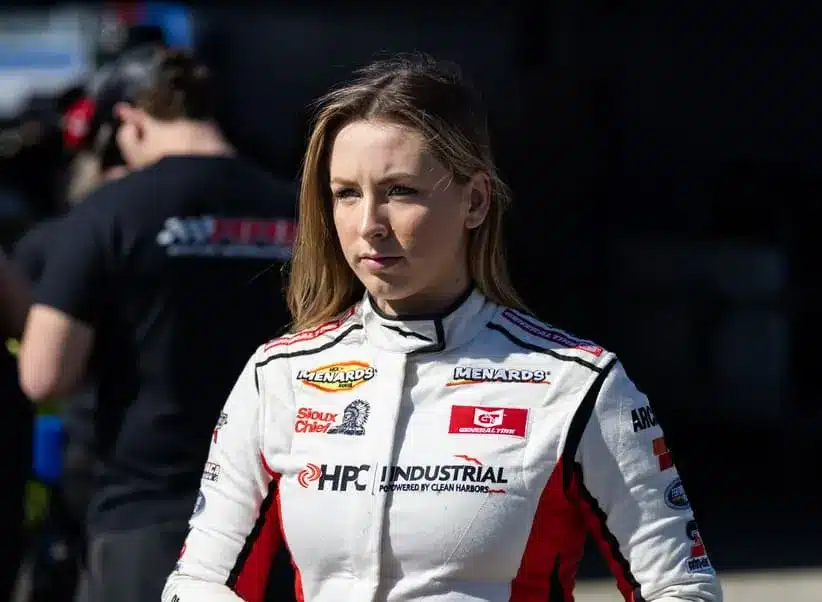
The smell of spent racing fuel and the crack of naturally aspirated V8s bouncing off concrete walls can push people away or pull them in forever. For Sanford, Florida native Logan Misuraca, that pull came early and never loosened its grip. The road to the ARCA Menards Series garage is rarely smooth.
It’s a grind of worn‑out parts, late nights in the shop, and constant sponsor hunting. Misuraca is navigating that world with a combination few drivers can claim: raw driving ability, academic firepower, and a growing sense that her journey is shaping something larger than her own career.
From Ballet Shoes To The Bullring
Most drivers in the stock‑car pipeline grew up with a steering wheel in their hands. Misuraca’s childhood looked different. Her early life revolved around ballet discipline, balance, precision, and the relentless pursuit of perfection. She once imagined a future on stage, not in a race car.
But her family’s racing roots eventually pulled her toward the track, and by her teenage years, the ballet slippers were gone, replaced by a fire suit and a Simpson helmet.The transition from dance studio to asphalt sounds dramatic, but the fundamentals overlap more than people think. Balance. Spatial awareness. Body control.
The ability to make split‑second adjustments. Misuraca carried those traits into quarter midgets, go‑karts, and legend cars, climbing the grassroots ladder the hard way. Her breakout came in 2020 at New Smyrna Speedway, a high‑banked half‑mile that has humbled countless young drivers.
Misuraca didn’t just survive it. She owned it. She won the Pro Late Model Championship and earned Rookie of the Year, becoming one of fewer than 10 women to win a NASCAR‑sanctioned short‑track title in the last two decades. That season cemented her as a legitimate prospect, not a novelty.
What separates her from most rising drivers is what she does away from the track. Misuraca is pursuing a degree in Aerospace Engineering at the University of Central Florida, a field that demands the same precision she brings to the cockpit.
In a sport where aerodynamics, mechanical grip, and data analysis shape performance, her academic background gives her a rare analytical edge and sets a precedent for future drivers who want to blend engineering with racing.
Breaking Into ARCA: A Fight For Every Lap
The ARCA Menards Series is a proving ground, but it’s also a financial gauntlet. Talent matters, but funding often decides who gets a full‑time seat. Misuraca has had to capitalize on every opportunity, no matter how last‑minute. In 2022, she got the call from Josh Williams Motorsports to fill in at New Smyrna, her home track, with almost no preparation.
Pressure like that can bury a young driver. Instead, she delivered. Starting sixth, she muscled the No. 60 Chevrolet to a seventh‑place finish, the second‑best short‑track finish by a woman in ARCA over the last five seasons. It was a statement run that proved she could compete with established veterans and well‑funded development drivers.
But racing is never linear. Her recent starts at Bristol Motor Speedway in the No. 9 Chevrolet for Rev Racing have been punishing. Bristol is a concrete arena that chews up equipment and punishes even the smallest mistake.
Finishes of 25th and 27th don’t reflect the effort or the potential, but they do reflect the reality of part‑time racing: sometimes the night ends in the garage, not at the checkered flag.These are the moments that test a driver’s resolve. They’re also the moments that reveal what kind of legacy a driver is building.
A Legacy Taking Shape In Real Time
Women have made fewer than 150 combined ARCA Menards Series starts over the last decade, a tiny fraction of the thousands of entries logged in that span. Only three women have ever won an ARCA race apart from Shawna Robinson, Erin Crocker, and Hailie Deegan. Only one has finished in the top three in the championship standings.
Misuraca is fighting to be added to a list that is still shockingly short. And she’s doing it while balancing a full engineering course load and clawing for part‑time opportunities in a system where funding often outweighs talent. Her presence alone matters.
NASCAR’s female fanbase has grown by nearly 20% in the last ten years, and drivers like Misuraca are a major reason why. She’s visible. She’s accessible. She’s honest about the grind. And she’s showing young girls that the garage area isn’t off‑limits.
During one of her tough weekends in Bristol, a young girl approached her in the garage. She raced at the same Florida short tracks Misuraca grew up on. She asked for a photo. She looked at Logan the way Logan once looked at the drivers she admired . Moments like that are the foundation of a legacy.
What Her Journey Says About The Sport
Misuraca’s path highlights a truth about modern NASCAR development: the system still leans heavily on funding. There are short‑track champions across the country with the talent to compete, but without financial backing, they’re fighting uphill battles.
Misuraca’s story is a reminder that finishing positions don’t always tell the full story. Context matters. Equipment matters. Opportunity matters. She also represents a demographic NASCAR desperately needs to nurture.
Her authenticity, her academic background, and her willingness to share her struggles make her a powerful ambassador for young fans, especially young girls who rarely see themselves reflected in the garage area. And every season she spends in this sport widens that doorway a little more.
Her legacy is forming in the margins: the autograph sessions, the classroom hours, the late‑night shop work, the quiet conversations with young racers who see her as proof that the sport is changing. She’s becoming the kind of driver whose influence shows up long before the results do. And the young competitors watching her now will be the ones carrying her impact forward.
The Road She’s Clearing For The Next Wave
Racing breaks more hearts than it rewards. It demands unreasonable commitment. Logan Misuraca keeps climbing into race cars because the fire that started at New Smyrna still burns. She pushes through the setbacks, the mechanical failures, and the sponsorship battles because she knows her journey carries weight.
Whether she’s studying airflow dynamics in a classroom or wrestling a 3,300‑pound stock car around a half‑mile oval, she’s proving that resilience defines a racer more than any trophy. The results will come. The legacy is already taking shape, and the path she’s carving will make it easier for the next generation to follow.
