The Countdown is On: Bill Miller Prepares Arlington for IndyCar’s Newest Spectacle

While the rest of the country is busy tracking holiday packages and waiting for Santa, Bill Miller has been waiting on a very different kind of delivery. The President of the upcoming Grand Prix of Arlington recently signed for a shipment that would give most city planners nightmares: nearly three miles of fencing and 2,800 steel-tube barriers.
For Miller, these materials aren’t just industrial clutter. They are the skeleton of what promises to be one of the most ambitious street circuit projects in modern American open-wheel racing. With the inaugural race scheduled for March 15, the clock is ticking loudly. There are fewer than 100 days remaining to transform the streets surrounding the Dallas Cowboys’ AT&T Stadium and the Texas Rangers’ Globe Life Field into a 2.73-mile theater of speed.
Delivering Memories in the Heart of Arlington
It is easy to get lost in the logistics of bolts, barriers, and concrete, but Miller keeps his focus on the human element of the sport. He isn’t just building a track; he is manufacturing an experience. We are working in an industry where we are delivering happiness,” Miller said, reflecting on the massive undertaking.
“We’re delivering excitement, and we’re delivering memories. And even for us, sometimes you just have to stop and look around and just go, ‘This is pretty darn cool, and we get to be a part of it.’ And so you try not to lose that perspective along the way.”
That perspective is crucial because the task ahead requires absolute precision. Miller, whose resume includes leadership roles at California Speedway and SEMA, knows that turning a functioning entertainment district into a racetrack requires more than just paving over potholes. It requires a level of orchestration that rivals a military operation.
The Logistical Dance of a Street Circuit
Building a temporary circuit in a busy metropolitan hub is disruptive, but the Arlington project has a unique set of neighbors. The track utilizes a mix of public roadways and private lots belonging to two of the biggest franchises in sports.
The primary suite hospitality structures and the pit lane are set to take over one of the AT&T Stadium lots. According to Miller, the physical build-out begins in early February. From there, it becomes a race against time to erect grandstands on both the Cowboys and Rangers properties.
The timeline is incredibly tight. Miller’s team must sequence the barrier installation on surface streets about a month out from the green flag. But the real pressure comes from the calendar: Major League Baseball’s Opening Day is roughly ten days after the Grand Prix.
The IndyCar circus needs to pack up and vanish to clear the way for baseball fans.“It comes down quick,” Miller noted regarding the teardown process. “A lot of sequencing to accomplish all that. But everything has gone smooth and according to plan thus far.”
A Track Designed for Speed and Visibility
One of the biggest complaints regarding modern street circuits is the “tunnel effect” concrete canyons, where fans can’t see more than a blur of color as cars fly by. The Arlington layout aims to fix that.
Doug Boles, president of the Indianapolis Motor Speedway and the NTT IndyCar Series, recently walked the grounds and was impressed by the venue’s openness. Because the Entertainment District was designed to handle massive crowds for football and baseball, its infrastructure is already wider and more accommodating than that of a typical downtown grid.
“You think of street racing oftentimes, and it’s really tight quarters and maybe doesn’t feel quite as fan-friendly in terms of the ability to see things,” Boles said. “I think it’s going to be a really, really great venue. It’s going to race well. It’s going to have really high speeds in it.”
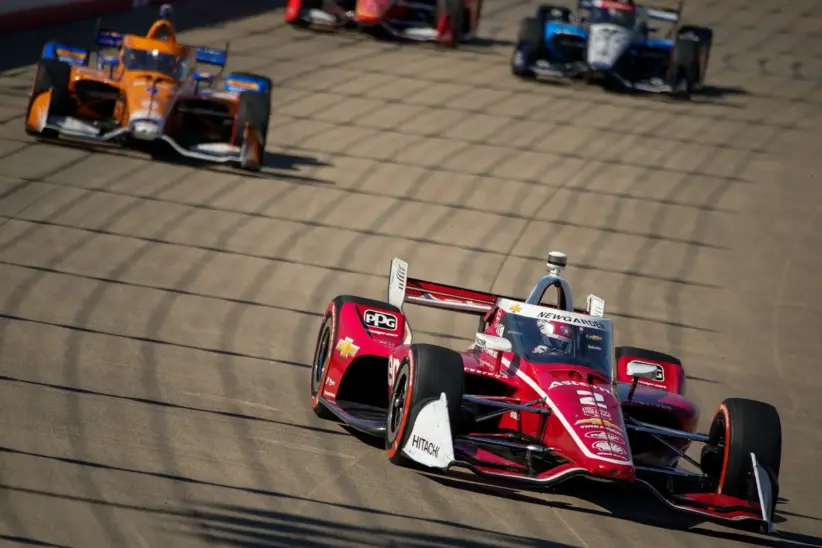
Those speeds will come courtesy of a massive 0.9-mile straightaway that rockets past the Live! by Loews Hotel. It creates a visual dynamic rarely seen in street racing: cars screaming down a nearly mile-long stretch with the towering, iconic architecture of two major stadiums serving as the backdrop.
Investing in the Arlington Experience
The reported $50 million investment in this event isn’t a one-off expenditure. It represents a multi-year commitment to infrastructure that will serve the race for seasons to come. This aligns with the ethos of the partners involved.
When you have Penske Entertainment working alongside the Jerry Jones family and the Rangers ownership, “good enough” isn’t part of the vocabulary.“They do things first class, and they do things exceptionally well,” Miller said of his partners. “They are the standard when it comes to sports and entertainment.”
Final Thoughts
Come March, the roar of engines will echo off the glass and steel of Arlington, signaling not just a new race but a new standard for what a street course event can look like in the Lone Star State.