
A Superspeedway Strategy Storm: Letarte And Wallace Weigh The Talladega Fuel Gamble

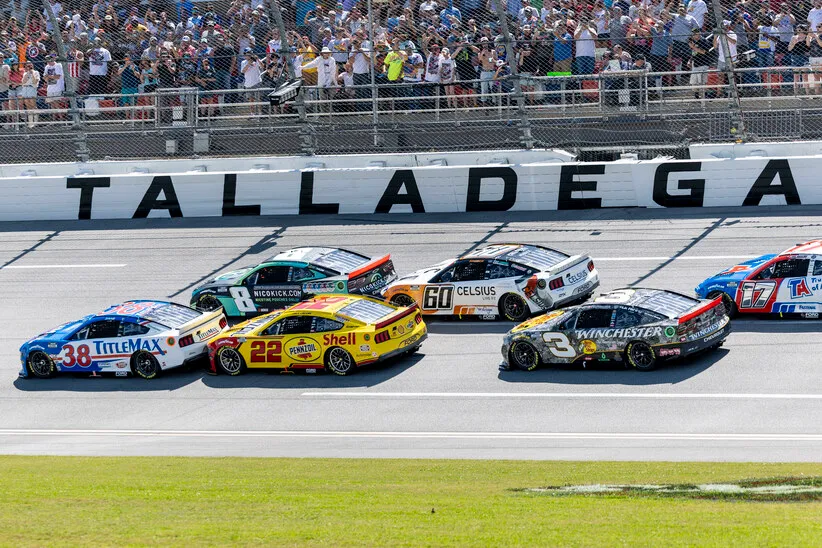
Talladega Superspeedway has never been subtle. The 2.66‑mile tri‑oval, the longest oval on the NASCAR schedule, has produced more lead changes, more drafting chaos, and more race‑altering crashes than any other track in the sport’s modern era.
Since 2000, Talladega has averaged 40+ lead changes per race, and the “Big One” has appeared in 31 of the last 40 Cup events held there. It is a place where the margin between glory and disaster is measured in inches and milliseconds. But this weekend, the danger isn’t just in the draft. It’s in the fuel tank.
NASCAR’s recent adjustments to Talladega’s stage lengths have detonated every established playbook in the garage. For years, teams built their superspeedway strategy around predictable fuel windows, typically 38 to 41 laps on a full tank under green.
Now, the revised stage lengths sit just outside those traditional numbers, forcing teams to choose between saving fuel at an uncomfortable pace or pitting at moments that leave them exposed. This isn’t a minor tweak. It’s a fundamental reshaping of how Talladega is raced.
A Superspeedway Built On Fuel Math
To understand the magnitude of the change, you have to look at how superspeedway racing evolved over the last decade. With the introduction of tapered spacers, reduced horsepower, and tightly packed drafting lanes, fuel saving became the dominant storyline in the early laps of every Talladega and Daytona race.
Drivers routinely lifted off the throttle entering the corners, sometimes saving a full lap of fuel every 25 laps. It was a conservative, methodical approach and one that minimized time on pit road and maximized the chance of staying in the lead draft.
The new stage lengths blow that rhythm apart. The windows are now tight enough that a single miscalculation can leave a driver sputtering off Turn 4 or pitting alone, doomed to lose the draft by 10 to 12 seconds. At Talladega, that gap is unrecoverable.
Letarte and Wallace Break Down The New Reality

When Steve Letarte and Bubba Wallace dissect these changes, the tension between the pit box and the cockpit becomes obvious. Letarte, who won a Daytona 500 and multiple superspeedway races as a crew chief, knows exactly how fragile Talladega strategy can be.
He has lived the nightmare of watching fuel numbers drop while the laps tick down. Wallace, meanwhile, has become one of the most consistent superspeedway performers in the field. Since 2021, he has recorded five top‑five finishes at Daytona and Talladega, including a win.
He thrives in the draft, but fuel saving runs counter to every instinct a driver has at 190 mph. Midway through their discussion, Letarte summed up the new challenge in a way that resonated across the garage. His quote captures the essence of the weekend. The margin for error is gone.
“You can’t hide anymore. These stage lengths force your hand. If you save too much, you lose the pack. If you don’t save enough, you don’t make the stage. There’s no safe option,” Letarte said.
The Crew Chief’s Tightrope
For crew chiefs, the new stage lengths turn every lap into a math problem. They must decide whether to short‑pit and risk losing manufacturer help, or stretch the run and pray for a caution. And with the windows this tight, even a perfect plan can unravel with one mistimed lap.
A single mistake, a slow stop, a loose wheel, a crew member stepping over the wall early, becomes a race‑ending penalty because the field will be too strung out to recover. Manufacturers will attempt coordinated pit cycles, but even that is risky.
If one car misses the call or loses the draft, the entire group’s strategy collapses. The difference between pitting with eight teammates and pitting with three can be the difference between contending for the win and finishing 28th, trapped a lap down.
The Driver’s Burden
From the driver’s seat, the challenge is even more brutal. Saving fuel at Talladega means lifting early into the corners, sometimes by 200 to 300 feet, while still maintaining position in a three‑wide pack. One misjudgment, one hesitation, and the driver gets shuffled to the back.
Wallace has spoken openly about the mental strain of this style of racing. The physical demand of holding a car steady at 190 mph is intense enough. Adding fuel‑saving discipline on top of that, while surrounded by 39 other cars, is exhausting.
Drivers will have to make decisions earlier in the race than ever before. They can no longer ride in the back for 150 miles and expect to surge forward in the final stage. The new format punishes passivity.
What Fans Should Expect
The result of all this is unpredictability, the very thing Talladega was built on. The old pattern of saving fuel for 40 laps and then sprinting to the stage break is gone. Talladega has always been chaotic, but this is a different kind of chaos, one created not by the draft but by the stopwatch and the fuel probe.
Talladega becomes a place where nobody knows who’s safe on fuel and who’s seconds from running dry. That uncertainty forces earlier moves and harsher choices, all while the pack stays welded together at full speed.
It also puts the pit box under a spotlight, because one wrong call can bury a contender instantly. When the fuel windows don’t match the stages, every lap becomes a gamble, and only the teams willing to live with that risk stay in the fight.
What To Keep An Eye On At Talladega
- Split strategies across the field.
- Manufacturers are pitting in massive groups to maintain drafting strength.
- Drivers forced into early aggression to stay in position.
- More green‑flag pit cycles, which historically produce the biggest lead changes.
- A higher chance of mistakes, because the margin for recovery is razor-thin.
What’s Next
Talladega has produced some of NASCAR’s most iconic moments, from the 88‑lead‑change thriller in 2010 to the photo finishes that defined the early 2000s. But this weekend, the battle won’t just be against the banking or the draft. It will be against the calculator.
The teams that adapt quickly will contend for the win. The ones who cling to old habits will be loading up early. The margin for error shrinks to nothing when the fuel windows don’t line up cleanly. And Talladega has a way of exposing anyone who hesitates for even a lap.
For More Great Content
Stay plugged in with more race analyses, features, and behind‑the‑garage storytelling. Follow Sarah on Facebook, LinkedIn, and X at Sarah Talker, where the conversation keeps rolling long after the checkered flag drops.
