
Letarte: Reddick’s Rising Profile Is Being Built On Pure Performance

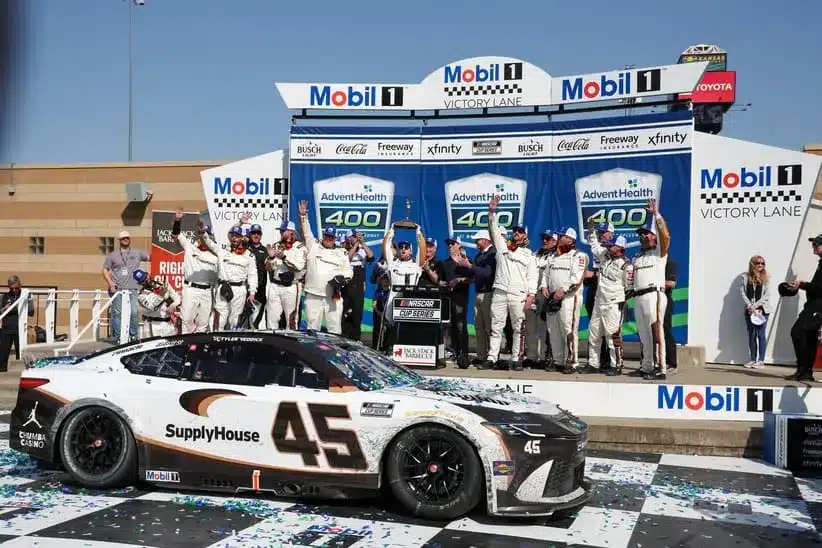
The 700‑horsepower thunder rolling off Kansas Speedway left one statistic echoing louder than the rest: Tyler Reddick has now won five of the first nine races of the 2026 NASCAR Cup Series season, a level of early‑year dominance the series hasn’t seen in more than a decade. His Kansas win wasn’t a fever pitch, a strategy steal, or a late‑race miracle. It was a methodical dismantling of the field.
Reddick led 102 laps, posted one of the best average running positions of the afternoon, and controlled every restart inside the final 50 laps. Fans didn’t need the timing sheets to understand what they were watching. The numbers told the story long before the checkered flag fell.This isn’t a hot streak. This is a driver and a team operating at a championship‑grade pace.
Steve Letarte saw this shift weeks ago. When a team finds rhythm before May, the entire garage feels it. The pressure moves off the winner and onto the 30‑plus teams scrambling to keep up. Letarte says the No. 45’s baseline speed is already forcing crew chiefs to rewrite their intermediate notebooks and Kansas only stretched that gap further.
The Relentless Drive of Tyler Reddick
Five wins in a single season is a career year for most drivers. Five wins before the All‑Star break put a driver into statistical territory reserved for the sport’s most dominant eras. Reddick has always maintained an elite pace, with two Xfinity (O’Reilly Series) championships and multiple Cup wins on road courses and intermediates.
Raw speed doesn’t create a run like this. Execution does. And the No. 45 team is executing at a clinical level. Their pit stops keep dipping under 10 seconds, their strategy has been flawless since Phoenix, and their simulation work is unloading fast everywhere. Reddick is matching it with elite tire management, carving grip out of lanes where others slide.
Teams use the Next Gen wake to protect track position without torching the right‑rear and to turn restarts into a decisive weapon. The confidence radiating from that group is unmistakable. And confidence, when paired with speed, becomes a competitive problem for everyone else.
Letarte On The Hot Hand
On Inside the Race, Letarte broke down what he calls Reddick’s “hot hand.” In racing, the hot hand isn’t superstition. It’s a measurable alignment of preparation, execution, and performance. The hauler setup is close. Practice speeds validate the data. The car responds to adjustments. And once the green flag drops, the race becomes a controlled execution drill.
Letarte emphasized that Reddick is no longer a driver who can steal a win when circumstances break his way. He’s become a driver the field expects to run top‑five every week. That expectation is backed by numbers.
Reddick has logged six top‑five finishes, led more than 350 laps this season, and has yet to finish outside the top 15 on an intermediate track. Letarte noted that sustaining this level is brutally difficult, but Reddick looks completely unfazed by the pressure.
Kyle Petty’s Read on the Dominance
Kyle Petty joined the broadcast to echo those sentiments. Petty has seen the greatest streaks in NASCAR history: Gordon in the ’90s, Johnson in the late 2000s, Kyle Busch’s multi‑win explosions, and he recognizes when a driver enters a mental zone where losing simply doesn’t compute.
Petty said Reddick is driving with a rare blend of aggression and discipline. That combination is dangerous. When a car is this fast, the biggest threat is self‑inflicted mistakes: overdriving a corner, speeding on pit road, abusing the rear tires, or forcing a pass that isn’t there.
Reddick is avoiding all of it. He’s letting the race come to him, trusting his crew, and striking exactly when the window opens. Petty and Letarte both agreed that this version of Tyler Reddick is a problem for the entire playoff grid.
What This Means
Five wins equal a massive haul of playoff points, giving the No. 45 team the freedom to experiment. They can gamble on strategy, test aggressive setups, and chase long‑term gains without worrying about postseason eligibility. That flexibility becomes a competitive advantage as the summer stretch approaches.
For the rest of the garage, the urgency ramps up. Teams that believed they had a strong intermediate‑track notebook are suddenly questioning their baseline. Kansas, Las Vegas, and Homestead all share aerodynamic characteristics, and Reddick has been fast at each. Matching his speed isn’t enough.
Teams must outthink a group that’s firing on every cylinder. The ripple effect is already visible. Organizations are shifting simulation priorities. Crew chiefs are adjusting tire‑falloff models. Drivers are studying Reddick’s lane choices on restarts. When one team raises the bar, the entire field is forced to respond.
What’s Next
The 2026 NASCAR Cup Series season is rapidly becoming the Tyler Reddick show. Watching a driver capture lightning in a bottle and sustain it week after week is one of the rarest sights in motorsports. Letarte said Reddick is becoming famous for this level of execution, and the numbers back it up.
The raw talent has finally aligned with the perfect situation, creating a devastating combination of speed, precision, and consistency. If the No. 45 team carries this momentum into the summer, the road to the championship will run straight through them, and everyone else will be chasing a moving target.
For More Great Content
Stay plugged in with more race analyses, features, and behind‑the‑garage storytelling. Follow Sarah on Facebook, LinkedIn, and X at Sarah Talker, where the conversation keeps rolling long after the checkered flag drops.
