
Kyle Larson Explains How He Held Off Justin Allgaier In The Final Laps At Texas Motor Speedway

FORT WORTH, Texas — The closing laps of the SpeedyCash.com 250 at Texas Motor Speedway delivered the kind of tension the 1.5‑mile oval is built for. With 20 degrees of banking in Turns 1 and 2 and 24 degrees in Turns 3 and 4, the track demands precision and punishes hesitation.
Kyle Larson needed every bit of that precision as Justin Allgaier mounted a late charge that nearly changed the outcome. Allgaier’s pace surged in the final stage, and twice in the last two laps, he closed to Larson’s bumper with enough momentum to threaten the lead.
Larson’s car tightened up, especially off Turn 2, and the gap between them shrank to just a couple of car lengths. From the stands, it looked like the No. 7 had the run he needed to make the winning move. Larson held on anyway, but the margin was razor-thin.
Breaking Down The Final Laps
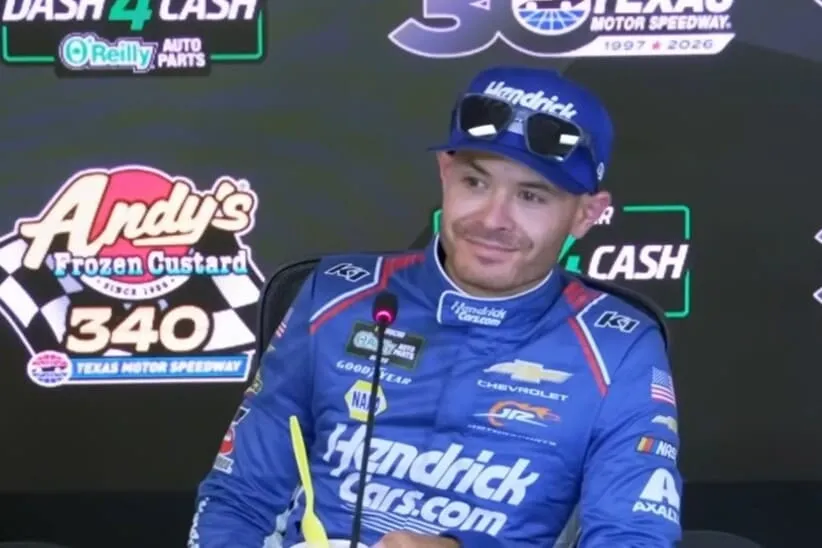
During the post‑race press conference, Total Apex Sports reporter Sarah Talker asked Larson to walk through the final moments of the race. The room had already quieted by the time she spoke, everyone waiting to hear how he managed those last two laps.
Larson leaned forward slightly, almost as if replaying the sequence in his head before answering. The tension of the finish was still written across his expression, and it was clear he understood exactly how close the battle had been.
“On the last couple of laps, it looked like Justin was going to pass you a couple of times. What was your strategy for keeping him at bay?” Talker asked.
Larson didn’t hesitate to admit how tough those final laps were. He said Allgaier clearly had the faster car and was building big runs off the corners, especially up high, which forced him to focus on clean exits and taking just enough air off Allgaier’s nose to slow the momentum. When he tried moving up to match the line, the car tightened immediately.
How Larson Managed The Toughest Laps Of The Afternoon
From the moment Larson hit the final laps, he said earning the win was simply about entering lower, protecting the bottom, and not giving Allgaier the mistake he needed. He knew Allgaier had more grip and more speed, but track position and a few clean exits were enough to keep the No. 7 behind him.
He said the car wasn’t perfect, but it was stable enough to let him control the entry and keep the rhythm he needed. Every lap became a small calculation of how low to enter, how much wheel to give it, and how to keep the rear planted just long enough to stay out front.
He said the key was keeping the car settled just long enough to finish the job, even as the balance faded. The rear wanted to step out more than he liked, but he trusted the line that had kept him out front all afternoon. In those moments, he relied on instinct more than anything on the dash, knowing one slip would have handed Allgaier the race.
What This Means
Larson’s win wasn’t about dominance. It was about execution under pressure. He didn’t have the faster car in the final laps, and he didn’t pretend otherwise. What he did have was the ability to adapt when the balance shifted and the confidence to defend the bottom without overdriving the entry.
For Allgaier, the run reinforces his status as one of the strongest drivers in the O’Reilly Auto Parts Series. His ability to generate speed in multiple lanes, especially late in the race, showed how well his team adjusted to the changing track.
For Larson, the victory provides valuable information heading into Sunday’s Cup Series race. He logged a full afternoon of data on tire falloff, lane migration, and how the resin behaved as temperatures changed, the kind of real‑time knowledge that often translates into a measurable advantage.
Wbat’s Next
The SpeedyCash.com 250 delivered the kind of finish Texas Motor Speedway is known for — tense, technical, and decided by precision rather than raw speed. Larson’s honesty afterward underscored just how close the battle truly was. He didn’t out‑run Allgaier; he out‑managed him. And on a track where the smallest mistake can erase a lead in seconds, that was enough.
As teams shift their focus to the Cup Series race, Larson’s Saturday performance stands as another example of why he continues to win across disciplines. He adapts, he adjusts, and when the pressure peaks, he finds a way to close.
For More Great Content
Stay plugged in with more race analyses, features, and behind‑the‑garage storytelling. Follow Sarah on Facebook, LinkedIn, and X at Sarah Talker, where the conversation keeps rolling long after the checkered flag drops.
