
Spotter Freddie Kraft Challenges NASCAR’s Driver Approval Process: Points At McFarland And Decker’s Daytona Performances


Daytona International Speedway has always been the sport’s great equalizer and its great separator. It’s a place where the draft can turn a mid‑pack truck into a contender, but it’s also a place where inexperience is exposed instantly and violently.
The track doesn’t care about your résumé, your fanbase, or your intentions. It cares about precision. It cares about discipline. And above all, it cares about whether you can hold a line when the air gets turbulent, and the lanes start shifting like a school of fish.
Drivers know this. Spotters know this. Crew chiefs know this. That’s why Daytona has always carried an unwritten rule: if you’re out there, you’d better belong out there. When someone doesn’t, the garage doesn’t whisper. It roars.
This year, that roar came through a microphone. Freddie Kraft, one of the most respected and unfiltered spotters in the sport, used his platform on Door Bumper Clear to call out NASCAR’s driver approval process. And he didn’t do it for shock value. He did it because, in his eyes, the system that’s supposed to protect the competitors failed them.
A Spotter’s View Of Who Belongs
Spotters are the unsung guardians of superspeedway racing. They see the race from a vantage point no driver ever will and a bird’s‑eye view of the entire pack, the runs forming, the blocks coming, the mistakes brewing. They know which drivers are predictable and which ones are wild cards. They know who can be trusted three‑wide and who can’t be trusted two‑wide.
Freddie Kraft has been doing this long enough to recognize patterns. He’s watched countless superspeedway races unfold, and he’s watched countless wrecks develop from a single moment of hesitation or misjudgment. So when he questions the approval process, it’s not coming from ego. It’s coming from experience.
On the Monday episode of his show, Kraft didn’t just question who was approved. He questioned how they were approved. He suggested that NASCAR’s criteria have shifted from evaluating a driver’s readiness to evaluating their marketability.
“Are we trying to get the best racecar drivers on the racetrack, or are we trying to get the biggest social media following?” he asked. That’s not a throwaway line. It’s a direct challenge to the sport’s current direction.
NASCAR wants growth, but Kraft argues that growth can’t come at the expense of the people risking their lives. Superspeedway racing is already unpredictable. Adding inexperience doesn’t make it exciting. It makes it dangerous.
The Cleetus McFarland Problem
Cleetus McFarland is a phenomenon in his own world, a massive online personality with a loyal following and legitimate car control in the disciplines he’s mastered. He’s built an empire on horsepower, entertainment, and spectacle. But Daytona is not a spectacle. It’s a discipline. And it’s one that takes years of repetition to understand.
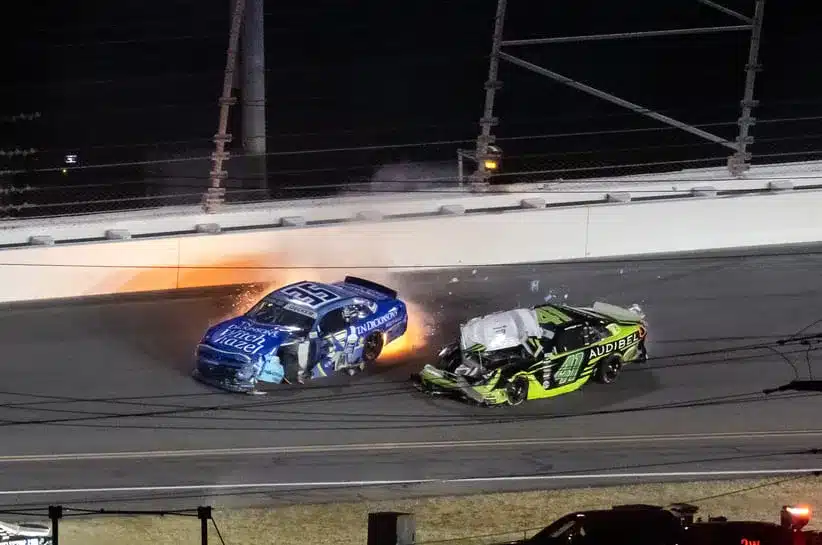
McFarland’s Truck Series race ended early, and Kraft pointed out that this wasn’t an isolated incident. McFarland has now entered three superspeedway‑style events and crashed in all three. One of those wrecks wiped out half the field on a restart, a moment that still frustrates drivers who were caught up in it.
Kraft didn’t hold back: “We’re just lucky the other night that he didn’t wipe out the Truck field because when he spun, he went down instead of up.”That’s the kind of nuance only a spotter sees. A spin up the track at Daytona is a disaster.
A spin down the track is a warning shot. Kraft’s point wasn’t that McFarland is a bad person or even a bad driver. He actually praised him as a “phenomenal person” with real talent in other forms of racing. The issue is readiness. Daytona is not a place to learn. It’s a place where one driver’s inexperience becomes everyone’s risk.
Natalie Decker and the Numbers That Don’t Add Up
Then came Natalie Decker, a driver who has long been a polarizing figure in the sport. Decker has a strong social media presence and a dedicated fanbase, but her on‑track results have consistently lagged behind the attention she receives.
Daytona marked her 14th Truck Series start. Kraft pointed directly at the numbers: an average finish of 29th and a pattern of being involved in incidents. Those aren’t opinions, they’re statistics. “First of all, how did she ever get approved?” he asked.
Kraft’s argument wasn’t that Decker shouldn’t race. It was that the approval process should be based on performance, not popularity. He argued that NASCAR needs a mechanism to reevaluate approvals when a driver consistently underperforms or becomes a recurring safety concern.
“At what point do you look and say, ‘Alright, we made a mistake approving this person, now we need to take it back.’”This is where Kraft’s criticism shifts from the drivers to the system. Decker and McFarland didn’t force their way into the field. They were allowed in. Kraft’s issue is that NASCAR didn’t step in and say, “Not yet.”
A Bigger Question for NASCAR’s Future
Kraft’s comments highlight a tension that’s been building for years. NASCAR wants to modernize. It wants younger fans, viral moments, and crossover appeal. But racing isn’t like other sports. The consequences of inexperience aren’t limited to poor performance. They can be violent, expensive, and dangerous.
If the approval process becomes perceived as lenient for influencers or drivers with large followings, it undermines the credibility of the field. It also creates resentment among drivers who spent years grinding through late models, ARCA, and regional tours to earn their shot. And that resentment matters.
NASCAR is built on a culture of respect for the craft, the equipment, and the danger. When someone enters the field without a résumé to back it up, it disrupts that culture. Spotters feel it. Drivers feel it. Crew chiefs feel it. And when someone like Kraft speaks up, it’s usually because the garage has been whispering the same thing.
A Warning NASCAR Can’t Ignore
Freddie Kraft didn’t start this conversation to stir controversy. He started it because he believes the system designed to protect the competitors failed them at Daytona. Superspeedways are unforgiving. They don’t care about your brand, your followers, or your marketing potential. They care about whether you can survive the draft.
Kraft’s message was clear: the approval process needs to be tightened, not relaxed. NASCAR can chase new audiences without compromising the integrity of the field. But it has to draw a line, and Daytona is the last place where that line should ever blur.
What’s Next
Whether NASCAR listens remains to be seen. But the warning has been delivered, and it came from someone who watches the danger unfold in real time. If the sport wants to protect the safety of the pack and the trust that makes superspeedway racing possible, this can’t be brushed aside. This is a crossroads moment. And the next decision NASCAR makes will say a lot about what kind of future it wants.
