
Inside Hamlin’s Approach: Trusting His Crew Chief Over 23XI Data

Modern NASCAR has shifted from a sport defined by brute force to one shaped by information. Teams now rely on simulation accuracy, engineering models, and thousands of telemetry lines to build speed before a single lap is turned on the track.
Every decision is influenced by data, from shock builds to aerodynamic balance, and the teams that understand how to apply that information rise to the front. The numbers matter, but the way those numbers are interpreted matters even more. No one sits closer to this evolution than Denny Hamlin, who straddles two roles that rarely intersect smoothly.
Hamlin’s Dual Role Inside Toyota’s System
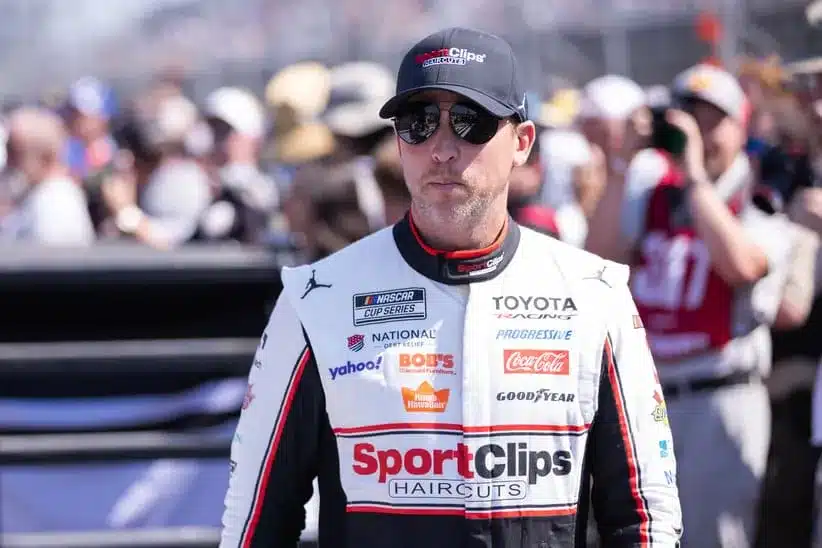
Hamlin drives the No. 11 Toyota for Joe Gibbs Racing, one of the most successful organizations in NASCAR history. At the same time, he co‑owns 23XI Racing, the rapidly ascending Toyota satellite team he built with Michael Jordan.
That dual identity places him in a unique position within the manufacturer’s ecosystem. He competes for one team while helping guide another, and both rely on the same technical foundation. The relationship between JGR and 23XI is close, but the competitive tension is impossible to ignore.
In recent seasons, 23XI has frequently outrun the parent team, and Hamlin has been open about how that dynamic has developed. It’s a shift that has forced both sides to rethink how they measure progress.
How the JGR–23XI Pipeline Works
The partnership between JGR and 23XI is built on a full technical alliance. Industry estimates place the annual cost of that alliance at roughly $8 million, a figure that covers engineering support, access to simulations, and shared data.
The teams use the same simulation software, the same wind‑tunnel information, and the same baseline setups. Nothing is hidden, and nothing is off‑limits. The information flows in both directions, and both groups have access to the same tools. Yet the results on track often look very different.
Tyler Reddick opened the season with four wins in the first six races, while the JGR cars struggled to match that pace. The difference is not in the equipment. The difference is in how each team uses the information.
Why Identical Data Produces Different Results
To understand the split, you have to understand how a modern Cup Series weekend begins. Preparation starts long before the haulers arrive at the track. The engineering groups build a baseline setup more than a week before the race, agreeing on the initial shock package, spring rates, and weight distribution.
Once the foundation is set, the drivers take over. They climb into the simulator and begin logging laps, and every lap produces feedback. If the car is too tight in the center, the engineers adjust. If the rear steps out on the corner exit, they tweak the virtual setup.
The process repeats until the driver feels confident in the digital version of the car. Even though the teams start with the same blueprint, the drivers push their setups in different directions. Each adjustment sharpens their understanding of how the real car should behave.
The Setup Process That Splits the Teams
Reddick prefers a car that rotates aggressively on entry and snaps to the bottom. Hamlin prefers a car that stays planted and stable over long runs. Christopher Bell, Chase Briscoe, and Bubba Wallace all have their own preferences as well.
The engineers build what the drivers ask for, and the drivers ask for what suits their style. That is why two teams with the same information can unload with two completely different race cars. The data may be identical, but the interpretation is not.
The setups evolve based on feel, and feel is personal. That is the heart of the divide between the two organizations. The numbers guide the process, but the drivers shape the final product. And that final layer of interpretation is where philosophies truly separate.
Trusting the Driver Over the Numbers
Hamlin has addressed the obvious question: if 23XI Racing hits the setup perfectly, why not copy it? His answer is simple. A setup that makes Reddick unbeatable might make Hamlin miserable. Driving styles are not interchangeable, and forcing a driver into someone else’s setup usually leads to disaster.
Hamlin trusts his own instincts and the instincts of his crew chief. He rarely looks at 23XI’s setup sheets before a race because second-guessing his own team would only create confusion.
After the race, he may review the data to understand why another driver excelled, but once the weekend begins, he commits to his own path. That discipline is part of what has kept him competitive for nearly two decades.
What This Reveals About the Next Gen Era
The broader takeaway is clear. In the Next Gen era, the cars are standardized. Teams cannot fabricate trick parts or out‑spend their rivals. Every organization receives the same chassis, suspension components, and aerodynamic platform.
The only remaining advantage is how well a team understands the information in front of it. Data alone does not win races. The ability to translate that data into a car that handles traffic, manages tire wear, and adapts to changing track conditions is what separates contenders from pretenders.
23XI Racing has excelled in that area. Their engineers have shown a remarkable ability to identify the right setup direction early in the week, and their drivers have provided clear, actionable feedback that sharpens the final product.
The Bigger Picture for Toyota
The alliance between Joe Gibbs Racing and 23XI Racing remains one of the most intriguing relationships in the sport. Hamlin stands at the center of it, balancing the competitive fire of a driver with the long‑term responsibility of building a championship‑caliber organization.
The data will always be shared, and the equipment will always be equal. But when the engines fire, the spreadsheets fade into the background. Success comes down to which team chooses the right path during the week and which driver can push that setup to its limit.
Right now, 23XI is executing at a remarkably high level, but momentum in NASCAR never stays in one place for long. Another swing is coming. The only question is which team catches it first. And when it does, the entire competitive landscape can shift overnight.
What’s Next
The partnership between Joe Gibbs Racing and 23XI Racing has created one of the most compelling dynamics in the sport, and Denny Hamlin sits squarely in the middle of it. Both teams share the same information, yet their results often diverge because instinct and interpretation still matter more than any spreadsheet.
The Next Gen era has leveled the mechanical playing field, putting a premium on feel, feedback, and execution. Right now, 23XI is turning that combination into results, but momentum in NASCAR never stays still for long. The next shift in this rivalry is already on the horizon.
