
Denny Hamlin Captures First 2026 Cup Win In A Defining Las Vegas Performance

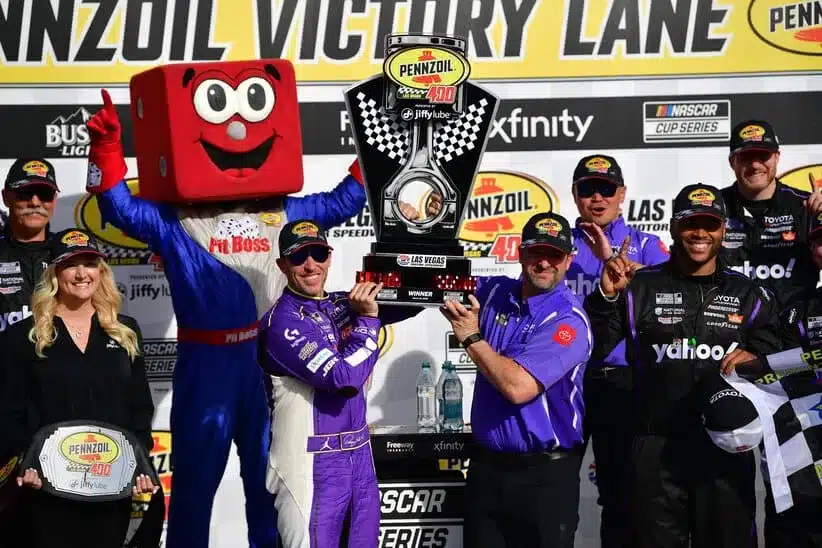
Denny Hamlin arrived in Las Vegas with pressure building around him. Three races into the 2026 NASCAR Cup Series season, the headlines belonged almost exclusively to Tyler Reddick, whose three‑race winning streak had put the entire garage on notice. Hamlin, meanwhile, had been consistent but winless, answering the same question every week: When will the No. 11 break through?
On March 15, 2026, under the bright desert sun and in front of a sold‑out Las Vegas Motor Speedway crowd, Hamlin delivered the answer with authority. His victory snapped a nine‑race winless stretch dating back to late 2025 and marked his 58th career Cup Series win, tying him with Kevin Harvick for 10th on the all‑time list. For a driver who has built a career on resilience, this one meant more than most.
Hamlin Takes Control At The Right Moment
Las Vegas Motor Speedway has long been one of Hamlin’s most reliable battlegrounds. The 1.5‑mile tri‑oval rewards drivers who excel in long‑run pace, tire conservation, and aerodynamic discipline, three areas where Hamlin has historically thrived. Entering the weekend, he held an average finish of 8.9 at the track over the previous seven races, including a win in 2021 and multiple top‑five runs.
That familiarity showed immediately. Hamlin didn’t dominate from the drop of the green flag, but he never drifted far from the front. He spent more than 120 laps inside the top five, steadily improving the balance of the No. 11 Toyota with each pit stop. His long‑run speed was among the best in the field, with lap times consistently within the top three on runs exceeding 20 laps.
When the race transitioned into its final stage, Hamlin’s car came alive. He took the lead for the final time with just under 40 laps to go, pulling away by more than 1.7 seconds at one point. The closing laps showcased the precision that has defined Hamlin’s career. He protected the bottom lane and managed his tire wear.
Surprisingly, he never allowed the field to mount a serious challenge. His fastest lap of the race, 30.11 seconds at 179.2 mph, came during a long green‑flag stretch, a sign of just how strong the No. 11 was when it mattered most. Hamlin didn’t just win; he controlled the race with the poise of a veteran who has mastered the art of timing.
What This Win Means For Hamlin And Joe Gibbs Racing
Context is everything. Joe Gibbs Racing entered Las Vegas riding the momentum of Reddick’s historic start, becoming the first driver since 2007 to win the first three races of a Cup season. Toyota had led more than 65% of all laps through the opening stretch, and the organization appeared to be operating at peak efficiency.
But even in a powerhouse stable, every driver wants and needs his own moment. For Hamlin, this victory carries weight beyond the trophy. At 45 years old, he remains one of the sport’s most accomplished active drivers, with multiple Daytona 500 wins and four Championship 4 appearances.
Yet the absence of a Cup title continues to fuel his competitive fire. A win this early in the season not only locks him into the playoffs but also reestablishes him as a legitimate championship threat. It also quiets the narrative that Reddick had become the clear No. 1 within the JGR lineup.
The No. 11 team also proved something important: they are still one of the most complete units in the garage. Their pit crew executed flawlessly, gaining Hamlin a combined six positions over the course of the race. Crew chief Chris Gayle made aggressive but calculated adjustments that improved the car’s balance throughout the afternoon.
When a team performs at that level, wins aren’t accidents. They’re expectations. For JGR as a whole, having two drivers win in the first four races strengthens their early grip on the manufacturer standings. It also sends a message to the rest of the field: this organization is deeper, faster, and more unified than it has been in years.
The Las Vegas Factor And Hamlin’s Legacy
Las Vegas Motor Speedway has played a meaningful role in Hamlin’s career arc. His previous win at the track came in 2021, but he has finished inside the top 10 in nine of his last 12 starts there. The track’s progressive banking and wide racing surface allows Hamlin to use his strengths: patience, rhythm, and tire management, to full effect.
When the race reached its decisive phase, he looked like a driver completely in sync with both the track and his equipment. Trust was the theme of the afternoon. Hamlin trusted his car to respond on long runs. He trusted his crew to make the right calls. And he trusted his instincts when the race tightened in the final 20 laps.
That level of confidence is rare, and it’s often the difference between finishing second and finishing first. Gabehart’s strategy was equally crucial. Opting for a two‑stop approach in the final stage, he positioned Hamlin to attack when others were forced to conserve.
The pit crew delivered a 10.88‑second stop on the final service, one of their fastest of the season, which gave Hamlin the track position he needed to close the deal. In a sport where races are often decided by tenths of a second, the No. 11 team executed with championship‑level precision.
What’s Next
Denny Hamlin’s Las Vegas victory served as a timely reminder of his enduring strength in the Cup Series, ending his early‑season drought and reestablishing him as a legitimate contender in 2026. After weeks spent watching others dominate the headlines.
He delivered the kind of poised, calculated performance that has defined his career, securing momentum that will matter as the season stretches toward summer and the playoff picture sharpens. The win didn’t just break the streak. It reaffirmed that Hamlin remains a force the field cannot overlook.
