
Why The Goodyear 400 At Darlington Is A Crew Chief’s Most Stressful Race Of The Year

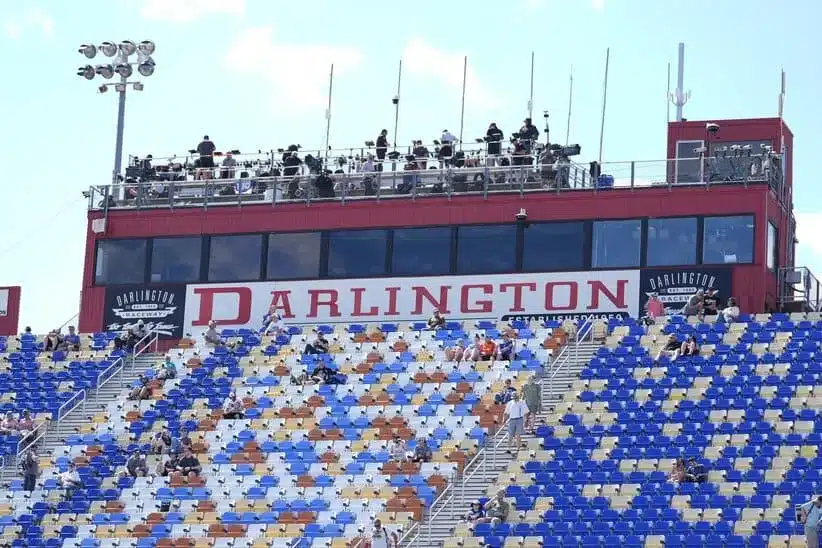
There’s a certain tension that settles over Darlington Raceway long before engines fire. The track’s reputation precedes it. “The Lady in Black” has ended championship runs, destroyed race-winning cars, and humbled some of the sport’s best. Drivers know they’re in for a physical and mental beating.
Yet, for crew chiefs, the Goodyear 400 is something else entirely, a four‑hour strategy gauntlet where one wrong call can erase an entire week’s worth of preparation. That pressure was already visible in the garage before practice even began. RFK Racing’s Chris Buescher didn’t hide how much he sympathized with his crew chief, Scott Graves.
With tire wear expected to be extreme and NASCAR’s updated rules package reducing aerodynamic stability while increasing horsepower, Graves faces a weekend full of decisions that could make or break the No. 17 team’s afternoon.
Darlington’s Surface: A Tire Shredder With No Mercy
Darlington’s abrasive asphalt has always been brutal, but this year’s combination of higher horsepower and reduced downforce has amplified the challenge. The track surface is already known for chewing through Goodyear rubber, and it becomes even more punishing under the South Carolina sun.
Temperatures in the mid‑80s during practice baked the surface, turning it slick and unpredictable. The radio chatter reflected the struggle. Joey Logano, a two‑time Cup Series champion, told crew chief Paul Wolfe he was “sideways everywhere” and simply trying to keep the No. 22 Ford pointed straight.
Rookie Zane Smith echoed the same concerns, reporting multiple near‑spins during a single run. Even veterans were fighting their cars from the moment they rolled off pit road. The numbers back it up. Lap‑time falloff during practice averaged 1.3 to 1.6 seconds over a 10‑lap run and was one of the steepest drop‑offs of any track on the schedule.
Michael McDowell said his first lap in practice “felt like a 15‑lap tire” compared to last season. That kind of degradation forces crew chiefs to rethink everything they know about Darlington strategy.
The New Rules Package Adds Another Layer Of Chaos
Ross Chastain’s first‑year crew chief, Brandon McSwain, was one of the first to point out how dramatically the new rules package changed the feel of the car. With less aerodynamic grip and more horsepower, drivers are sliding earlier, harder, and more often.
Teams expected a falloff, but not this much, this fast. The good news? Practice gave them data. The bad news? That data suggests Sunday’s race will be even more treacherous. As rubber builds up and temperatures rise, the track will only get slicker.
Crew chiefs know they’re heading into a race where grip will disappear almost instantly, and tire management will dictate every decision. Every lap becomes a calculation. One wrong assumption about falloff can bury a driver before the stage break.
A Limited Tire Allotment Creates A High‑Stakes Strategy Battle
The Goodyear 400 is 293 laps, broken into stages at Lap 90 and Lap 185. Teams have 10 sets of new tires, plus one set carried over from qualifying. That’s it. No extras. No safety net. With a falloff approaching two seconds over a long run, crew chiefs must decide when to pit, how often to pit, and whether to save a set for a late caution that may never come. It’s a strategic minefield.
Corey Heim’s win in the Craftsman Truck Series race earlier in the weekend proved how valuable a scuffed set can be during a late restart. But saving a set is a gamble. If the caution never comes, a team could finish the race with fresh tires sitting unused, a nightmare scenario for any crew chief.
Ryan Sparks, who calls the shots for Daniel Suárez, said the ideal plan would be splitting a stage with one stop. But with drivers begging for tires after 25–30 laps, that plan may not survive the opening run. Tyler Reddick stretched a set to 42 laps in practice, but admitted he was “hanging on for dear life” by the end.
Pit Road: Darlington’s Hidden Danger Zone
As if tire strategy weren’t enough, Darlington features one of the most unforgiving pit‑road entries in NASCAR. Drivers must drop off the banking of Turn 4 at high speed and hit a narrow commitment line. Miss it by inches, and the penalty ruins your day.
Because many stops will occur under green, drivers will be diving onto pit road with completely worn-out tires. Sparks noted that teams pitting toward the far end of pit road get a few extra seconds to prepare.
However, that advantage comes at a cost: drivers enter their stall at a higher speed, increasing the risk of overshooting the box or sliding through. It’s a sequence that requires absolute precision. One mistake, a lockup, a speeding penalty, a missed stall, can erase 30 laps of hard work.
What Fans Should Expect On Sunday
For fans, The Goodyear 400 won’t be a simple horsepower showcase. It will be a race of survival and strategy. The fastest car may not win. The smartest team might. The race will reward discipline, patience, and the ability to adapt on the fly. Here’s what to expect:
- Multiple strategy splits as teams choose between track position and fresh tires.
- Huge lap‑time swings depending on tire age.
- Drivers pitting earlier than expected to avoid losing two seconds per lap.
- Crew chiefs gambling on late cautions.
- At least one major pit‑road mistake shaping the outcome.
What’s Next
Darlington Raceway demands respect, and it punishes anyone who shows up unprepared. Drivers will climb out of their cars physically drained, but the crew chiefs will be just as exhausted, mentally spent from four hours of nonstop decision‑making.
Managing tire allotment, navigating the lack of grip, and predicting caution timing is a monumental task. The Goodyear 400 isn’t just a test of speed. It’s a strategic battlefield. And on Sunday, the sharpest minds on pit road will decide who survives the afternoon.
