
Ferrari Unleashes The SF‑26: Inside The Secret Test To Catch Mercedes

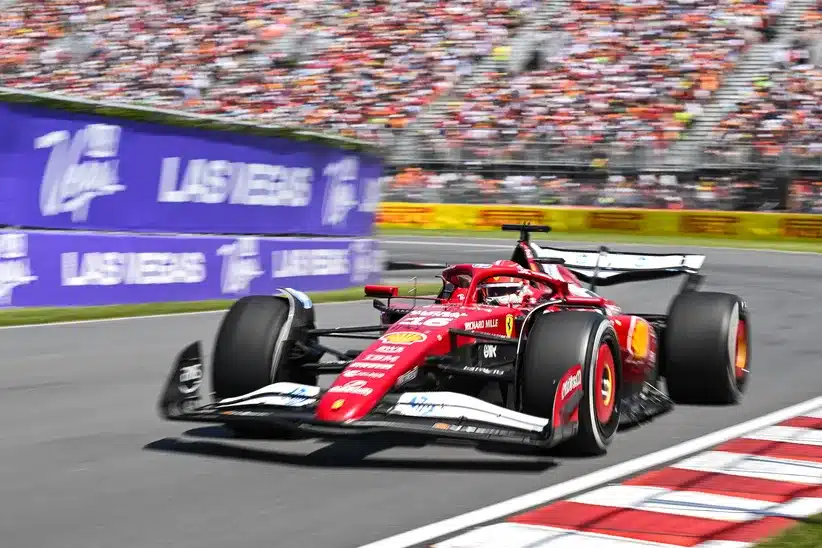
Ferrari has entered the 2026 season with a clear sense of urgency. The SF‑26 has already shown a competitive pace, and podiums for Lewis Hamilton and Charles Leclerc in Australia and China confirmed the car’s potential.
But potential isn’t enough when Mercedes is setting the early benchmark. Ferrari wants wins, and with a rare break in the calendar, the team is preparing a private test designed to extract the performance they’re still missing.
The Raw Power of the 2026 Season Break
The cancellation of the Bahrain and Saudi Arabian rounds created an unusual five‑week gap between the Japanese Grand Prix in late March and the Miami Grand Prix in early May. In a sport built on constant motion, a break this long is almost unheard of. For Ferrari, it’s a chance to reset, analyze, and refine.
The 2026 regulations have reshaped the technical landscape. The removal of the MGU‑H and the increase of the MGU‑K to 350 kW have forced teams to rethink energy management from the ground up. Ferrari’s 1.6‑liter turbo V6 and hybrid system have been reliable.
Yet, the team knows they’re leaving performance on the table. This break allows engineers to dig into deployment patterns, cooling behavior, and aerodynamic efficiency without the pressure of a race weekend compressing their timeline.
Unleashing the SF‑26: The Secret Filming Day
Formula 1 teams are allowed two filming days per season, each capped at 200 kilometers of running. Officially, these sessions exist for promotional footage. In practice, they’re one of the few legal opportunities to gather real‑world data outside of race weekends.
Ferrari’s January run at Fiorano was classified as a demonstration event, meaning both filming days remain unused. The team plans to deploy one during the April break to evaluate the SF‑26 under controlled but meaningful conditions. With the car’s new push‑rod suspension, revised aero surfaces for the 2026 active‑aero rules.
This also includes a lighter gloss paint finish to reduce weight. Ferrari wants to understand how these elements behave at speed. A filming day allows them to test engine maps, hybrid deployment strategies, and aerodynamic tweaks without burning through limited testing allowances.
Chasing the Silver Arrows On The Straights
Mercedes has been the class of the field in straight‑line performance so far. Their energy deployment is strong, their top‑end speed is consistent, and their hybrid system maintains power deeper into the straights than most rivals. Hamilton, now driving for Ferrari, has been direct about where the SF‑26 is losing time.
Ferrari’s hybrid system is experiencing more electrical de‑rating at the end of long straights, meaning the car loses power just when it needs it most. With the MGU‑K now responsible for up to 350 kW of output, optimizing battery recovery and deployment is critical.
Ferrari’s engineers are working to improve harvesting under braking, reduce thermal losses, and refine the interaction between the turbo and hybrid systems under full load. If they can close the gap in straight‑line performance, the SF‑26 becomes a far more dangerous contender.
Why Monza Is The Ultimate Proving Ground
If Ferrari wants to test straight‑line speed, Monza is the logical choice. The circuit is the fastest on the calendar, with cars regularly exceeding 350 km/h and averaging more than 250 km/h over a lap. It’s a track that exposes weaknesses immediately.
Battery drain, drag inefficiency, turbo lag, and thermal instability all become obvious within a few laps. Running the SF‑26 for 200 kilometers at Monza would give Ferrari the data they need to refine low‑downforce aero packages and hybrid deployment strategies.
It also mirrors the demands of upcoming circuits like Miami, Spa, and Mexico City. Using a filming day at such a demanding track is a calculated risk, but it’s the kind of decision that can shift the competitive balance.
What This Means For The Championship Fight
Ferrari’s approach signals a clear intent: they’re not content with podiums. They’re using every available tool to close the gap to Mercedes, and they’re doing it early enough in the season to make a difference. If the team can solve its energy‑deployment issues and unlock more top‑end speed, Hamilton and Leclerc will have a car capable of consistently fighting for wins.
A productive Monza filming day could become a turning point in the 2026 season. Ferrari already has the drivers and the foundation. What they need now is the final layer of performance that transforms a competitive car into a race‑winning one.
What’s Next
Ferrari believes the SF‑26 has more to give, and the team is determined to find it. With a rare break in the schedule and a strategic filming day on the horizon, they’re preparing to refine the car in ways that could reshape the season. When the lights go out in Miami, the rest of the grid will see whether Ferrari used this time to regroup or to reload.
