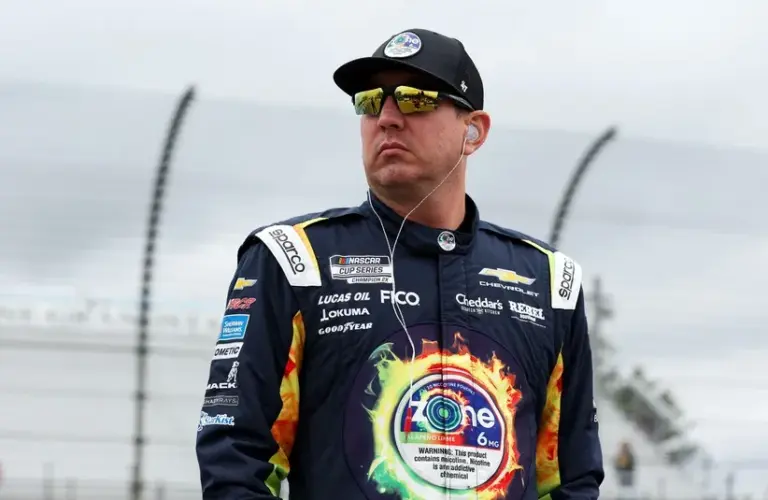


Rajah Caruth is attempting something almost no driver in the NASCAR O’Reilly Auto Parts Series is asked to do: compete for a playoff spot while splitting his season between two different teams, two different engine programs, and two completely separate race shops.
Most drivers operate out of one building, one simulator program, one crew chief, and one engineering group. Caruth’s reality is the opposite. Some weeks, he reports to JR Motorsports’ Mooresville headquarters, home to a four‑car operation with a combined 50+ O’Reilly Series wins and one of the most advanced simulation programs in the garage.
There, he drives the No. 88 Chevrolet, powered by a Hendrick Motorsports engine, the same engine department that has produced 300+ Cup Series victories. Other weeks, he drives 25 minutes north to Jordan Anderson Racing in Statesville, where he pilots the No. 32 Chevrolet with Earnhardt‑Childress Racing engines and a smaller, leaner crew.
The sponsor lineup, engineering notes, and setup philosophy all change the moment he walks through the door. Yet the mission never changes: stay in the playoff fight.Through eight races, Caruth has driven five events for JR Motorsports and three for Jordan Anderson Racing. Despite the split, he sits 10th in the standings, squarely inside the playoff grid.
The Logistical Reality of Running Two Programs
Most of his competitors enjoy 40+ hours per week with the same group of people. Caruth divides that time between two buildings, two schedules, and two expectations. Yet, once he arrives at the track, the noise disappears.
His focus now shifts to raw speed and execution. Switching between two teams isn’t just inconvenient. It’s a competitive disadvantage. Each transition forces him to recalibrate faster than the drivers he’s racing against. Caruth must also adapt weekly to different:
- Crew chiefs
- Spotters
- Simulation models
- Setup philosophies
- Communication styles
That approach has kept him afloat in a season where inconsistency could have buried him early. The physical toll is real travel, debriefs, and double the meetings. The mental toll is heavier.
He’s racing against drivers with unified programs while he’s juggling two. Caruth calls it necessary. He believes the experience of grinding out top‑20s in lesser equipment will make him lethal when he finally lands a full‑time, top‑tier ride.
Caruth and the Search for Consistency
Rajah Caruth’s best run came at Rockingham, where a late‑race surge delivered a career‑best fourth place, locking him into the Dash 4 Cash at Bristol. He also muscled the No. 32 to eighth at Phoenix, outperforming the car’s average finish by a wide margin. The numbers tell the story of a season defined by peaks and valleys:
- JR Motorsports: 1 top‑five, 3 top‑10s, 5 starts.
- Jordan Anderson Racing: 1 top‑10, 3 starts.
However, the growing pains are obvious. A late‑race incident with Jesse Love at Martinsville wiped out a top‑10 and dropped him to 25th. An early‑season mistake at EchoPark Speedway cost him track position and points he still regrets.
Caruth, who holds a Motorsports Management degree from Winston‑Salem State University, grades his season as a C+ or B‑. He believes he has left results on the table, and he’s right. He knows the execution hasn’t matched the speed he’s shown in flashes. The margin for error in a split‑team season is thin, and he’s felt every bit of it.
A Non‑Traditional Path To The Garage
Caruth is only 23 years old, and his path is one of the most unconventional in the field. He didn’t grow up in quarter midgets or late models. He started on iRacing, using simulation racing to earn real‑world opportunities.
Now he’s in a contract year with no guaranteed future. No multi‑year deal. No promised Cup Series pipeline. Every lap matters because every lap is an audition. He knows it. The garage knows it. Owners know it.
What This Means
Caruth’s season is a case study in modern NASCAR development. Funding still dictates opportunity, but Caruth is proving that adaptability and grit still carry weight. His willingness to run a split schedule, something most prospects avoid, shows he’s willing to take the hard road for seat time.
If Caruth reaches the playoffs while juggling two teams, he’ll send a clear message to every Cup Series owner: he can handle pressure, complexity, and adversity. He’s also become the clearest example that sim racers can break into NASCAR, but only through relentless work and real‑world results.
What’s Next
Rajah Caruth is staring down the most important season of his career. The dual responsibilities of driving for JR Motorsports and Jordan Anderson Racing would overwhelm many drivers. Instead, he’s using the friction to sharpen his racecraft.
He’s owning his mistakes, maximizing his equipment, and fighting for every point in a series where nothing is guaranteed. When the season ends in November, Caruth intends to walk away knowing he emptied the tank. The O’Reilly Auto Parts Series is unforgiving. But Caruth is proving he’s built for the climb.
 Don't stop here
Every Score. Every Story. One Home.
Breaking sports, entertainment and news from across the Total Apex network, updated all day.
Get the Full Story →
Don't stop here
Every Score. Every Story. One Home.
Breaking sports, entertainment and news from across the Total Apex network, updated all day.
Get the Full Story →