
Lap‑2 Chaos at Kansas Sends Carson Kvapil Into A Violent Backstretch Rollover

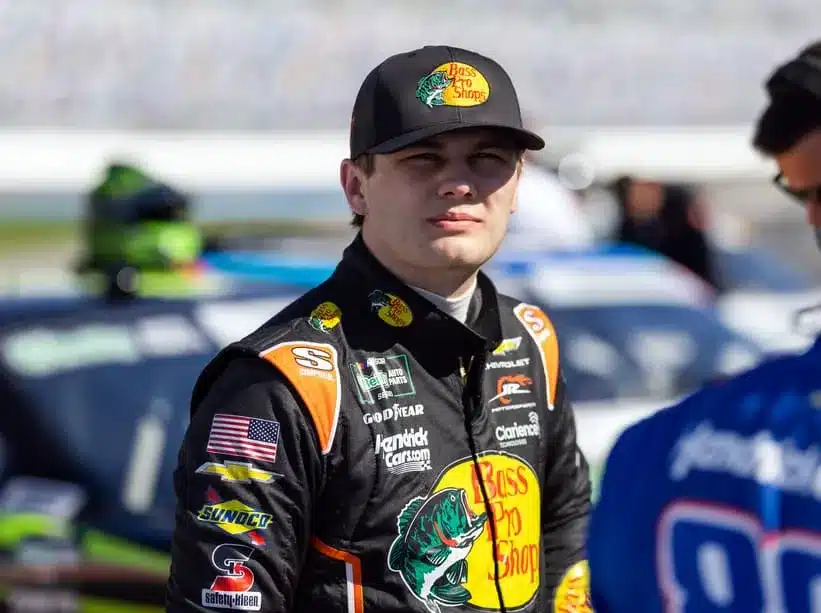
Kansas Speedway has seen dramatic nights before, but Saturday delivered one of its most violent crashes in years. The O’Reilly Auto Parts Series race had barely started when the backstretch erupted, sending the pole‑sitter’s car tumbling through sparks and debris. Carson Kvapil’s night ended less than a minute after the green.
The weather set the stage for it. Severe storms wiped out all Friday track time, forcing NASCAR to set the lineup by the performance metric formula and putting Kvapil on the pole. The 22‑year‑old entered fifth in points with one of his team’s best intermediate cars.
The plan was simple: control the early laps and settle in. Instead, the opening moments unraveled in a chain reaction no one saw coming. What was supposed to be a calm settle‑in phase became a scramble for survival. By the time the field reached the backstretch, the race had already shifted from strategy to damage control.
Lap 2 Turns Violent In A Three‑Wide Battle
Kansas Speedway demands precision at nearly 185 miles per hour, and the first two laps often set the tone for the night. Kvapil led the field to green with teammates William Byron and Justin Allgaier lined up behind him. By the time the pack reached Turn 2 on Lap 2, the intensity had already spiked.
Kvapil found himself in a tight three‑wide battle, with Byron charging the inside lane and Allgaier rolling the top. The air grew turbulent, the lanes compressed, and the margin for error evaporated. A slight shift in momentum was all it took for the whole situation to spiral out of control.
As the trio exited Turn 2, William Byron made slight contact with the left‑rear quarter panel of Kvapil’s Chevrolet. The touch was small, but at that speed, it was enough to destabilize the No. 1. Kvapil counter‑steered to save the slide, but the car snapped right and slammed head‑on into the outside wall.
Secondary Hit Launches Kvapil Into One Of The Season’s Wildest Crashes
Parker Retzlaff, with smoke and debris blocking his view, plowed into the passenger side of Kvapil’s crippled car at full speed. The secondary hit acted like a launch point, lifting the rear of the No. 1 off the ground.
What followed was one of the most violent sequences of the season. Kvapil’s car rotated, flipped, and tumbled down the backstretch, shedding sparks, sheet metal, and suspension pieces. It skidded on its roof, flipped again, and finally came to rest upside down near the entrance of Turn 3.
The crash looked more like a superspeedway “big one” than a typical intermediate‑track incident. For several seconds, the only sound in the stadium was the crackle of radios and the distant hum of idling engines.
A Twelve‑Minute Rescue And A Walk‑Away Moment
The red flag flew immediately as safety crews rushed to the wreck. It took twelve minutes to stabilize the car and carefully roll it back onto its wheels. Fans held their breath until Kvapil finally climbed out under his own power, raising a hand to signal he was okay.
The relief was immediate and widespread. He was transported to the infield care center, evaluated, and released shortly afterward. Despite the violence of the crash, Kvapil remained composed, though visibly frustrated. He knew he was fortunate to walk away from a crash that could have ended much differently.
He admitted he never expected the car to flip from that angle and said his biggest disappointment was losing a car his team believed could contend for the win. The No. 1 Chevrolet was one of JR Motorsports’ best intermediate packages of the season, and losing it on Lap 2 with no chance to show its speed stung deeply.
Championship Implications And Team Fallout
The crash is a significant setback in Kvapil’s championship campaign. Entering Kansas fifth in points, a last‑place finish hands valuable ground to his rivals and forces the No. 1 team into recovery mode. It puts even more pressure on the next stretch of races, where mistakes carry an even steeper cost.
With the playoffs approaching, every point matters, and losing a top‑five starting position and a potential top‑five finish on Lap 2 is a blow that will echo through the standings.JR Motorsports will also face internal discussions after two teammates made contact less than two laps into the race.
Multi‑car organizations emphasize cooperation early in events, and losing two cars in the same incident is a frustration no team owner takes lightly. The team will review the footage, evaluate communication, and determine how a three‑wide battle between teammates escalated so quickly.
Safety Questions and NASCAR’s Next Steps
Beyond the competitive implications, the crash raises renewed questions about the aerodynamic behavior of the current cars. Intermediate‑track flips are rare, and NASCAR will analyze the data to understand how the No. 1 caught air after the secondary impact.
Engineers will study telemetry, video angles, and damage patterns to determine whether airflow beneath the car contributed to the rollover. Safety officials will also review how the roof, roll cage, and window net performed during the violent sequence.
Every major crash becomes a case study, and this one will receive close scrutiny. It exposes how quickly small misjudgments can escalate. Analysts will break down every angle to understand what triggered the sequence. Teams will use those findings to tighten their own margins before the next race.
A Night Kansas Speedway Won’t Forget
Saturday night’s wreck will be remembered for the harrowing image of Carson Kvapil’s car tumbling down the backstretch, sparks trailing behind it as the field scattered to avoid the debris. It was the kind of crash that freezes a crowd and tests every safety innovation the sport has built over the past two decades.
Kvapil walked away with the most important outcome of the night, but the wreck leaves his team with a destroyed Chevrolet, lost points, and a long week ahead. He will return to the seat with the same determination that put him on the pole. It’s the kind of setback that tests a team’s resolve as much as its equipment.
However, Kansas will stand as a brutal reminder of how quickly a race can turn. The racing community moves forward, grateful for the safety systems that protected him and aware that even in a sport built on speed, survival sometimes becomes the story. It’s a moment that will stay with everyone who watched the night unravel in an instant.
What’s Next
In the end, the wreck will fade from the highlight reels long before the lesson it leaves behind. Kansas reminded everyone how thin the margin is between control and catastrophe, and how quickly a promising night can turn on its head. It’s the kind of moment that stays with a driver long after the car is repaired and the points are reset.
For Kvapil and his team, the only option now is to regroup, rebuild, and move forward because in this sport, the next green flag always comes faster than the last crash. It’s a rhythm every team learns to live with, no matter how hard the last hit landed.
For More Great Content
Stay plugged in with more race analyses, features, and behind‑the‑garage storytelling. Follow Sarah on Facebook, LinkedIn, and X at Sarah Talker, where the conversation keeps rolling long after the checkered flag drops.
