
2026 Autotrader 400 Entry List: Cup Series Heads To Atlanta With A Full Field

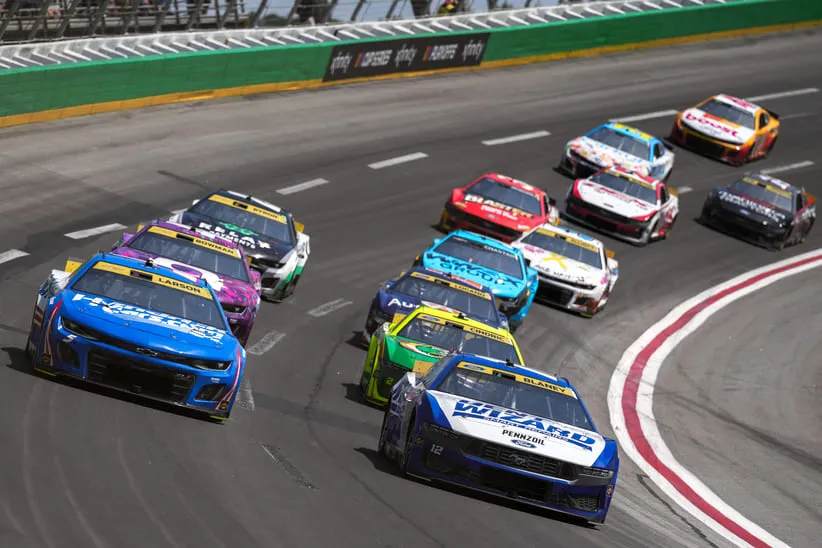
The Daytona 500 is barely behind us, but the NASCAR Cup Series doesn’t offer much time to settle in. The haulers are already parked in Hampton, Georgia, and the focus shifts to Atlanta Motor Speedway for the second race of the 2026 season.
The transition from Daytona to Atlanta is always abrupt. Daytona gives drivers room to breathe; Atlanta compresses everything into a mile and a half while still demanding the same discipline and awareness required on a superspeedway.
Tyler Reddick arrives with the confidence that comes from winning the Daytona 500, but Atlanta has a way of leveling the field. Since its reconfiguration, the track has raced like a superspeedway with far less margin for error.
The speeds remain high, the lanes stay narrow, and the draft becomes unpredictable in a hurry. Drivers who excel at reading air movement and anticipating runs tend to rise, while those who hesitate often find themselves caught in someone else’s mistake.
This weekend’s entry list includes 38 drivers. Every team that made the trip will compete, and the field reflects a mix of championship contenders, established veterans, and smaller operations hoping to capitalize on the volatility Atlanta often produces.
Full Entry List for the 2026 Autotrader 400 (38 Cars)
Chartered Cup Series Teams (1-36)
- 1. Kyle Larson – No. 5 (Hendrick Motorsports)
- 2. Chase Elliott – No. 9 (Hendrick Motorsports)
- 3. William Byron – No. 24 (Hendrick Motorsports)
- 4. Alex Bowman – No. 48 (Hendrick Motorsports)
- 5. Denny Hamlin – No. 11 (Joe Gibbs Racing)
- 6. Martin Truex Jr. – No. 19 (Joe Gibbs Racing)
- 7. Christopher Bell – No. 20 (Joe Gibbs Racing)
- 8. Ty Gibbs – No. 54 (Joe Gibbs Racing)
- 9. Austin Cindric – No. 2 (Team Penske)
- 10. Ryan Blaney – No. 12 (Team Penske)
- 11. Joey Logano – No. 22 (Team Penske)
- 12. Josh Berry – No. 4 (Stewart‑Haas Racing)
- 13. Noah Gragson – No. 10 (Stewart‑Haas Racing)
- 14. Chase Briscoe – No. 14 (Stewart‑Haas Racing)
- 15. Ryan Preece – No. 41 (Stewart‑Haas Racing)
- 16. Austin Dillon – No. 3 (Richard Childress Racing)
- 17. Kyle Busch – No. 8 (Richard Childress Racing)
- 18. Bubba Wallace – No. 23 (23XI Racing)
- 19. Tyler Reddick – No. 45 (23XI Racing)
- 20. Brad Keselowski – No. 6 (RFK Racing)
- 21. Chris Buescher – No. 17 (RFK Racing)
- 22. Ross Chastain – No. 1 (Trackhouse Racing)
- 23. Daniel Suárez – No. 99 (Trackhouse Racing)
- 24. Shane van Gisbergen – No. 97 (Trackhouse Racing)
- 25. John Hunter Nemechek – No. 42 (Legacy Motor Club)
- 26. Erik Jones – No. 43 (Legacy Motor Club)
- 27. Michael McDowell – No. 34 (Front Row Motorsports)
- 28. Todd Gilliland – No. 38 (Front Row Motorsports)
- 29. Ricky Stenhouse Jr. – No. 47 (JTG Daugherty Racing)
- 30. A.J. Allmendinger – No. 16 (Kaulig Racing)
- 31. Daniel Hemric – No. 31 (Kaulig Racing)
- 32. Corey LaJoie – No. 7 (Spire Motorsports)
- 33. Zane Smith – No. 71 (Spire Motorsports)
- 34. Carson Hocevar – No. 77 (Spire Motorsports)
- 35. Harrison Burton – No. 21 (Wood Brothers Racing)
- 36. B.J. McLeod – No. 78 (Live Fast Motorsports)
Additional Chartered Entry
- 37. J.J. Yeley — No. 44 (NY Racing Team)
Open Entries
- 38. TBA – No. 50 (Open Team)
- 39. TBA – No. 84 (Open Team)
Analyzing the Entry List
The field is full, and the composition gives us a clear picture of what to expect on Sunday. The 36 chartered teams bring the usual mix of championship-caliber organizations and mid-tier teams trying to maximize points early in the season.
The two open entries round out the grid, though neither is expected to contend for a top‑15 finish based on historical performance. J.J. Yeley and B.J. McLeod are two veterans who understand how to survive races like this.
Yeley has over 350 Cup starts and has built a reputation for keeping equipment intact. McLeod, with more than 200 Cup starts, often avoids the major incidents that define Atlanta’s closing laps. Their presence adds stability to the back half of the field.
Shane van Gisbergen remains one of the most intriguing names. His oval development has been steady, and Atlanta will test his ability to manage air movement in a confined pack. Last season, he averaged a 17.8 finish on drafting-style tracks — a respectable number for a driver still learning the discipline.
Favorites and Drivers to Watch
Chase Elliott enters the weekend with strong expectations. Atlanta is effectively a home race for him, and he has historically performed well here. Since the reconfiguration, Elliott has led over 150 laps at this track and has finished inside the top 10 in three of the last five Atlanta races.
Team Penske’s Ryan Blaney and Joey Logano remain consistent threats. Blaney has a win and four top‑five finishes at Atlanta since 2022. Logano won the spring Atlanta race in 2023 and has been one of the most reliable superspeedway-style racers in the field.
Kyle Larson and William Byron also enter with competitive odds. Byron has two Atlanta wins since the reconfiguration and has led more than 200 laps at the track in the last three seasons. Larson’s raw speed always makes him a factor, though his Atlanta results have been inconsistent due to late-race incidents.
Toyota’s presence is notable as well. Tyler Reddick and Bubba Wallace have both shown strength on drafting tracks. Wallace has finished inside the top five in four of his last eight superspeedway-style races, and Reddick’s Daytona win only reinforces Toyota’s momentum.
What This Entry List Suggests About Sunday
The field size and driver mix indicate a race characterized by tight lanes, limited space, and constant decision-making. Atlanta’s current configuration forces drivers into two-lane racing, and the draft behaves differently than it does at Daytona or Talladega.
Runs form quickly but stall just as fast, and drivers must anticipate blocks earlier than they would on a wider track. Expect long stretches of two-wide racing, with occasional three-wide moments when the field becomes restless. Tire wear remains a factor, though not to the extent it was before the reconfiguration.
Teams will prioritize straight-line speed and stability in the draft, and handling will matter most during long green-flag runs. The likelihood of multi-car incidents is high. In the last six Atlanta races, the average number of cars involved in accidents has been 18.7 per event. That statistic alone underscores how quickly things can unravel.
What’s Next
The Autotrader 400 marks the first real test of how teams adapt from Daytona’s wide-open racing to Atlanta’s compressed, high-speed environment. The entry list reflects a field prepared for a demanding afternoon, and the race will challenge every driver’s ability to manage space, anticipate movement, and stay disciplined in the draft.
Whether it’s Elliott racing in front of his home crowd, Reddick trying to build on his Daytona momentum, or a veteran like McDowell looking to capitalize on the unpredictability of the pack, Atlanta will reveal who can stay composed when the lanes tighten and the air becomes unstable.
The stage is set for a competitive and physical race. The field is full, the expectations are clear, and the second chapter of the 2026 season will unfold Sunday at 3 p.m. ET on FOX. So, get ready, because if this race is anything like Daytona, it is sure to be a nail-biter.
