
After 67 Starts, Honeycutt Finally Claims His First Victory At Watkins Glen

Friday’s Bully Hill Vineyards 176 didn’t ease anyone into the evening, especially Kaden Honeycutt. From the drop of the green flag, the race carried a sharp edge that never faded. Watkins Glen’s 2.45‑mile layout was already demanding enough, but NASCAR’s new tire packs in Turn 1 and the Carousel tightened the exits and forced drivers into lines they weren’t used to running.
Add in a full field of 36 trucks, a damp forecast, and a handful of road‑course specialists sprinkled through the grid, and the stage was set for a race that was going to take something out of everyone. When the checkered flag finally waved, the driver who had been chasing a breakthrough for four seasons finally got his moment.
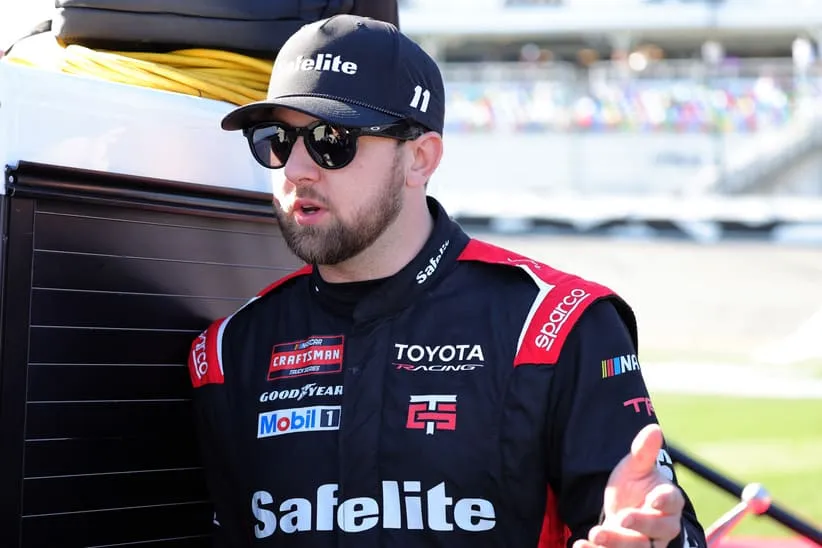
After 67 career starts, Kaden Honeycutt drove his No. 11 TRICON Garage Toyota to Victory Lane for the first time. Honeycutt didn’t back into this one. He had to work through a field that included Cup Series veterans, international road‑course aces, and young drivers who were willing to take risks that didn’t always make sense.
He survived multiple crashes, two overtime restarts, and a leaderboard that never stopped shifting. Earlier in the day, he’d already won the ARCA race, becoming the first driver since 2021 to sweep both events at The Glen. When he crossed the line, the emotion in his voice made it clear how much the moment meant.
A Race That Never Settled Into A Rhythm
The afternoon began with 16‑year‑old Brent Crews on the pole after setting a new track record in qualifying. His lap was more than half a second faster than the previous mark, and he backed it up by controlling the opening laps. But Watkins Glen doesn’t give anyone a comfortable lead.
The new tire packs forced drivers into tighter braking zones, and several trucks struggled to stay within the limits. Pit strategy shaped the early stages. A handful of teams short‑pitted Stage 1 to flip track position, and Daniel Hemric used that approach to steal the stage win. Stage 2 belonged to the road‑course specialists.
Connor Zilisch muscled past Crews in the esses, using a deeper braking point into the bus stop to take command. He led 14 laps and claimed the Stage 2 victory, positioning himself as the driver everyone would have to beat. Honeycutt stayed patient. He hovered inside the top ten, avoided the trouble that swallowed several contenders, and kept his truck clean while others burned through their equipment.
Shane van Gisbergen climbed from 18th to the top five with steady, calculated moves. Ross Chastain, starting 33rd after a mechanical issue in qualifying, charged through the field with the kind of aggression that always changes the tone of a race.
The Final Stage Turns Violent
The last 20 laps were a test of survival. Ross Chastain grabbed the lead on a restart, but NASCAR penalized him for jumping the throttle too early. The call sent him to the rear and detonated the front of the field. With Chastain out of the picture, the next restart became a free‑for‑all.
Drivers launched into Turn 1 with no margin for error. Carson Hocevar was turned by AJ Allmendinger and slammed into the inside wall. Moments later, a chain‑reaction crash collected Layne Riggs, Kris Wright, and Christian Eckes. The caution count climbed, and the field thinned.
Zilisch and Crews spent the final stage leaning on each other like two drivers fighting for the same future. They traded contact in the Carousel, rubbed fenders through the bus stop, and exchanged words over the radio. Crews accused Zilisch of racing with no respect, while Zilisch insisted he was matching the aggression he was given.
Their battle opened the door for someone who had been waiting for the race to come back to him. A late caution pushed the race into overtime. Gio Ruggiero briefly took the lead on the restart, but NASCAR penalized him for jumping early, handing the top spot back to Zilisch and setting up one final two‑lap shootout.
Honeycutt Takes Control
When the green flag waved for the last time, Honeycutt made the move that defined his night. He out‑braked Zilisch into Turn 1, cleared him cleanly, and never looked back. Over the final two miles, he hit every mark the braking zone into the bus stop, the throttle pickup through the Carousel, the exit of Turn 11 with the precision of a driver who had been waiting years for this exact moment.
Zilisch finished second, van Gisbergen third, Hemric fourth, and Chandler Smith fifth. Honeycutt climbed from his truck on the frontstretch, raised his arms to the crowd, and let the moment sink in. He thanked his team, thanked Toyota, and then celebrated the way a first‑time winner should.
He grabbed a beer, cracked it open, and shotgunned it in front of a roaring Watkins Glen grandstand. The crowd fed off the moment, cheering as he wiped his face and raised the empty can in the air. It was the kind of raw, unfiltered celebration that fit a first win earned the hard way.
What The Win Means
Honeycutt entered the weekend leading the regular‑season standings, and this victory solidifies him as a legitimate championship contender. Winning at Watkins Glen, a track that demands precision, discipline, and adaptability, proves his versatility. He has been consistent all year, but a win changes the way the garage looks at a driver.
TRICON Garage’s decision to put him in the No. 11 truck now looks like one of the smartest moves of the offseason. For the rest of the field, the message is clear: if you want the 2026 championship, you’re going to have to go through Honeycutt.
And with the way he’s stacking results, teams can’t afford to treat him like a streaky newcomer anymore. He’s racing with the confidence of someone who expects to be in the fight every single week. That kind of consistency forces everyone else to raise their game, whether they want to or not.
A Statement Made
The Bully Hill Vineyards 176 delivered everything fans expect from the Truck Series: contact, strategy swings, tempers, and a finish that will be replayed for months. Zilisch and Crews provided the fireworks, but Honeycutt delivered the performance that mattered.
He survived the chaos, seized his moment in overtime, and earned a deeply emotional first career victory. And now, with the season entering its most demanding stretch, the No. 11 team has momentum and a driver who finally knows what it feels like to win.
For More Great Content
Stay plugged in with more race analyses, features, and behind‑the‑garage storytelling. Follow Sarah on Facebook, LinkedIn, and X at Sarah Talker, where the conversation keeps rolling long after the checkered flag drops.
